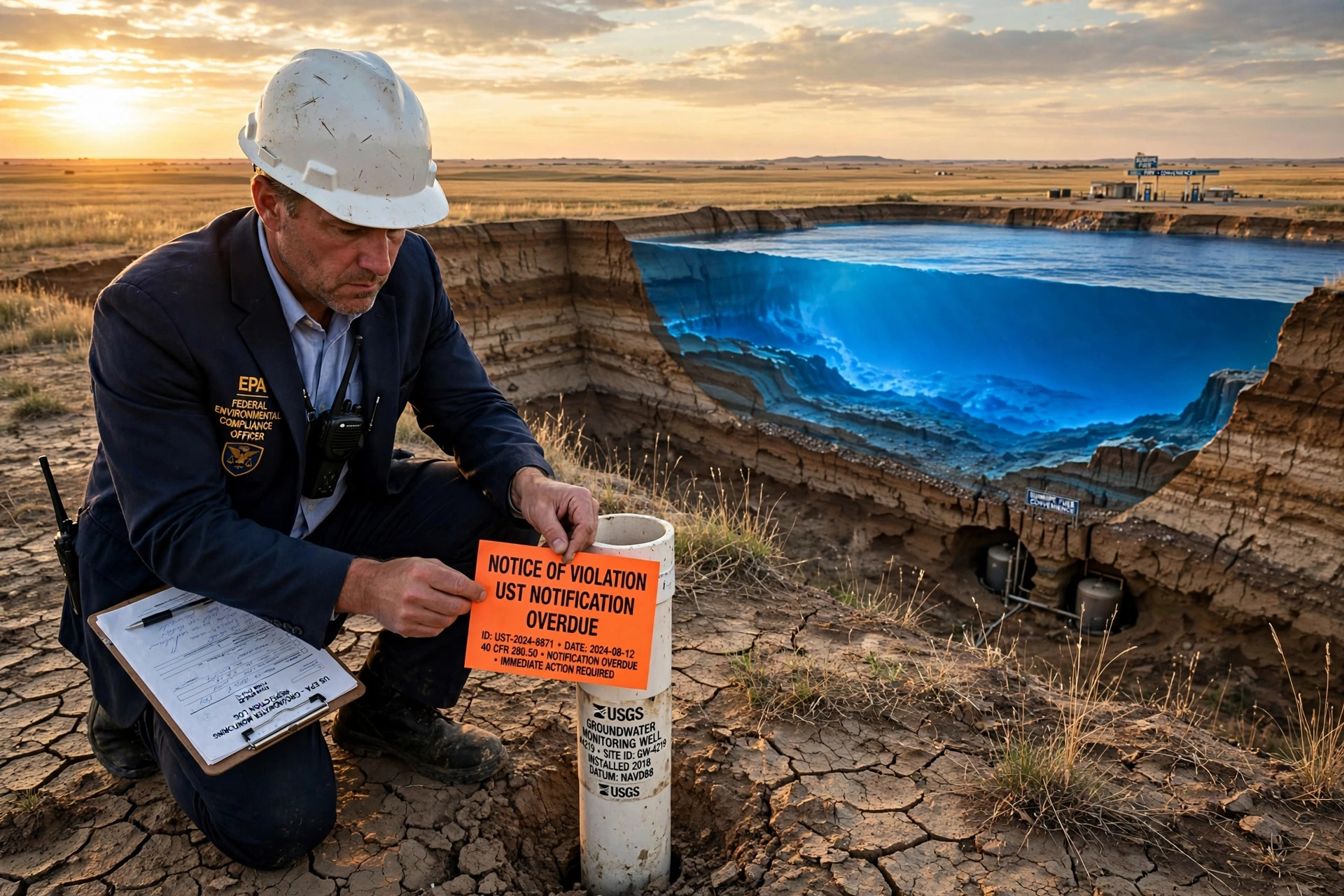
I. The Notification Requirement
In 1984, Congress added Subtitle I to the Resource Conservation and Recovery Act, creating a national program for the regulation of underground storage tanks. The program’s first instrument was not a technical standard. It was a census. Section 6991a(a)(1) of Title 42 provides that within eighteen months after November 8, 1984, “each owner of an underground storage tank shall notify the State or local agency or department” of the tank’s existence, “specifying the age, size, type, location, and uses of such tank.”1 Eighteen months after November 8, 1984 is May 8, 1986. The deadline has therefore been in the past for forty years.
The statute is thorough. Owners who brought a tank into use after the initial notification period must notify within thirty days.2 Owners must report even tanks taken out of operation after January 1, 1974.3 Congress wanted the age, the size, the type, the location, and the uses, and it wanted them for tanks that had already been retired. The notification is not onerous. It is a form. The statute asks five questions, and Congress believed the answers could be obtained.
One tank’s answers were never obtained. Its age is approximately ten million years. Its size is 111.6 million acres. Its type is unconsolidated sand, silt, clay, and gravel. Its location is beneath eight states. Its uses are irrigation, drinking water, and industry. No notification has ever been filed.
II. The Tank Definition
Section 6991(1) of Title 42 defines “underground storage tank” as “any one or combination of tanks (including underground pipes connected thereto) which is used to contain an accumulation of regulated substances, and the volume of which (including the volume of the underground pipes connected thereto) is 10 per centum or more beneath the surface of the ground.”4
Read the definition again. It does not say steel. It does not say manufactured. It does not say vessel, container, or receptacle. It says “tanks,” and then defines the term entirely by function, “used to contain an accumulation,” and by position, “10 per centum or more beneath the surface of the ground.” The definition then lists nine exclusions: farm or residential tanks of 1,100 gallons or less used for noncommercial motor fuel, heating-oil tanks for consumptive use on the premises, septic tanks, pipeline facilities, surface impoundments, stormwater and wastewater collection systems, flow-through process tanks, oil-and-gas liquid traps, and tanks sitting on the floor of a basement or mine.4 Nine exclusions. The aquifer is none of them.
The farm-tank exclusion comes closest in spirit. It misses by approximately 948 trillion gallons minus 1,100.
III. The Performance Standards
The regulation at 40 CFR 280.20 provides that “in order to prevent releases due to structural failure, corrosion, or spills and overfills for as long as the UST system is used to store regulated substances, all owners and operators of new UST systems must meet” requirements including corrosion protection and spill and overfill prevention equipment.5 Tanks installed or replaced after April 11, 2016 must additionally be secondarily contained, with interstitial monitoring capable of detecting a leak from the primary containment before it reaches the environment.6 Subpart D of the same part requires release detection on every tank, and the statute directs the program to require leak detection and inventory control systems designed to identify releases.7
Apply the standards to the tank. The tank has no cathodic protection. The tank has no secondary containment. The tank has no spill bucket and no overfill alarm. The tank’s corrosion protection consists of being made of dirt. The tank’s spill prevention equipment consists of the Great Plains, which slope gently eastward.
The Agency’s own research establishes the stakes. In 1985, the EPA estimated that of the nation’s two million underground storage tanks, eighty percent were unprotected bare steel, and determined that corrosion of bare steel accounted for “almost all leaks” from underground tanks.8 The Agency has therefore established, as a matter of published science, that an unprotected tank in the ground corrodes and leaks. It has never applied this finding to the largest unprotected tank in the ground.
IV. The Universe
To appreciate the scale of the omission, consider the universe the program does regulate. As of March 2026, the national program counts 534,189 active underground storage tanks at approximately 190,224 facilities.9 At a typical retail facility, a service station or convenience store, the tanks hold tens of thousands of gallons of fuel.10 Since the program’s inception in 1984, operators and regulators have confirmed 583,313 releases and completed 530,454 cleanups, leaving 52,859 releases still awaiting cleanup.9 Eighty-one million Americans live within a quarter mile of a release, cleaned up or not.10 The national technical compliance rate, measuring whether regulated tanks meet release detection and prevention requirements, stands at 60.9 percent.9
The program exists for one reason: tanks leak, and what they leak into is groundwater. The statute defines a “release” as “any spilling, leaking, emitting, discharging, escaping, leaching, or disposing from an underground storage tank into ground water, surface water or subsurface soils.”11 The largest tank of groundwater in the United States has never been inspected, has never been registered, meets none of the technical requirements that 39.1 percent of regulated tanks also fail to meet, and is, by its operators’ own published measurements, releasing product.
V. The Tank
The High Plains Aquifer, commonly called the Ogallala Aquifer, underlies 174,000 square miles, or 111.6 million acres, in parts of eight states: Colorado, Kansas, Nebraska, New Mexico, Oklahoma, South Dakota, Texas, and Wyoming.12 The United States Geological Survey estimated recoverable water in storage at approximately 2.91 billion acre-feet as of 2015.13 About sixty-five percent of that water lies under Nebraska, which is why the headline of this article says what it says.14 The formation was laid down approximately ten million years ago, when streams flowing east from the Rocky Mountains deposited the sand, silt, clay, and gravel that now hold the water.15 The average depth to water is on the order of one hundred feet; in parts of Nebraska the saturated formation extends a thousand feet below the surface.16
One hundred percent of the tank’s volume is beneath the surface of the ground. The statute requires ten percent. The tank exceeds the threshold by ninety percentage points.
An acre-foot is 325,851 gallons. The tank therefore holds approximately 948 trillion gallons, or the contents of roughly 47 billion service-station tanks at twenty thousand gallons each. The notification form asks for the size of the tank. The honest answer would have been the largest entry in the program’s history by a factor of roughly eighty-eight million, measured against the entire regulated universe combined.
VI. The Inventory
The statute demands inventory control: the operator must know, at all times, how much product is in the tank. The operators of this tank perform inventory control. The United States Geological Survey’s High Plains Water-Level Monitoring Study measures the tank’s contents and reports to Congress and the public every two years.12 The inventory is meticulous. The inventory is also alarming.
Recoverable water in storage stood at about 2.91 billion acre-feet in 2015, a decline of 273.2 million acre-feet since predevelopment conditions around 1950.13 Measured water-level changes ranged from a rise of 84 feet in Nebraska to a decline of 234 feet in Texas, with an area-weighted average decline of 15.8 feet across the aquifer.13 In plain terms: 273.2 million acre-feet of product, or approximately 89 trillion gallons, are unaccounted for. The operators call it depletion. Section 6991(8) defines “release” to include any leaking, discharging, escaping, or disposing from an underground storage tank into groundwater.11
A service-station release is measured in hundreds of gallons. At five hundred gallons per release, the tank’s documented release exceeds a typical one by a factor of roughly 178 billion. That is eleven orders of magnitude, and it is the largest release in the program’s history by a margin this publication will describe, conservatively, as decisive.
VII. The Leak
The tank leaks by design. Precipitation infiltrates from above, which the operators call recharge, and water discharges from below and at the margins, which the operators call discharge. In much of the region, less than one inch of precipitation per year reaches the groundwater.17 The former Director of the United States Geological Survey observed that the aquifer is “Nature’s nearly perfect water storage system” and that “in less than 100 years we are seriously depleting what took Nature more than 10,000 years to fill.”18 The tank took more than ten thousand years to fill. The notification form takes approximately twenty minutes.
The operators’ own technical literature describes the tank’s losses in the statute’s vocabulary. A USGS geohydrologic assessment of the aquifer in western Kansas reports annual discharge including 81,000 acre-feet per year of, quote, “leakage to streams.”19 The implementing literature uses the word “leakage” without irony and without a permit application attached. Under natural conditions, the tank’s contents migrate southeast at roughly 150 feet per year.16 The operators call this groundwater flow. The statute would call it a release in progress.
VIII. The Contents
The notification form requires the owner to specify the type and quantity of substances stored in the tank. The tank stores water, and the water is not pure. A USGS assessment of the central High Plains aquifer found that most sampled wells “contained detectable concentrations of the trace elements aluminum, arsenic, barium, chromium, molybdenum, selenium, zinc, and uranium.”20 In the northern High Plains, arsenic exceeded the EPA Maximum Contaminant Level in eight percent of sampled wells, and nitrate, uranium, iron, and manganese each exceeded drinking-water standards in six percent.21 Fifty-five of the sampled wells exceeded the proposed radon standard.20
None of this appears on any notification form, because no notification form has ever been filed. The honest answer to “type and quantity of substances” would run to several pages and include two radioactive elements. The statute asks. The tank does not answer.
IX. The Defense
This publication has considered the defenses, and reports them faithfully.
First, the regulated-substance problem. Section 6991(2) limits the subchapter to petroleum and CERCLA hazardous substances.22 The tank contains water. Water is not a regulated substance. This publication concedes the point, and notes that the concession exempts 948 trillion gallons with a single defined term: the most consequential drafting choice in the subchapter’s history. Congress wrote “regulated substances” where the hydrogeology required “substances.”
Second, the ownership problem. The statute says “each owner.” No owner has been identified. The eight states have not filed. The irrigators have not filed. This publication nominates the United States Geological Survey, which knows the tank’s age, size, type, location, and uses better than anyone alive, publishes them biennially, and reports them to Congress: the only inventory reports the tank has ever produced.
Third, the common-sense problem: an aquifer is not a tank. Against this, the text. The definition does not require steel, manufacture, walls, or a roof. It requires function and position. The aquifer is used to contain an accumulation, and one hundred percent of it is beneath the surface of the ground.
This publication finds the defense unpersuasive on the merits and dispositive as a matter of law, which is the worse outcome for everyone except the tank.
X. The Arithmetic of Noncompliance
Section 6991e(d)(1) provides that any owner who knowingly fails to notify is subject to a civil penalty of up to $10,000 for each tank for which notification is not given.23 The tank is singular. Section 6991e(a)(3) provides a civil penalty of up to $25,000 for each day of continued noncompliance with an order.23 Subpart H of the regulations requires owners to demonstrate financial responsibility for corrective action and third-party liability. No demonstration has been made for 2.91 billion acre-feet.
Measured conservatively from the notification deadline of May 8, 1986, the violation has continued for 14,773 days. At the statutory rate of $25,000 per day, the exposure is approximately $369 million, before the Agency considers the compliance history, which is forty years of total noncompliance, or any other factor the Administrator considers appropriate.
Measured from installation, approximately ten million years ago, the exposure is approximately $91 trillion: roughly the gross domestic product of the entire planet, assessed against a hole in the ground with no owner of record.
XI. Conclusion
The notification was due May 8, 1986. The form asks for the age of the tank. The honest answer, ten million years, would have been the oldest tank ever registered, by ten million years. No one filed it.
The tank remains in service. The inventory declines. The statute remains the law. The water remains underground: unregistered, uninspected, unprotected, 2.91 billion acre-feet of product in a tank with no walls, no permit, and no owner of record.
Therefore.
Sources
- 42 U.S.C. 6991a(a)(1) (“Within 18 months after November 8, 1984, each owner of an underground storage tank shall notify the State or local agency or department designated pursuant to subsection (b)(1) of the existence of such tank, specifying the age, size, type, location, and uses of such tank”). govregs.com ↑
- 42 U.S.C. 6991a(a)(3) (“Any owner which brings into use an underground storage tank after the initial notification period specified under paragraph (1), shall notify the designated State or local agency or department within thirty days of the existence of such tank”). govregs.com ↑
- 42 U.S.C. 6991a(a)(2)(A) (notification required for each tank taken out of operation after January 1, 1974). govregs.com ↑
- 42 U.S.C. 6991(1) (“underground storage tank” means “any one or combination of tanks (including underground pipes connected thereto) which is used to contain an accumulation of regulated substances, and the volume of which … is 10 per centum or more beneath the surface of the ground”; nine exclusions at subparagraphs (A) through (I), including farm or residential tanks of 1,100 gallons or less). govregs.com ↑
- 40 CFR 280.20 (“In order to prevent releases due to structural failure, corrosion, or spills and overfills for as long as the UST system is used to store regulated substances, all owners and operators of new UST systems must meet the following requirements”; corrosion protection and spill and overfill prevention equipment). govinfo.gov ↑
- 40 CFR 280.20, as amended 2015: tanks and piping installed or replaced after April 11, 2016 must be secondarily contained with interstitial monitoring per 40 CFR 280.43(g). epa.gov ↑
- 40 CFR Part 280, Subpart D (release detection for all UST systems); 42 U.S.C. 6991b (EPA to promulgate requirements including leak detection and inventory control systems designed to identify releases). govregs.com ↑
- U.S. EPA, “EPA Sets Standards for Underground Storage Tanks” (1985): over 95 percent of the nation’s two million USTs hold petroleum products; an estimated 80 percent are unprotected bare-steel tanks; “corrosion of bare steel accounts for almost all leaks from underground tanks.” epa.gov ↑
- U.S. EPA, UST Performance Measures (March 2026): 534,189 active USTs at approximately 190,224 facilities; 583,313 cumulative confirmed releases since 1984; 530,454 cleanups completed; 52,859 releases remaining; technical compliance rate 60.9 percent. epa.gov ↑
- U.S. EPA, “National UST Program Cleans Up Over 500,000 UST Releases”: at a typical retail facility USTs “hold tens of thousands of gallons of fuel”; approximately 81 million people live within 0.25 mile of a release. epa.gov ↑
- 42 U.S.C. 6991(8) (“release” means “any spilling, leaking, emitting, discharging, escaping, leaching, or disposing from an underground storage tank into ground water, surface water or subsurface soils”). govregs.com ↑
- U.S. Geological Survey, High Plains Water-Level Monitoring Study: the aquifer underlies 174,000 square miles in parts of eight states (Colorado, Kansas, Nebraska, New Mexico, Oklahoma, South Dakota, Texas, Wyoming); water-level changes reported to Congress and the public every two years. usgs.gov ↑
- U.S. Geological Survey Scientific Investigations Report 2017-5040: recoverable water in storage in 2015 was about 2.91 billion acre-feet, a decline of 273.2 million acre-feet since predevelopment; water-level changes ranged from a rise of 84 feet to a decline of 234 feet; area-weighted average decline of 15.8 feet. usgs.gov ↑
- Kerr Center for Sustainable Agriculture, Ogallala Aquifer data: in 1990 the aquifer in the eight-state area contained 3.270 billion acre-feet of water, of which about 65 percent was located under Nebraska. kerrcenter.com ↑
- Oklahoma Ag in the Classroom, “Buried Treasure: Oklahoma’s Aquifers”: “The Ogallala Aquifer was formed beginning 10 to 12 million years ago during late Tertiary (Miocene/Pliocene) geologic time.” agclassroom.org ↑
- Oklahoma Ag in the Classroom, ibid.: average depth of the aquifer about 100 feet, maximum about 1,000 feet in Nebraska; groundwater moves northwest to southeast at about 150 feet per year under natural conditions in the Southern High Plains. agclassroom.org ↑
- University of Colorado Law Review, “Dustbowl Waters”: “Little precipitation, less than one inch per year, reaches the groundwater because most of it evaporates before sinking into the earth”; the Ogallala is effectively a nonrenewable resource because pumping exceeds recharge. lawreview.colorado.edu ↑
- USGS Director Marcia McNutt, quoted in USGS reporting on High Plains depletion: “The High Plains Aquifer is Nature’s nearly perfect water storage system” and “in less than 100 years we are seriously depleting what took Nature more than 10,000 years to fill.” wateronline.com ↑
- U.S. Geological Survey, “Geohydrology of the High Plains Aquifer, Western Kansas”: simulated predevelopment water budget showed annual discharge of 108,000 acre-feet including 81,000 acre-feet per year of “leakage to streams.” usgs.gov ↑
- U.S. Geological Survey, “Ground-Water Quality in the Central High Plains Aquifer, Colorado, Kansas, New Mexico, Oklahoma, and Texas, 1999”: “Most samples contained detectable concentrations of the trace elements aluminum, arsenic, barium, chromium, molybdenum, selenium, zinc, and uranium”; 55 samples exceeded the proposed radon standard of 300 picocuries per liter. usgs.gov ↑
- U.S. Geological Survey, “Ground-Water Quality of the Northern High Plains Aquifer, 1997, 2002-04”: arsenic exceeded the EPA Maximum Contaminant Level in 8 percent of samples; nitrate, uranium, iron, and manganese exceeded drinking-water standards in 6 percent. usgs.gov ↑
- 42 U.S.C. 6991(2) (“regulated substance” means any CERCLA hazardous substance as defined in 42 U.S.C. 9601(14), excluding substances regulated as hazardous waste under Subtitle C, and petroleum). govregs.com ↑
- 42 U.S.C. 6991e(d)(1) (knowing failure to notify: civil penalty up to $10,000 for each tank); 42 U.S.C. 6991e(a)(3) (failure to comply with an order: civil penalty of up to $25,000 for each day of continued noncompliance). govregs.com ↑