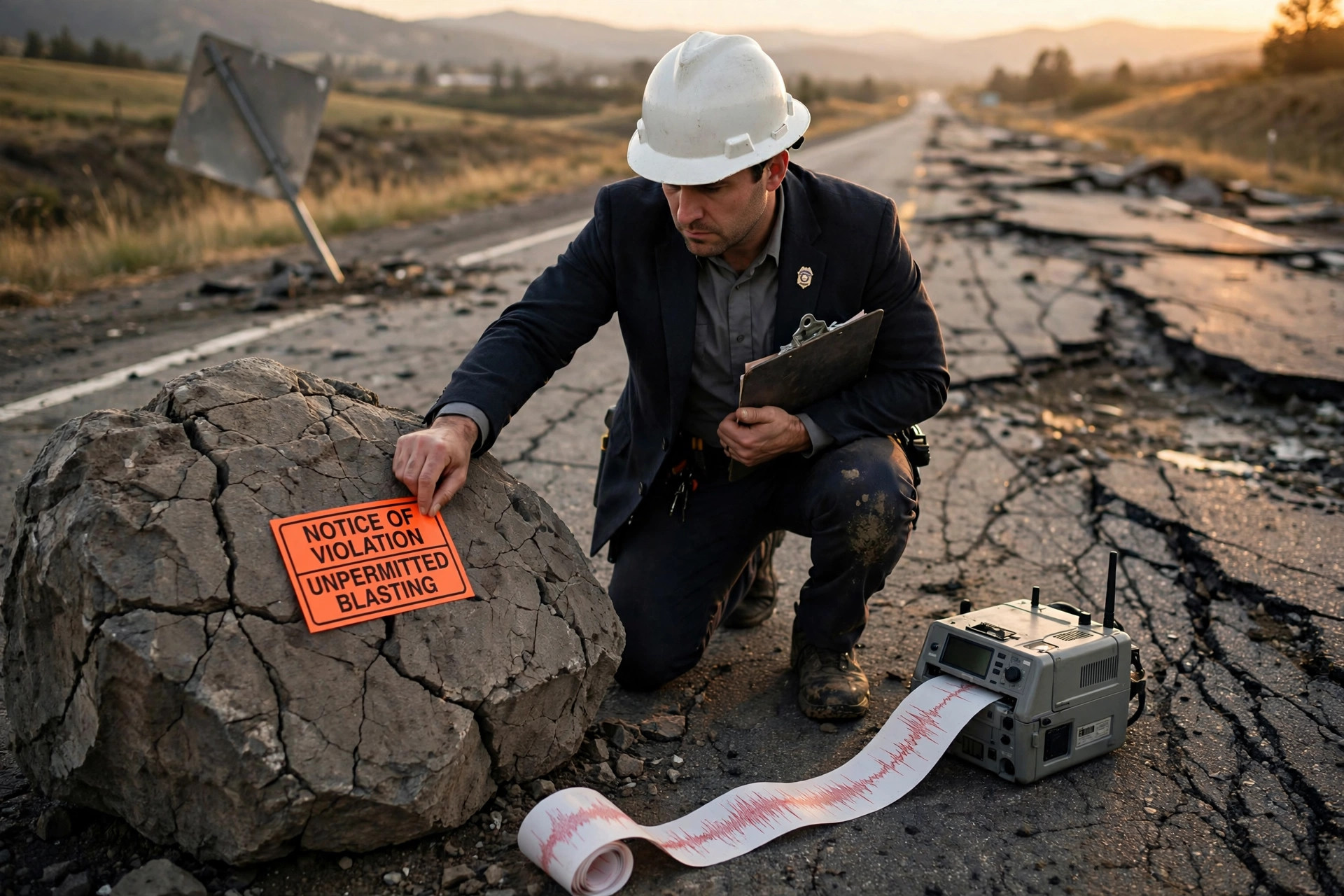
I. The Licensing Framework
Commerce in explosives is one of the most tightly licensed activities in American law. The regulation at 27 CFR 555.41(b)(1)(i) provides, in language that leaves no room for the improvising entrepreneur:
“Each person intending to engage in business as an importer or manufacturer of, or a dealer in, explosive materials, including black powder, must, before commencing business, obtain the license required by this subpart for the business to be operated.”1
The licensing regime does not stop at manufacture. Each person who intends to acquire explosive materials for use, or to transport explosive materials in interstate or foreign commerce, must obtain a user permit under the same subpart.1 The Bureau of Alcohol, Tobacco, Firearms and Explosives has clarified the boundary of the exemption that matters here: a person engaged in the business of providing a blasting service using explosives of their own manufacture must hold a manufacturer’s license, while persons who manufacture explosives for their personal, nonbusiness use are not required to hold one.2
The exemption, in other words, is personal and nonbusiness. It covers the hobbyist, not the industry. The operation under investigation in this article is not personal, and it is not nonbusiness. It is the largest producer of explosive-scale energy releases on the planet, it distributes its product across state lines on a daily basis, and it has never applied for anything.
II. The Blaster
Where blasting occurs in construction, the Occupational Safety and Health Administration prescribes not only permits but personnel. Section 901 of 29 CFR Part 1926, Subpart U, sets the qualifications for the one individual on whom the entire regulatory structure depends:
“A blaster shall be qualified, by reason of training, knowledge, or experience, in the field of transporting, storing, handling, and use of explosives, and have a working knowledge of State and local laws and regulations which pertain to explosives.”3
Blasters, the regulation continues, “shall be required to furnish satisfactory evidence of competency in handling explosives and performing in a safe manner the type of blasting that will be required.”3 The blaster must be knowledgeable and competent in the use of each type of blasting method used.
No fault has ever furnished satisfactory evidence of competency. The San Andreas has submitted no training certificates. The Cascadia subduction zone has no working knowledge of state and local laws on file with any authority. The qualification standard is stated unconditionally, and the compliance record, examined over the full history of the Republic, is blank.
III. The Warning Signal
The regulation at 29 CFR 1926.909 governs the firing of the blast, and its requirements are specific enough to be posted on a sign. Before a blast is fired, the code of blasting signals prescribed in Table U-1 must be posted in one or more conspicuous places at the operation, and all employees must be required to familiarize themselves with it.4
Table U-1 prescribes three signals: a warning signal, consisting of a one-minute series of long blasts five minutes prior to the blast signal; the blast signal itself, a series of short blasts one minute prior to the shot; and an all-clear signal, a prolonged blast following inspection of the blast area.4 Section 1926.909(b) then provides:
“Before a blast is fired, a loud warning signal shall be given by the blaster in charge, who has made certain that all surplus explosives are in a safe place and all employees, vehicles, and equipment are at a safe distance, or under sufficient cover.”4
Flagmen must be stationed on highways passing through the danger zone to stop traffic during blasting operations.4 And Section 1926.909(d) assigns the central administrative duty in language of unusual directness: “It shall be the duty of the blaster to fix the time of blasting.”4
On March 27, 1964, at 5:36 p.m. local time, a discharge of approximately 950 million tons of TNT equivalent occurred in Prince William Sound, Alaska. No Table U-1 code was posted in any conspicuous place. No warning signal was given five minutes prior. No flagmen were stationed on any highway. The time of blasting was fixed by no one.
IV. The Discharge Record
The United States Geological Survey estimates that several million earthquakes occur in the world each year. Of these, approximately 500,000 are detected worldwide annually, and about 100,000 are felt by people.5 On average, about 20 major earthquakes of magnitude 7.0 or higher occur globally each year. The Survey’s National Earthquake Information Center locates about 20,000 earthquakes each year, or approximately 55 per day.5
Consider what that figure means in regulatory terms. Every located event is a documented release of energy at a scale the explosives regulations were written to govern. Fifty-five times a day, on average, a discharge occurs for which no license was obtained, no user permit was issued, no qualified blaster was named, and no warning signal was given. The Survey’s detection network, a federal investment in seismic instrumentation spanning the globe, functions in practice as the most complete violation log in the history of American administrative law. It records each event’s time, location, depth, and magnitude with scientific precision. It refers none of them for enforcement.
V. The Energy Equivalences
Seismology measures earthquakes in magnitudes, but the explosives industry measures energy in tons of TNT, and the two scales convert directly. The magnitude scale is logarithmic: each whole-number increase corresponds to roughly 32 times more energy released.6 The equivalences are as follows: a magnitude 6.0 earthquake releases energy equivalent to approximately 15,080 tons of TNT; a magnitude 7.0 releases the equivalent of approximately 476,879 tons; a magnitude 8.0 releases the equivalent of approximately 15.08 million tons.7
These are not abstractions. The 1994 Northridge earthquake in California, magnitude 6.7, released energy equivalent to almost 2 billion kilograms of explosive, about 100 times the amount of energy released by the atomic bomb that destroyed the city of Hiroshima.8 A moderate earthquake, by the standards of the scale, detonated with one hundred times the yield of the first weapon of its kind ever used in war. No blasting license covered the operation. No warning signal preceded it.
The equivalences scale without mercy. The 1964 Alaska earthquake, at magnitude 9.2, released energy equivalent to approximately 950 million tons of TNT.9 That is more than 60,000 times the Hiroshima bomb. One analysis calculated that the Alaska event released the equivalent seismic energy of a cascade of nearly 2,000 magnitude-7 earthquakes.10 Each of those 2,000 hypothetical magnitude-7 detonations would itself have required a licensed blaster, a posted signal code, flagmen on the highways, and a fixed time of blasting. The actual event required none of them, because it asked for none of them.
VI. The Great Alaska Detonation
At 5:36 p.m. local time on Good Friday, March 27, 1964, the second-largest earthquake ever recorded struck 22.5 kilometers beneath Prince William Sound, where the Pacific Plate subducts beneath the North American Plate along the 3,400-kilometer Aleutian Trench.11 At magnitude 9.2, it remains the most powerful earthquake in the recorded history of the United States and North America, second globally only to the 1960 magnitude-9.5 earthquake in Chile.12
The ground shook for four and a half minutes. A 580-mile section of the fault plane ruptured in approximately 240 seconds, with lateral movements of up to 67 feet. Shaking was felt over an area of more than 1.3 million square kilometers; significant tectonic deformation occurred over more than 200,000 square kilometers, and some areas near Kodiak were permanently raised by 30 feet.11 The earthquake and the tsunamis it generated killed 131 people. The United States Geological Survey estimates property losses at $3.1 billion in 2024 dollars.13
The Cold War detail is worth preserving. With the United States and the Soviet Union facing off in a nuclear standoff, some Alaskans, feeling the ground heave for nearly five minutes, concluded that the Russians had dropped a nuclear bomb on Anchorage.11 They were wrong about the origin. They were not wrong about the yield.
The discharge crossed state lines. The Senate resolution commemorating the event records that the earthquake was felt as far away as Seattle and was registered by water-level recorders in 47 states.12 Under the licensing framework of Section I, the transport of explosive materials in interstate commerce requires a user permit. The effects of this discharge were registered in 47 states without one.
VII. The California File
The unlicensed operation maintains an active California division. The M7.9 Great San Francisco earthquake of 1906 leveled much of the city. On October 17, 1989, at 5:04 p.m. Pacific time, a magnitude 6.9 earthquake struck the San Francisco and Monterey Bay regions, the strongest to hit the Bay Area since 1906, killing 63 people, injuring 3,757, and causing an estimated $6 billion in property damage.14
The Loma Prieta discharge lasted 8 to 15 seconds and released energy equivalent to roughly 340,000 tons of TNT.7 It collapsed a 1.25-mile section of the Cypress Street Viaduct in Oakland, killing 41 people, and dropped a section of the San Francisco–Oakland Bay Bridge’s upper deck onto the lower level.14 No blaster was identified. No Table U-1 signals were posted on any conspicuous place. No flagmen were stationed on Interstate 880, though the regulation requires them on highways passing through the danger zone.
The state of California, which requires blasting permits for commercial operations and maintains some of the strictest explosives regulations in the nation, has never issued a blasting permit to the San Andreas Fault, the Hayward Fault, or any other structure responsible for these discharges.
VIII. The Violation Log
The National Earthquake Information Center operates around the clock, detecting and locating earthquakes around the globe within minutes of their occurrence. Its catalog is public, searchable, and updated in near real time. Every entry records the precise time of an unpermitted discharge, its location, its depth, and its magnitude, from which the TNT equivalent can be computed directly.
The catalog therefore constitutes a confession, updated 55 times a day, that the licensing framework is not being enforced against its largest violator. Each entry documents a release of explosive-scale energy for which no license was obtained under 27 CFR Part 555, no qualified blaster was named under 29 CFR 1926.901, no warning signal was given under 29 CFR 1926.909, and no time of blasting was fixed by anyone. The documentation is exemplary. The compliance rate is zero. The number of entries referred for enforcement is zero.
No regulatory regime in American history has a wider gap between documentation and enforcement, because no regulatory regime maintains a federally operated, real-time, publicly searchable database of 20,000 annual violations and acts on none of them.
IX. The Defense
The defense has three parts, and this article states all three before overruling them, as the genre requires.
First, the persons. Section 555.41 addresses “each person intending to engage in business,” and a fault is not a person. The explosives statutes were written for importers, manufacturers, and dealers, meaning human commercial actors, not geological structures. The personal-nonbusiness-use exemption exists precisely because the law contemplates human-scale activity.
Second, the blast. Tectonic strain release is not a blast in the regulatory sense. Subpart U governs construction blasting: drilled holes, loaded charges, stemming, firing lines. An earthquake involves no explosive materials, no charges, and no firing. The regulation’s silence on geology is not an oversight; it is a jurisdictional boundary.
Third, the time. Section 1926.909(d) makes it the blaster’s duty to fix the time of blasting, but earthquakes cannot be predicted with the precision a blasting schedule requires. The duty presupposes a human operator who chooses the moment. Where no one can fix the time, the duty cannot attach.
The overrule is as follows. On the persons: the licensing regime is triggered by commerce in explosive energy at scale, and the personal-nonbusiness exemption cannot stretch to cover a 950-million-ton discharge whose effects were registered in 47 states. Scale defeats the exemption; a hobbyist’s firecracker and a 950-million-ton interstate discharge are not the same regulatory event, and the law knows the difference by magnitude. On the blast: the regulation prescribes the warning signal before “a blast is fired” and measures the hazard by energy release, not by geology, and Table U-1 contains no geological exception. Seismology itself reports earthquakes in tons of TNT, which is the industry’s unit. If the science measures the event in the industry’s unit, the industry’s rules apply. On the time: that no one can fix the time of blasting is not a defense to the duty; it is the violation stated plainly. The regulation does not condition the blaster’s duty on convenience. The time was not fixed. The regulation was not satisfied.
X. The Arithmetic of Noncompliance
The Survey locates approximately 20,000 earthquakes each year: roughly 55 unpermitted discharges per day, every day, documented to the minute, the kilometer, and the magnitude. Against this record, the compliance figures are as follows.
Explosives licenses obtained under 27 CFR Part 555: zero. User permits issued for the interstate transport of explosive energy: zero. Blasters qualified by training, knowledge, or experience under 29 CFR 1926.901: zero. Satisfactory evidence of competency furnished: zero. Table U-1 signal codes posted in conspicuous places: zero. Warning signals given five minutes prior: zero. Blast signals given one minute prior: zero. All-clear signals given following inspection: zero. Flagmen stationed on highways through the danger zone: zero. Times of blasting fixed by the blaster in charge: zero.
The documentation rate is exemplary. The compliance rate is zero. No enforcement regime in the federal government maintains a more complete record of its own non-enforcement.
XI. Conclusion
Federal law requires a license before commencing business as a manufacturer of, or dealer in, explosive materials. The safety regulations require a qualified blaster, satisfactory evidence of competency, a posted code of blasting signals, a loud warning signal before the blast is fired, flagmen on the highways through the danger zone, and a blaster who fixes the time of blasting.
The ground has complied with none of it. It discharges at a rate of roughly 55 events per day, at yields ranging from firecracker scale to 950 million tons of TNT, it distributed the effects of its largest American discharge across 47 states, and it has never applied for a license, named a blaster, posted a signal code, or fixed a time.
Every fact in this article is documented. Every conclusion follows from the regulation. The regulation is the problem.
Ergo.
Sources
- 27 CFR 555.41(b)(1)(i) (each person intending to engage in business as an importer or manufacturer of, or a dealer in, explosive materials must obtain the license before commencing business); 555.41(b)(1)(iii) (user permits for acquisition for use and for transport in interstate or foreign commerce). govinfo.gov ↑
- Bureau of Alcohol, Tobacco, Firearms and Explosives: a manufacturer’s license is required by persons engaged in the business of providing a blasting service using explosives of their own manufacture; persons who manufacture explosives for their personal, nonbusiness use are not required to have a manufacturer’s license. atf.gov ↑
- 29 CFR 1926.901(c) (blaster qualified by training, knowledge, or experience; working knowledge of State and local laws); 1926.901(d) (satisfactory evidence of competency). govinfo.gov ↑
- 29 CFR 1926.909 (firing the blast): Table U-1 warning, blast, and all-clear signals; 1926.909(b) (loud warning signal before a blast is fired); 1926.909(c) (flagmen on highways through the danger zone); 1926.909(d) (duty of the blaster to fix the time of blasting). osha.gov ↑
- U.S. Geological Survey, Earthquake Hazards Program: approximately 500,000 earthquakes detected worldwide each year, about 100,000 felt by people; about 20 major earthquakes (magnitude 7.0 or higher) per year; the National Earthquake Information Center locates about 20,000 earthquakes each year, approximately 55 per day; roughly 20,000 earthquakes occur in the United States each year. ↑
- The magnitude scale is logarithmic; each whole-number increase corresponds to approximately 32 times more energy released. minnstate.pressbooks.pub (citing IRIS) ↑
- Earthquake magnitude to TNT equivalent: magnitude 6.0, approximately 15,080 tons of TNT; magnitude 7.0, approximately 476,879 tons; magnitude 8.0, approximately 15.08 million tons. Loma Prieta (magnitude 6.9) computed at approximately 340,000 tons. easycalculation.com ↑
- IRIS Education and Outreach Series (produced in cooperation with the U.S. Geological Survey): the 1994 Northridge, California earthquake, magnitude 6.7, released the energy equivalent of almost 2 billion kilograms of explosive, about 100 times the amount of energy released by the atomic bomb that destroyed the city of Hiroshima. boqueteweather.com (IRIS/USGS) ↑
- The 1964 Alaska earthquake, magnitude 9.2, released energy equivalent to approximately 950 million tons of TNT. spacemath.gsfc.nasa.gov (via archive) ↑
- The 1964 Alaska earthquake released the equivalent seismic energy of a cascade of nearly 2,000 magnitude-7 earthquakes. earthmagazine.org ↑
- March 27, 1964, 5:36 p.m. local time, magnitude 9.2, 22.5 km beneath Prince William Sound; ground shook for four to five minutes; some Alaskans believed the Soviet Union had dropped a nuclear bomb; shaking felt over more than 1.3 million square kilometers; areas near Kodiak permanently raised by 30 feet. earthmagazine.org ↑
- S. Res. 400, 113th Congress: the Great Alaska Earthquake measured 9.2 on the moment magnitude scale, the largest recorded earthquake in United States history and the second-largest ever recorded using modern instruments; felt as far away as Seattle; registered by water-level recorders in 47 states; 131 fatalities. congress.gov ↑
- U.S. Geological Survey: magnitude 9.2; second largest earthquake ever recorded; shaking lasted 4.5 minutes; 131 fatalities; $3.1 billion in property losses (2024 dollars); 36 feet maximum uplift on Montague Island; 580-mile section of the fault plane ruptured in approximately 240 seconds; 185,000 square miles of surface destruction, an area larger than California; lateral movements up to 67 feet. usgs.gov ↑
- U.S. Geological Survey: the magnitude 6.9 Loma Prieta earthquake of October 17, 1989, at 5:04 p.m. Pacific time, the strongest earthquake to hit the San Francisco Bay region since the M7.9 Great San Francisco earthquake of 1906; 63 deaths, 3,757 injuries, an estimated $6 billion in property damage; the Cypress Street Viaduct collapse killed 41; a section of the San Francisco–Oakland Bay Bridge upper deck collapsed. usgs.gov ↑