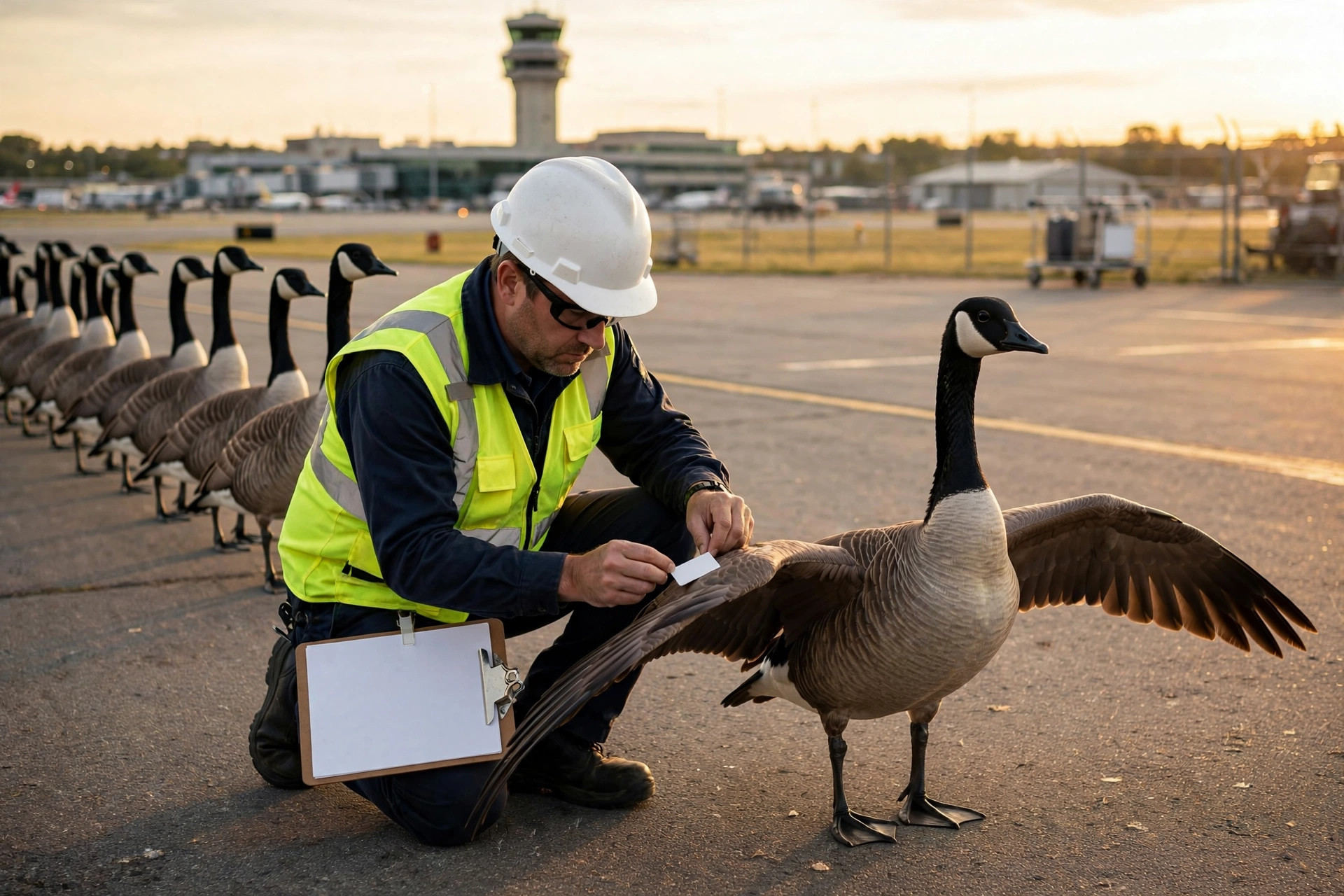
I. The Statutory Definition
Section 40102(a)(6) of Title 49, United States Code, provides the following definition:1
“‘Aircraft’ means any contrivance invented, used, or designed to navigate, or fly in, the air.”
The regulation at 14 CFR 1.1 restates it in plainer terms: an aircraft is a device that is used or intended to be used for flight in the air.2
Three verbs, joined by the disjunctive “or”: invented, used, or designed. A contrivance need satisfy only one of them. A bird was not invented. Whether a bird was designed is a question this article leaves to theologians and evolutionary biologists. But a bird is used, every day, by its operator, for flight in the air. The statute asks nothing more.
II. The Pirker Precedent
In October 2011, Raphael Pirker flew a five-pound styrofoam glider, the Ritewing Zephyr, over the University of Virginia to photograph the campus, and the Federal Aviation Administration fined him $10,000 for careless and reckless operation under 14 CFR 91.13(a). Pirker argued the Zephyr was a model aircraft, not an aircraft at all. On March 6, 2014, Administrative Law Judge Patrick Geraghty agreed and dismissed the case, warning that the agency’s reading of the statute would sweep in paper airplanes and toy balsa wood gliders.3
The agency appealed. On November 18, 2014, the full National Transportation Safety Board reversed in Administrator v. Pirker, NTSB Order No. EA-5730. The Board held that under the plain language of 49 U.S.C. 40102(a)(6) and 14 CFR 1.1, “an ‘aircraft’ is any ‘device’ ‘used for flight in the air,’” that “[t]his definition includes any aircraft, manned or unmanned, large or small,” and that “[t]he definitions are as broad as they are clear, but they are clear nonetheless.”4
The Board was warned, on the record, that its reading would classify paper airplanes as aircraft. It classified them anyway. A paper airplane is unpowered, unpiloted, and uncontrolled. A Canada goose is powered, piloted, and capable of controlled flight at forty miles per hour and more. If the paper airplane is an aircraft, the goose is an aircraft a fortiori. The Board’s logic admits no exception for feathers.
III. The Registration Requirement
Section 44101 of Title 49 requires the registration of civil aircraft of the United States. The regulation at 14 CFR 47.3 provides that no person may operate an aircraft in the United States unless it has been registered, and registration is evidenced by the issuance of an N-number, the alphanumeric mark the aircraft must display under 14 CFR Part 45.5
The Federal Aviation Administration’s 2024 General Aviation and Part 135 Activity Survey counted 213,756 active general aviation aircraft. Every one carries an N-number. The registry as a whole holds on the order of three hundred thousand civil aircraft, and every one is marked.6
Against this, consider the birds. The best available accounting, published in Science in 2019, found that North America has lost nearly 3 billion breeding birds since 1970, a decline of 29 percent.7 Three billion lost implies billions remaining. Billions of contrivances, used daily for flight in the air, operating continuously in the national airspace system.
Not one has ever been issued an N-number. Not one displays a registration mark. Congress provided civil penalties for violations of the registration requirements at 49 U.S.C. 46301, and criminal penalties, including up to three years of imprisonment, for knowingly operating an unregistered aircraft at 49 U.S.C. 46306.8 The government has never invoked either against a bird.
IV. The Airworthiness Requirement
Section 91.203(a) of Title 14 provides that no person may operate a civil aircraft unless it has within it an appropriate and current airworthiness certificate.9 Airworthiness begins with type certification under 14 CFR Part 21: the design is shown to meet the airworthiness standards, the agency issues a type certificate, each airframe is shown to conform, and the system continues through annual inspections under 14 CFR 91.409 and airworthiness directives as unsafe conditions emerge.10
No bird has ever held a standard airworthiness certificate. The Federal Aviation Administration has never issued a type certificate for a hollow-bone airframe with feathered lifting surfaces and a flapping propulsion system. No annual inspection has ever been performed on a bird under 91.409. No airworthiness directive has ever been issued against a species, though the record of unsafe conditions is extensive and will be reviewed in Section VII.
Maintenance is governed by 14 CFR Part 43, which requires that maintenance be recorded and performed by qualified persons.11 Birds perform their own maintenance continuously. Molting is not an FAA-approved inspection program.
V. The Pilot Certification Requirement
Section 61.3 of Title 14 provides that no person may serve as a required pilot flight crewmember of a civil aircraft unless that person holds a pilot certificate issued under Part 61. A private pilot certificate requires, under 14 CFR 61.109, a minimum of 40 hours of flight time, including dual instruction and solo requirements, followed by a practical test.12
The Federal Aviation Administration’s Air Traffic by the Numbers for fiscal year 2024 reports 848,770 total active pilot certificates held in the United States, not counting flight instructor or remote pilot certificates.13 The number held by birds is zero.
No bird has logged an hour of dual instruction. No certificated flight instructor has ever endorsed a bird for solo flight under 14 CFR 61.87. No bird has passed a practical test, holds a medical certificate under 14 CFR Part 67, or has completed a flight review under 14 CFR 61.56.14 The average Canada goose migrates thousands of miles each year, much of it at night, without a single hour of logged instruction. Section 46306(b)(7) of Title 49 makes it a criminal offense, punishable by up to three years of imprisonment, to knowingly serve as an airman without an airman’s certificate. The geese serve nightly.8
VI. The Transponder Mandate
Section 91.225 of Title 14 requires ADS-B Out equipment, effective January 2, 2020, in Class A, Class B, and Class C airspace, and in all airspace above 10,000 feet mean sea level.15 Class A airspace extends from 18,000 feet mean sea level to flight level 600. It is the most strictly controlled airspace in the system: instrument flight rules, air traffic control clearances, and now, universal surveillance.
On November 29, 1973, a Rüppell’s griffon vulture was ingested into the engine of an airliner cruising at 37,000 feet, or 11,300 meters, over Abidjan in the Ivory Coast. The species was identified from five complete and fifteen partial feathers recovered from the engine. The bird, a soaring specialist whose hemoglobin is adapted to the thin air of the upper troposphere, had been operating in what the regulations now define as Class A airspace: no transponder, no clearance, no flight plan, no radio.16
The ADS-B mandate took effect on January 2, 2020, forty-seven years after the vulture’s flight. The species has not equipped since. Satellite-tagged bar-headed geese have been tracked above 23,000 feet over the Himalayas, routinely in airspace where the surveillance rules apply.17 No bird has ever squawked a discrete code. Air traffic control has never vectored one, because air traffic control cannot see them, because they carry no equipment the system is designed to see.
VII. The Collision Record
The Federal Aviation Administration and the Department of Agriculture maintain the National Wildlife Strike Database under an interagency agreement. For the 34-year period from 1990 through 2023, the database holds 296,613 strike reports from 2,299 airports in the United States. In 2023 alone, 19,603 strikes were reported, a 14 percent increase over 2022.18
About 97 percent of reported strikes involved birds. Between 1990 and 2021, the remains of 620 bird species were identified in the wreckage. Waterfowl, gulls, and raptors cause the most damage to civil aircraft. European starlings, small and numerous, are responsible for the greatest loss of human life.19
The agency estimates that reported strikes cost American civil aviation an average of $248 million per year over the period, $205 million in direct costs and $43 million in other costs, with 100,105 hours of aircraft downtime annually. For 2023 alone, the estimate is $461 million in direct and indirect costs and 62,761 hours of downtime. The reports are voluntary, filed on FAA Form 5200-7, and the agency cautions that the figures understate the problem.20
The most documented collision between a registered aircraft and unregistered aircraft in aviation history occurred on January 15, 2009, when US Airways Flight 1549, an Airbus A320 departing New York, flew through a flock of Canada geese. Both engines failed. The crew ditched the aircraft in the Hudson River. All 155 people aboard survived.21 The geese were never charged with careless or reckless operation under 14 CFR 91.13(a).
The Smithsonian Institution’s Feather Identification Laboratory identifies the species from the remains, feather by feather.22 The federal government can determine, from fragments in a turbine, exactly which species of unregistered operator was involved. It cannot produce a registration certificate for any of them.
VIII. The Regulated World’s Response
Section 139.337 of Title 14 requires certificated airports to conduct wildlife hazard assessments and maintain wildlife hazard management plans.23 Airports spend public money on habitat modification, harassment, and removal. They file the reports. They manage the hazard.
The hazard, meanwhile, holds no certificate of any kind. The regulatory structure is perfectly inverted: the registered parties bear the entire compliance burden for collisions with unregistered parties, and the unregistered parties are not parties at all. The database grows by more than fifty reports a day. The registry of bird operators remains empty.
Strike reporting is voluntary. The registered pilot files FAA Form 5200-7 describing the collision. The unregistered operator, if it survives, departs without filing anything, which the regulations cannot punish because the regulations do not know it exists.
IX. The Defense
The defense has three parts, and this article states all three before overruling them, as the genre requires.
First, the verbs. “Invented, used, or designed” contemplates human artifice: a contrivance is a thing contrived, and birds were not contrived. They evolved. The definition was written for machines.
Second, the treaties. The Convention on International Civil Aviation governs the aircraft of contracting states. No contracting state has registered a bird, issued it a certificate of airworthiness, or filed a flight plan on its behalf. The international system does not recognize the operators.24
Third, the shield. The Migratory Bird Treaty Act, at 16 U.S.C. 703, makes it unlawful to pursue, hunt, take, capture, or kill any migratory bird.25 Hundreds of species are protected. The Federal Aviation Administration cannot ground what the Fish and Wildlife Service protects. Enforcement would require the government to take action against conduct that a second statute effectively insulates.
The overrule is as follows. The Board has already rejected the narrow reading: warned that its definition would reach paper airplanes, it reached anyway, holding the definitions “as broad as they are clear, but clear nonetheless.” The statute joins its verbs with “or,” and “used for flight in the air” is satisfied continuously, by billions of operators, every day. The treaties describe which aircraft states must recognize; they do not undefine the rest. And the Migratory Bird Treaty Act explains the enforcement gap without closing the violation: it is entirely possible for conduct to be simultaneously prohibited by one federal statute and shielded by another, and the birds have achieved exactly that. The violation stands. The violators cannot be touched.
X. The Arithmetic of Noncompliance
In 2023, the database recorded 19,603 collisions with unregistered operators: more than fifty per day, every day, for a year. The estimated cost was $461 million. The number of enforcement actions taken against the operators was zero. The number of N-numbers issued to them was zero. The number of airworthiness directives issued against their designs was zero.
The Federal Aviation Administration issues hundreds of airworthiness directives each year against registered types, grounding fleets over cracks measured in millimeters. Against the unregistered fleet, whose documented failure mode destroyed both engines of a departing airliner, it has issued none, because it cannot issue an airworthiness directive to a species.
The compliance rate is zero. The reporting rate, by the registered parties who collide with them, is exemplary. No regulatory regime in American aviation has a wider gap between the regulated and the unregulated, because no regulatory regime has a few hundred thousand registrants on one side and billions of violators on the other, every one of them operating daily in the national airspace system.
XI. Conclusion
The statute defines an aircraft as any contrivance invented, used, or designed to navigate, or fly in, the air. The Board has held the definition reaches any device used for flight in the air, manned or unmanned, large or small, and that the definitions are as broad as they are clear, but clear nonetheless.
The regulations require registration, airworthiness certification, certificated pilots, and ADS-B Out surveillance. The birds have none of these. They operate in Class A airspace without clearances, collide with registered aircraft more than fifty times a day, cost the industry hundreds of millions of dollars a year, and are shielded by a second federal statute from any enforcement of the first.
Every fact in this article is documented. Every conclusion follows from the statute. The statute is the problem.
Ergo.
Sources
- 49 U.S.C. § 40102(a)(6). uscode.house.gov ↑
- 14 CFR 1.1 (definition of “aircraft”). ↑
- Administrator v. Pirker, NTSB Order No. EA-5730 (Nov. 18, 2014). suasnews.com ↑
- Raphael Pirker fined $10,000 for October 2011 flight of five-pound styrofoam Ritewing Zephyr over the University of Virginia; ALJ Patrick Geraghty dismissed the case on March 6, 2014, warning the FAA’s reading would sweep in paper airplanes and toy balsa wood gliders. engadget.com ↑
- 49 U.S.C. § 44101; 14 CFR 47.3 (aircraft registration); 14 CFR Part 45 (identification and registration marking). uscode.house.gov ↑
- FAA 2024 General Aviation and Part 135 Activity Survey: 213,756 active general aviation aircraft. generalaviationnews.com (citing FAA) ↑
- Rosenberg et al., “Decline of the North American avifauna,” Science 366:120–124 (2019): nearly 3 billion breeding birds lost since 1970, a 29 percent decline. ↑
- 49 U.S.C. § 46301 (civil penalties); 49 U.S.C. § 46306(b)(6)–(7) (criminal penalties, up to three years of imprisonment, for knowingly operating an unregistered aircraft and for serving as an airman without an airman’s certificate). uscode.house.gov ↑
- 14 CFR 91.203(a) (civil aircraft flight manual, marking, and placard requirements; airworthiness certificate). ↑
- 14 CFR Part 21 (certification procedures for products and articles); 14 CFR 91.409 (inspections, including annual inspections). ↑
- 14 CFR Part 43 (maintenance, preventive maintenance, rebuilding, and alteration). ↑
- 14 CFR 61.3 (requirement for certificates, ratings, and authorizations); 14 CFR 61.109 (aeronautical experience: 40 hours for private pilot). ↑
- FAA, Air Traffic by the Numbers, FY2024: 848,770 total active pilot certificates held (CY2024), not including flight instructor or remote pilot certificates. ↑
- 14 CFR 61.87 (solo requirements for student pilots); 14 CFR Part 67 (medical standards and certification); 14 CFR 61.56 (flight review). ↑
- 14 CFR 91.225 (Automatic Dependent Surveillance-Broadcast (ADS-B) Out equipment and use; effective January 2, 2020); Class A airspace, 18,000 feet MSL to FL600 (FAA Aeronautical Information Manual). ↑
- Rüppell’s griffon vulture (Gyps rueppelli) confirmed at 11,300 m (37,000 ft) over Abidjan, Ivory Coast, on November 29, 1973, ingested into an airliner engine; identified from five complete and fifteen partial feathers. wikipedia.org; slashgear.com ↑
- Satellite-tagged bar-headed geese tracked above 23,000 feet over the Himalayas (Hawkes et al., migration physiology studies). ↑
- FAA, Wildlife Strikes to Civil Aircraft in the United States, 1990–2023 (June 27, 2024): 296,613 strike reports from 2,299 U.S. airports; 19,603 strikes in 2023, a 14 percent increase over 2022. nwrc.contentdm.oclc.org (FAA/USDA report) ↑
- FAA Draft Advisory Circular 150/5200-32C, Reporting Wildlife Aircraft Strikes: about 97 percent of reported strikes involved birds; 620 bird species identified 1990–2021; waterfowl, gulls, and raptors cause the most damage; European starlings responsible for the greatest loss of human life. faa.gov ↑
- FAA 1990–2023 strike report, op. cit.: average $248 million per year ($205 million direct, $43 million other) and 100,105 hours of downtime; 2023 estimates of $461 million and 62,761 hours. Reporting via voluntary FAA Form 5200-7. nwrc.contentdm.oclc.org (FAA/USDA report) ↑
- US Airways Flight 1549, Airbus A320, January 15, 2009: Canada goose strikes disabled both engines after departure from New York; ditching in the Hudson River; all 155 aboard survived (NTSB investigation). ↑
- Smithsonian Institution, National Museum of Natural History, Feather Identification Laboratory (identification of bird strike remains). ↑
- 14 CFR 139.337 (wildlife hazard management at certificated airports). ↑
- Convention on International Civil Aviation (Chicago, 1944), Articles 12 and 17–21 (rules of the air; nationality and registration of aircraft of contracting states). ↑
- 16 U.S.C. § 703(a) (Migratory Bird Treaty Act: unlawful to pursue, hunt, take, capture, kill, or attempt the same as to any migratory bird). uscode.house.gov ↑