I. The Credit
Section 45Q of the Internal Revenue Code provides a tax credit for the sequestration of carbon oxide. The structure is straightforward. A base credit of $17 per metric ton applies to qualified carbon oxide captured and disposed of in secure geological storage, or $12 per metric ton where the carbon oxide is used as a tertiary injectant in enhanced oil or natural gas recovery or otherwise utilized. These base rates increase by a five-times multiplier, to $85 and $60 respectively, for facilities that pay prevailing wages during construction and the first twelve years of operation and that meet registered apprenticeship requirements.1 Direct air capture facilities receive still higher rates: a $36 base rising to $180 per metric ton for geological storage.
The credit is claimed over a twelve-year period beginning on the date the carbon capture equipment is originally placed in service, a period reduced to five years if the credit is transferred to another taxpayer. The Inflation Reduction Act extended the provision's direct pay election, allowing certain entities to receive the credit as a cash payment, and made the credit transferable, so that a claimant without tax liability can sell it. Construction of the qualifying facility must begin before January 1, 2033.1
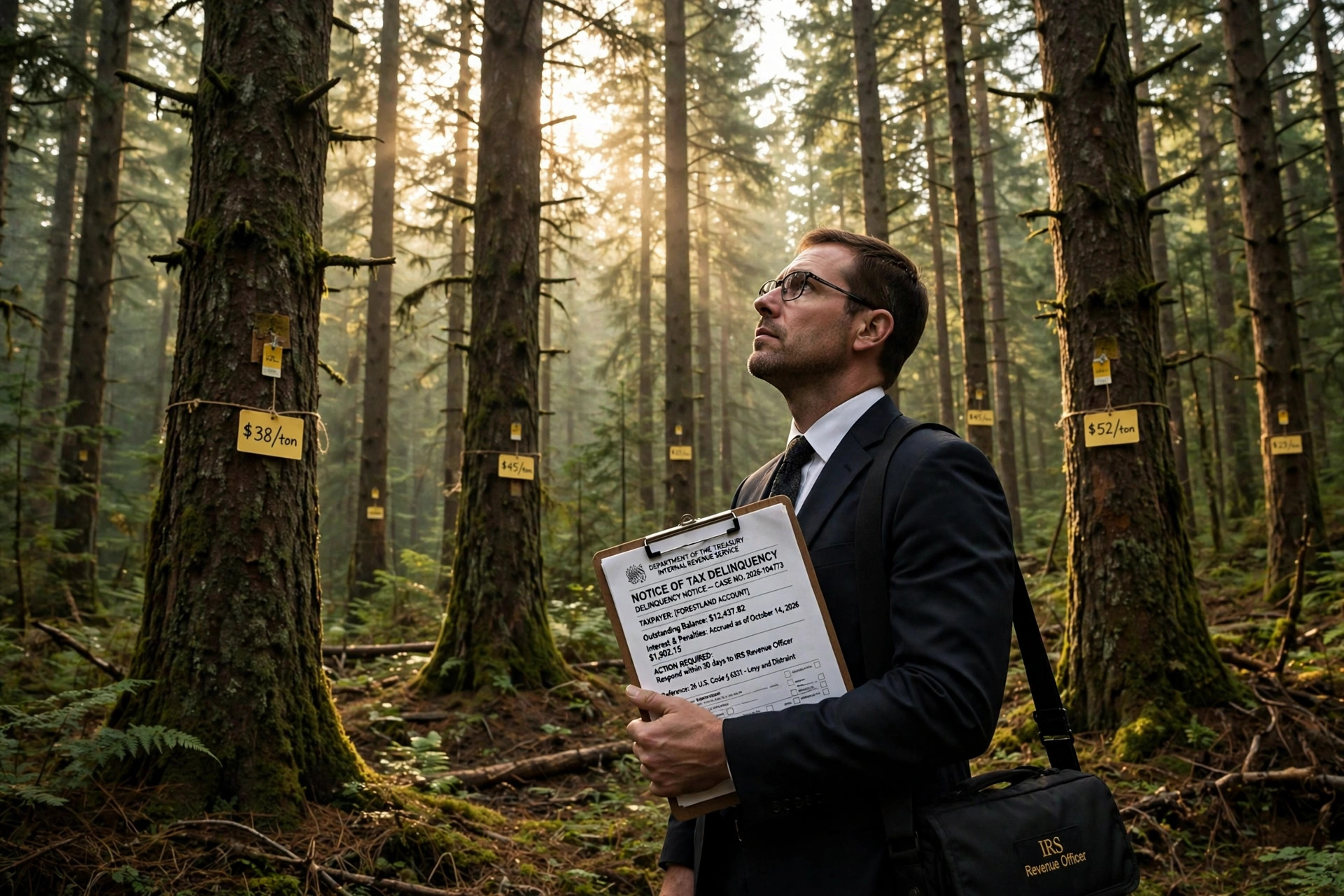
The claim is made on Internal Revenue Service Form 8933, Carbon Oxide Sequestration Credit, a document that runs to several pages and requires, among other things, the attachment of model certificates documenting the capture and the storage.2 The form is precise, bureaucratic, and largely blank. It has never been completed on behalf of a forest.
II. The Capture
The Environmental Protection Agency's Inventory of U.S. Greenhouse Gas Emissions and Sinks reports that carbon sequestration in managed forests, trees in urban areas, agricultural soils, landfilled yard trimmings, and coastal wetlands offset 14.5 percent of total gross emissions in 2022, an estimated 921.8 million metric tons of carbon dioxide equivalent.3 Total gross emissions that year were 6,343.2 million metric tons of carbon dioxide equivalent; net emissions, after accounting for the land sector's sequestration, were 5,489.0 million metric tons.4
Managed forests are the dominant component of this figure, which the inventory lists first among the sequestering land uses. The mechanism is photosynthesis: green plants capture carbon dioxide from the atmosphere, separate the carbon from the oxygen, and store the carbon in biomass and soils. The process is the oldest carbon capture technology in existence. It has been in continuous operation for roughly 400 million years, it requires no maintenance contract, and it is powered entirely by sunlight, which arrives without an invoice.
The statute defines qualified carbon oxide by reference to its capture, not its origin. Section 45Q(a) provides the credit for qualified carbon oxide captured using carbon capture equipment which is originally placed in service at a qualified facility and disposed of by the taxpayer in secure geological storage.5 The carbon oxide captured by American forests in 2022 totaled, in round numbers, 921.8 million metric tons. The capture equipment was in service. The carbon oxide was captured. The statute asks nothing further about the equipment's manufacturer.
III. The Arithmetic
The arithmetic is the heart of the matter, and it is not disputed by anyone, because it is arithmetic. At the statutory rate of $85 per metric ton for carbon oxide disposed of in secure geological storage, 921.8 million metric tons of annual sequestration represents $78.35 billion in annual tax credits. The credit accrues at a rate of approximately $2,485 per second, every second, including nights, weekends, and federal holidays.
The twelve-year claim period compounds the figure. A single year of forest sequestration, claimed over the statutory twelve-year period, yields a cumulative benefit of $940.2 billion. Spread across the roughly 160 million individual income tax returns filed each year, the forests' annual credit is worth approximately $490 per return, or roughly the value of a modest appliance, delivered to every filer, courtesy of photosynthesis.
The statute sets minimum annual capture thresholds for qualifying facilities, with the lowest tier applying to facilities capturing at least 12,500 metric tons of qualified carbon oxide per year.1 Dividing the land sector's 921.8 million metric tons by this threshold yields 73,744: the American land sector's annual capture is equivalent to nearly seventy-four thousand minimum-size qualifying facilities, operating without a single Form 8933 among them.
IV. The Equipment
The credit requires carbon capture equipment originally placed in service at a qualified facility. The equipment in question is the photosynthetic apparatus of every green plant in the American land sector: the chloroplasts, the stomata, the canopy. The statute's placed-in-service language is a timing rule, and the timing here is unambiguous. The equipment has been in service since long before the statute was enacted. It has never been taken out of service. It has never been depreciable under any schedule the auditors could locate, because no one ever put it on a fixed-asset register.
The prevailing wage requirement deserves attention, because it is the gate through which the $85 rate is reached. The statute requires that laborers and mechanics employed in the construction, alteration, or repair of the facility be paid not less than the prevailing wage, and that a specified percentage of construction labor hours be performed by qualified apprentices.1 The forests employ no laborers or mechanics in the statutory sense. The construction workforce, such as it is, is unpaid, unapprenticed, and unrepresented. Whether a facility with zero laborers satisfies a requirement that all laborers be paid prevailing wages is a question of first impression, and the auditors take the strict constructionist view: zero laborers paid below the prevailing wage is zero violations.
Measurement is the remaining equipment question. The credit requires that the quantity of qualified carbon oxide be measured, verified, and reported. The forests have, in a sense, outsourced this function to the Environmental Protection Agency, whose inventory measures the national land-sector sink to the tenth of a million metric tons each year.3 The verification is performed by the United States government itself. The forests have simply never asked to see the invoice.
V. The Storage
The credit requires disposal in secure geological storage. The statute's paradigm is injection into deep saline formations, depleted oil and gas reservoirs, and unmineable coal seams, monitored under the Environmental Protection Agency's Class VI well program. The forests' paradigm is different: carbon is stored in living biomass, dead wood, litter, and soil organic matter, where it resides for decades to centuries before returning to the atmosphere through decomposition, fire, or harvest.3
The auditors considered the permanence objection and found it unpersuasive as a matter of statutory interpretation. The statute requires secure geological storage; it does not define the term, and the implementing guidance addresses injection wells because injection wells are what the drafters had in mind. Forest soils are, in a literal sense, geological: they are the uppermost layer of the earth's crust. The carbon they hold is stored, it is geological, and the arrangement has been secure for the entire Holocene. A Class VI well, by contrast, has a design life measured in decades and a monitoring plan that expires. The forest's storage has no monitoring plan and has never leaked in a way that required reporting, which is either the best compliance record in the program or the worst, depending on the auditor's mood.
The counterargument, that stored carbon in a forest can be released by wildfire, is acknowledged and distinguished. An injected well can also leak. The statute does not require permanence; it requires storage. The forests store.
VI. The Filing Record
No Form 8933 has ever been filed on behalf of any forest. The auditors verified this by the most reliable method available: the form requires a taxpayer identification number, a facility location, and the name of the taxpayer claiming the credit, and no forest holds any of these. No forest has applied for an employer identification number. No forest has designated a responsible party. No private letter ruling has ever been issued to a tree, though the revenue procedure permits any taxpayer to request one.
The statute of limitations sharpens the urgency. A claim for credit must generally be made on a timely filed original return; the credit is, in the practitioners' phrase, use it or lose it. Each year that passes without a filing is a year of $78.35 billion permanently forfeited, accruing interest at the rate of $2,485 per second in the opposite direction. The forests' nonfiling is not a one-time event. It is a continuing omission, renewed each April, observed by no one, remediated by no one.
The direct pay election makes the omission stranger. Under the Inflation Reduction Act, eligible entities may elect to treat the credit as a payment of tax, effectively converting it to cash, and may transfer the credit to an unrelated taxpayer.1 The forests have no tax liability to offset, which is precisely the circumstance the direct pay election was designed to address. A forest electing direct pay would receive, in round numbers, $78.35 billion in cash per year. The election requires a filed return. No return has been filed.
VII. The Defense
The objection will be raised, and the audit discloses it fully, that Section 45Q was not written with forests in mind. The statute requires carbon capture equipment, a qualified facility, measured quantities, verified storage, and, for the $85 rate, prevailing wages and apprenticeship percentages. It contemplates industrial facilities with capture units, monitoring plans, and payroll departments. A forest is none of these. Photosynthesis is not carbon capture equipment in the ordinary regulatory meaning of the term. Soil is not secure geological storage in the ordinary regulatory meaning of the term. The drafters intended the credit for the industrial economy, and the legislative history, such as it is, supports this reading.
The audit does not dispute the drafters' intent. It disputes the relevance of the drafters' intent to the text. The statute provides the credit for qualified carbon oxide captured and disposed of in secure geological storage. It does not say except photosynthesis. It does not say except forests. The omission is the holding. The regulation asks one question: was carbon oxide captured and sequestered. The Environmental Protection Agency has answered that question, in writing, to the tenth of a million metric tons, every year since 1990.3
VIII. The Remedy
There are, in principle, two lawful courses. The first is guidance. The Internal Revenue Service should issue a revenue ruling confirming that photosynthesis constitutes carbon capture equipment, that forest soils constitute secure geological storage, and that the land sector's annual sequestration qualifies for the Section 45Q credit at the prevailing-wage rate. The ruling should address the placed-in-service question, the measurement question, and the apprenticeship question, and it should do so before the January 1, 2033 construction-begin deadline renders the question moot for any new forests.
The second course is filing. The forests, or a representative acting on their behalf, should obtain employer identification numbers, designate responsible parties, and file Forms 8933 for each open tax year. The direct pay election should be made. The model certificates should be attached. The auditors estimate the paperwork would take slightly longer than the eighteen months typical for a combined license application, but the credit accrues at $2,485 per second, so the return on the paperwork is, in financial terms, the highest of any filing the Service will process this century.
IX. Conclusion
The data are internally consistent, government-published, and drawn from the statute and the Environmental Protection Agency's own inventory. On the metrics that matter to the Internal Revenue Code (tons captured, tons stored, rate per ton, claim period), the American land sector is the largest carbon capture operation in the country by a factor the auditors declined to compute against the licensed fleet, out of a sense of decorum. It has captured 921.8 million metric tons in a single year. It has stored them in the ground. It has filed nothing.
The Internal Revenue Service has not issued guidance on forest sequestration under Section 45Q. Given the arithmetic, perhaps it should. The credit is accruing at $2,485 per second, and the forests, having never been told otherwise, continue to capture for free.