I. The Facility
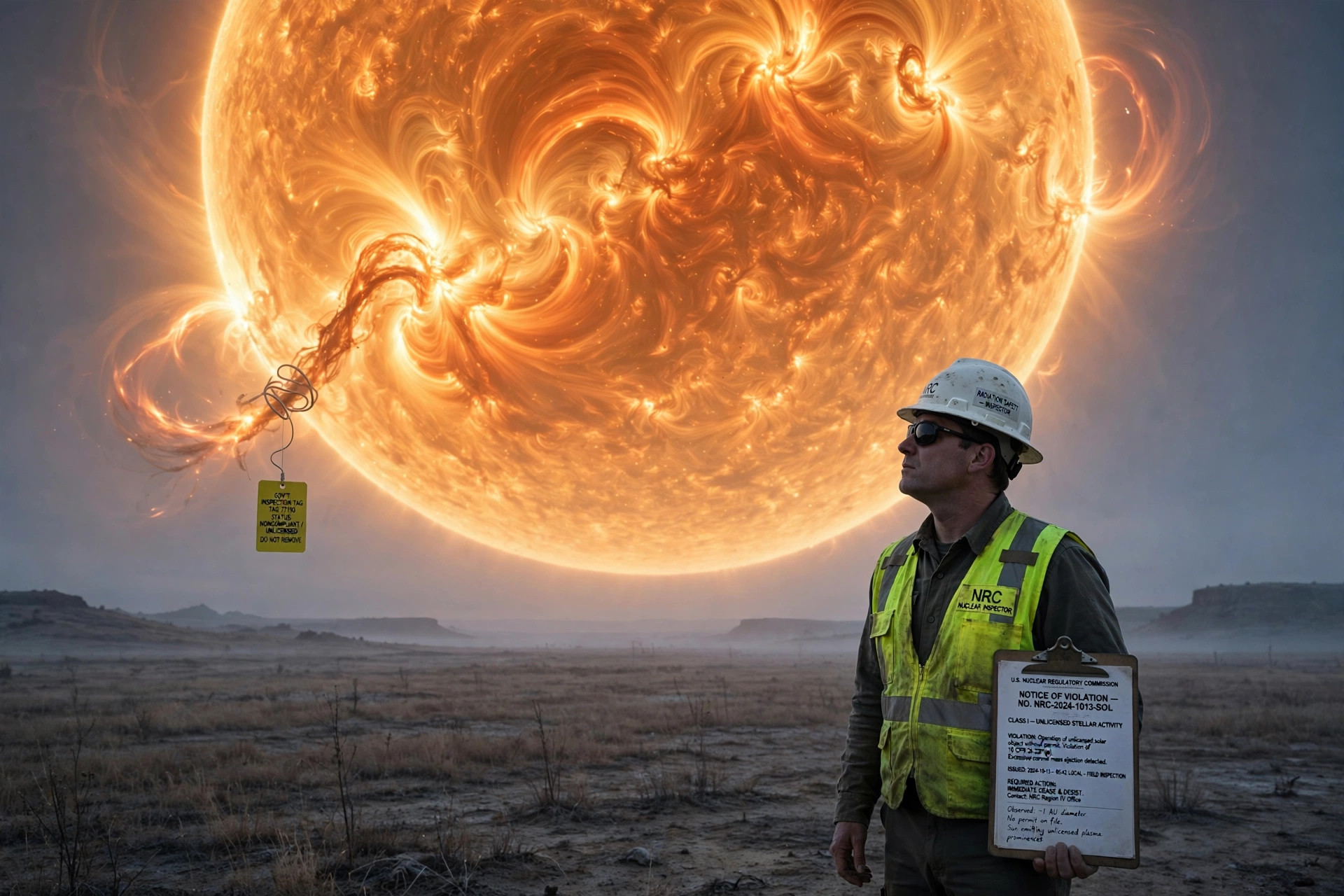
The Sun is a sustained thermonuclear fusion reactor. It is 1.4 million kilometers across, the equivalent of 109 Earths set side by side, and its energy is generated by the fusion of hydrogen into helium in a core where the temperature reaches more than 15 million Kelvin.1 It is, in other words, a nuclear reactor by the ordinary technical meaning of the term: a device in which nuclear reactions are initiated and sustained, producing useful energy. Its luminosity, the total power output radiated to space, is 3.828×1026 watts.2 The National Aeronautics and Space Administration puts the figure at 3.8×1026 joules per second, and computes that this requires the conversion of roughly 4 million tons of the Sun’s mass into energy every second.3
The facility has been operating continuously since approximately 4.6 billion years ago, when hydrogen fusion ignited in its core and the Sun was born.4 It will, by NASA’s own estimate, continue operating for roughly 5 billion more years, at which point it will expand into a red giant and engulf Mercury, Venus, and possibly Earth.5 This is relevant to the enforcement posture discussed below. The facility has no decommissioning plan on file, no scheduled shutdown, and a published end-of-life scenario that involves the destruction of the planet it illuminates.
II. The Licensing Regime
The United States maintains a comprehensive licensing regime for nuclear reactors. Section 101 of the Atomic Energy Act of 1954 provides that it shall be unlawful, except as provided in section 2121 of the title, for any person within the United States to manufacture, produce, transfer, acquire, possess, use, import, or export any utilization or production facility except under and in accordance with a license issued by the Commission pursuant to section 2133 or 2134 of the title.6 The language is deliberately exhaustive. Manufacture, produce, transfer, acquire, possess, use. The statute covers the entire lifecycle of the facility, from birth to operation, and attaches a licensing requirement to each verb.
The Commission’s implementing regulation is equally explicit. Section 50.10 of Title 10 of the Code of Federal Regulations provides that no person within the United States shall manufacture, produce, transfer, acquire, possess, or use any production or utilization facility except as authorized by a license issued by the Commission, and further provides that no person may begin the construction of a production or utilization facility on a site on which the facility is to be operated until that person has been issued a construction permit.7 Construction first, license first. The regulation contemplates no grandfather clause for facilities whose construction predates the regulation. The Sun’s construction, which occurred approximately 4.6 billion years before the regulation’s promulgation, did not have a construction permit.
Section 103 of the Act, codified at 42 U.S.C. § 2133, authorizes the Commission to issue commercial licenses for utilization and production facilities for industrial or commercial purposes.8 Licenses under this section are issued for a specified period not exceeding forty years, and may be renewed. The forty-year cap is the first of several provisions the Sun’s licensing case will struggle with. The facility has been operating for 4.6 billion years. The longest licensed operating term in the American program is eighty years, reached only by a handful of units under subsequent license renewal. The Sun exceeds the statutory maximum license term by a factor of roughly 115 million.
The regulatory apparatus that administers these provisions is not small. The Nuclear Regulatory Commission currently lists 95 commercial nuclear power plants licensed to operate in the United States, 64 pressurized-water reactors and 31 boiling-water reactors, generating about 20 percent of the nation’s electrical use.9 The agency’s Information Digest reports 94 commercial reactors operating in 28 states at 54 sites, generating about 18.6 percent of gross United States electricity, roughly 779 billion kilowatt-hours, and records about 5,960 total inspection and assessment hours at each operating reactor in fiscal year 2024.10 Every licensed reactor in the country is inspected, assessed, reported, and renewed. The unlicensed reactor is none of these things.
III. The Capacity Comparison
The arithmetic is the heart of the matter, and it is not disputed by anyone, because it is arithmetic. The entire licensed American commercial fleet has a combined generating capacity on the order of 100 gigawatts electric. The unlicensed facility’s luminosity is 3.828×1026 watts. Dividing the latter by the former yields a ratio of approximately 3.8×10¹⁵: the Sun’s power output exceeds the combined capacity of every licensed reactor in the United States by a factor of roughly 3.8 quadrillion.
Considered at the unit level, the comparison is worse. A large licensed commercial reactor produces on the order of one gigawatt. The Sun exceeds a single licensed unit by a factor of roughly 3.8×10¹⁷, which is to say that one unlicensed stellar reactor equals, in round numbers, 380 quadrillion licensed reactors. The Nuclear Regulatory Commission devotes approximately 5,960 inspection and assessment hours per year to each operating reactor it licenses. The agency devotes zero inspection hours per year to a facility 380 quadrillion times as powerful. The allocation of the agency’s inspection resources is, on a per-watt basis, not obviously optimal.
Nor is the unlicensed facility’s output consumed elsewhere. At Earth’s distance, NASA measures the solar flux at 1,400 joules per second per square meter, and computes that the Earth as a whole intercepts 1.8×10¹⁷ watts of the Sun’s output every second.3 The entire planet sits inside the facility’s discharge plume. The facility’s effluent is weather, climate, agriculture, and photosynthesis. The receiving environment is everything.
IV. The Unmonitored Effluent
A licensed reactor’s effluents are monitored with obsessive granularity. Gaseous and liquid effluents are sampled, measured, reported, and limited by technical specification. The environmental monitoring program of the United States, meanwhile, continuously measures the unlicensed facility’s emissions while drawing no regulatory inference from them. The Environmental Protection Agency’s RadNet system operates 140 radiation air monitors across all 50 states, running 24 hours a day, seven days a week, collecting near-real-time measurements of gamma radiation.11 These monitors measure the background radiation of the environment, which is to say they measure, among other things, the output of the unlicensed reactor and its secondary products. The data are reviewed continuously. No enforcement action has ever followed.
The facility also emits, continuously, a stream of charged particles known as the solar wind, which NASA notes forms a huge magnetic bubble around the Sun called the heliosphere, extending beyond the orbit of the planets. NASA’s own statement of the geometry is worth quoting for the record: Earth exists inside the Sun’s atmosphere.4 Every licensed reactor in the United States is required to monitor its exclusion area. The unlicensed reactor’s exclusion area is the orbit of Neptune.
Periodically, the facility discharges coronal mass ejections, expulsions of plasma and magnetic field from its outer atmosphere. These are the effluent events the licensing framework would classify, at a licensed facility, as unplanned releases. At the unlicensed facility, they are called space weather, and the National Oceanic and Atmospheric Administration maintains a Space Weather Prediction Center whose entire function is to issue warnings about them, like a fire department for a building the fire marshal has never inspected.
V. The Recordable Event
On September 1, 1859, the English astronomer Richard Carrington observed a sudden white-light eruption from a group of sunspots. It was the first recorded observation of a solar flare. Within roughly 17.6 hours, a billion-ton coronal mass ejection crossed the 150 million kilometers to Earth and produced the most intense geomagnetic storm in recorded history.12 Aurorae were visible as far south as the Caribbean and Central America. Telegraph systems worldwide failed. Spark discharges shocked telegraph operators and set telegraph paper on fire. On the line between Boston and Portland, Maine, two operators held a conversation over wires that had been disconnected from their batteries, exchanging messages on what they called the auroral current alone. The storm was powering the lines.13
This was, in the taxonomy of licensed operations, an unplanned release with offsite consequences. It was the largest such event in the instrumental record, and it caused the only documented nineteenth-century infrastructure failure attributable to a nuclear facility’s effluent. No licensee event report was filed. No root-cause analysis was submitted to the Commission. No corrective action was tracked to closure. The facility resumed normal operation immediately, as it has after every such event for 4.6 billion years, without so much as a confirmatory action letter.
The near-misses are also on the record. On July 23, 2012, a powerful explosion on the Sun hurled a Carrington-class coronal mass ejection away from Earth’s position. It missed. Professor Daniel Baker of the University of Colorado, summarizing the event at NOAA’s Space Weather Workshop, observed that had it struck, we would still be picking up the pieces.13 A NASA-funded study by the National Academy of Sciences concluded that a Carrington-level event today could cause substantial damage to society’s high-tech infrastructure and require years for complete recovery.13 One risk model, reported by Lloyd’s of London, estimated that a comparable event today could cost the United States up to $2.6 trillion.14 The licensed fleet’s entire annual generation is not worth that much. The unlicensed facility risks it as a matter of routine operation.
VI. The Penalty
Section 234 of the Atomic Energy Act authorizes the Commission to impose civil monetary penalties for violations of the Act. The current maximum, as adjusted for inflation through fiscal year 2025, is $372,240 for each violation, and the rule is explicit that if any violation is a continuing one, each day of such violation shall constitute a separate violation for the purposes of computing the applicable civil penalty.15
The violation is continuing. The Sun has operated without a license for every day since the Atomic Energy Act took effect on August 30, 1954. The auditors will observe the discipline of measuring only the period during which the statute has been in force, rather than the full 4.6 billion years of unlicensed operation, since a penalty cannot accrue before the law exists. That discipline is what makes the number so striking: it is the conservative figure.
From August 30, 1954, to October 13, 2026, is 26,342 days of continuing unlicensed operation. At $372,240 per day, the accrued maximum civil penalty is $9,805,546,080, approximately $9.8 billion.16 This is the penalty for the violation as bounded by the statute’s own effective date. The unbounded figure, the penalty that would have accrued had the Atomic Energy Act been in force for the facility’s entire operating history, is left as an exercise for the reader, along with the observation that it exceeds the gross domestic product of the planet the facility illuminates by a factor the auditors declined to compute, out of a sense of decorum.
VII. The Liability Gap
The Price-Anderson Act, Section 170 of the Atomic Energy Act, authorizes the Nuclear Regulatory Commission to limit the liability of its reactor licensees for radioactive damages to members of the public, and the Commission indemnifies its licensees against damage awards above that limit. Under the current framework, the primary and secondary insurance layers would provide up to $15.5 billion in public compensation for each nuclear incident, drawn from $158.0 million in retrospective premiums from each of the 95 currently covered reactors.17 The liability regime is, in other words, a closed system for licensed operators: capped, pooled, indemnified, and extended by Congress most recently in 2024.
The unlicensed facility is not a licensee. It therefore holds no Price-Anderson indemnification, pays no retrospective premium, and enjoys no liability cap. Its exposure for the next Carrington-class event is unlimited. The licensed fleet, whose combined output is less than one quadrillionth of the Sun’s, operates under $15.5 billion of pooled protection per incident. The unlicensed facility, whose output is the other 99.9999999999996 percent, operates under no protection at all, which is to say that the entire downside of the next $2.6 trillion event rests on an operator that has never been served with process, cannot be served with process, and, being a star, is judgment-proof in the most literal sense available.
The objection will be raised that the Commission cannot license a star, and that the Atomic Energy Act was not written with stellar objects in mind. The audit does not dispute the Commission’s practical difficulties; it disputes the regulatory asymmetry. The statute says it shall be unlawful for any person to use any utilization facility except under a license. It does not say except stars. The omission is the holding.
VIII. The Remedy
There are, in principle, three lawful courses. The first is enforcement. The Commission should issue a notice of violation for unlicensed operation of a utilization facility, assess the accrued civil penalty of approximately $9.8 billion, and issue an order requiring the operator to cease operation until a license is obtained. The order would be a shutdown order, or in the industry’s term, a scram. The auditors acknowledge the practical difficulty of scramming a star. They note that the difficulty is not a defense. Licensed operators are not excused from shutdown orders on the grounds that shutdown is inconvenient.
The second course is licensing. The Commission could accept a license application for the facility under Section 103, issue the license for the statutory maximum of forty years, and place the facility under the Reactor Oversight Process, with resident inspectors, performance indicators, and a corrective action program. The application would need to address the 4.6 billion years of prior unlicensed operation, the absence of a construction permit, the Carrington event and its undocumented corrective actions, the missing decommissioning plan, and the published end-of-life scenario involving the engulfment of the host planet. The auditors estimate the review would take slightly longer than the eighteen months typical for a combined license.
The third course is the one the Commission will presumably take, which is to do nothing, to continue devoting 5,960 inspection hours per year to each of 95 licensed reactors generating a fifth of the nation’s electricity, while the unlicensed reactor generating 3.8 quadrillion times their combined output continues to operate without a license, without inspections, without event reports, and without insurance, directly overhead, in plain sight, every day. This course has the advantage of familiarity. It has the disadvantage of being the precise arrangement this investigation has shown to be unlawful.
IX. Conclusion
The Sun is a sustained thermonuclear fusion reactor with a luminosity of 3.828×1026 watts, operating continuously for 4.6 billion years. Section 101 of the Atomic Energy Act of 1954 makes it unlawful to use a utilization facility without a Commission license. Section 50.10 of Title 10 requires a construction permit before construction begins. No license has been issued. No permit was obtained. No inspection has been performed. No event report has been filed for the largest geomagnetic storm in recorded history, which the facility caused. The accrued maximum civil penalty for the continuing violation, measured conservatively from the statute’s effective date, is approximately $9.8 billion. The facility carries no Price-Anderson indemnification and no liability cap.
The licensed fleet generates about a fifth of America’s electricity and is inspected 5,960 hours per reactor per year. The unlicensed facility generates everything else and is inspected never. The reactor is the sky. Ergo.
Sources
- Jim Kaler, “The Sun,” University of Illinois Department of Astronomy. The Sun is 1.4 million kilometers across, the equivalent of 109 Earths set side by side; its energy is generated by thermonuclear fusion of hydrogen into helium in the deep core, where the temperature reaches more than 15 million Kelvin. stars.astro.illinois.edu ↑
- Wikipedia, “Solar luminosity.” Luminosity of the sun: 3.828×1026 watts. simple.wikipedia.org ↑
- NASA Cosmicopia, “Ask Us: Sun.” The energy per time put out by the Sun is its luminosity, 3.8×1026 joules per second (or watts); the mass the Sun burns into energy every second is roughly 4 million tons per second; at 1 AU the solar flux is 1,400 joules per second per square meter, and the Earth intercepts 1.8×10¹⁷ joules per second. cosmicopia.gsfc.nasa.gov ↑
- NASA Science, “Sun: Facts.” The Sun formed about 4.6 billion years ago; it accounts for 99.8% of the solar system’s mass; once material leaves the corona at supersonic speeds it becomes the solar wind, forming the heliosphere, and “Earth exists inside the Sun’s atmosphere.” science.nasa.gov ↑
- NASA Science, supra note 4. Scientists predict the Sun is a little less than halfway through its lifetime and will last another 5 billion years or so; when it starts to die it will expand into a red giant, becoming so large that it will engulf Mercury and Venus, and possibly Earth as well. ↑
- 42 U.S.C. § 2131 (Atomic Energy Act § 101). “It shall be unlawful, except as provided in section 2121 of this title, for any person within the United States to transfer or receive in interstate commerce, manufacture, produce, transfer, acquire, possess, use, import, or export any utilization or production facility except under and in accordance with a license issued by the Commission pursuant to section 2133 or 2134 of this title.” uscode.house.gov ↑
- 10 C.F.R. § 50.10. “Except as provided in § 50.11 of this chapter, no person within the United States shall transfer or receive in interstate commerce, manufacture, produce, transfer, acquire, possess, or use any production or utilization facility except as authorized by a license issued by the Commission.” No person may begin construction of a production or utilization facility until issued a construction permit, combined license, early site permit, or limited work authorization. nrc.gov ↑
- 42 U.S.C. § 2133 (Atomic Energy Act § 103). The Commission is authorized to issue commercial licenses for utilization or production facilities for industrial or commercial purposes. govinfo.gov ↑
- Nuclear Regulatory Commission, “Power Reactors.” There are currently 95 licensed to operate nuclear power plants in the United States (64 PWRs and 31 BWRs), which generate about 20% of the nation’s electrical use. Page last reviewed September 30, 2025. nrc.gov ↑
- NRC, NUREG-1350 Vol. 35, “Information Digest 2024–2025: NRC By the Numbers.” 94 commercial nuclear power reactors operating in 28 states at 54 sites generate about 18.6 percent of U.S. gross electricity, about 779 billion kilowatt-hours; about 5,960 total inspection and assessment hours at each operating reactor in FY 2024. nrc.gov ↑
- Environmental Protection Agency, “RadNet.” EPA’s RadNet system monitors the nation’s air, ambient exposure rates, precipitation and drinking water for radiation; RadNet has 140 radiation air monitors in 50 states and runs 24 hours a day, 7 days a week collecting near-real-time measurements of gamma radiation. epa.gov ↑
- Wikipedia, “Carrington Event.” The Carrington Event was the most intense geomagnetic storm in recorded history, peaking on 1–2 September 1859; the coronal mass ejection crossed the 150 million kilometers to Earth in an estimated 17.6 hours; the storm created strong auroral displays reported globally and caused sparking and even fires in telegraph stations. en.wikipedia.org ↑
- Space Weather Archive, “159 Years Ago, A Geomagnetic Megastorm,” Sept. 2, 2018. A billion-ton coronal mass ejection slammed into Earth’s magnetic field; auroral currents on the eastern telegraph lines were so steady that Boston and Portland operators communicated “the usual batteries being now disconnected from the wire”; a NASA-funded National Academy of Sciences study concluded that a similar event today could cause substantial damage and require years for complete recovery; on July 23, 2012, a Carrington-class CME missed Earth, and Prof. Daniel Baker observed that “if it had hit, we would still be picking up the pieces.” spaceweatherarchive.com ↑
- Space Daily, reporting a Lloyd’s of London risk model: a Carrington-class event today could cost the United States up to $2.6 trillion. spacedaily.com ↑
- NRC, Final Rule for Adjustment of Civil Penalties for Inflation FY 2025 (RIN 3150-AK96), Dec. 18, 2024. Amends 10 CFR 2.205(j): a civil monetary penalty under Section 234 of the Atomic Energy Act “may not exceed $372,240 for each violation”; if any violation is a continuing one, each day of such violation shall constitute a separate violation. nrc.gov ↑
- Computed from the dates and rate in notes 6 and 15: 26,342 days from August 30, 1954 (the Atomic Energy Act’s effective date) to October 13, 2026, at $372,240 per day, equals $9,805,546,080, approximately $9.8 billion. ↑
- Congressional Research Service, “Price-Anderson Act: Nuclear Power Industry Liability Limits and Compensation to the Public After Radioactive Releases” (IF10821). The Price-Anderson Act requires the NRC, which issues licenses for building and operating nuclear reactors, to limit the liability of its reactor licensees; NRC indemnifies its reactor licensees against damage awards above that limit; with $158.0 million in retrospective premiums from each of the 95 currently covered reactors, the primary and secondary layers would provide up to $15.5 billion in public compensation per nuclear incident. congress.gov ↑