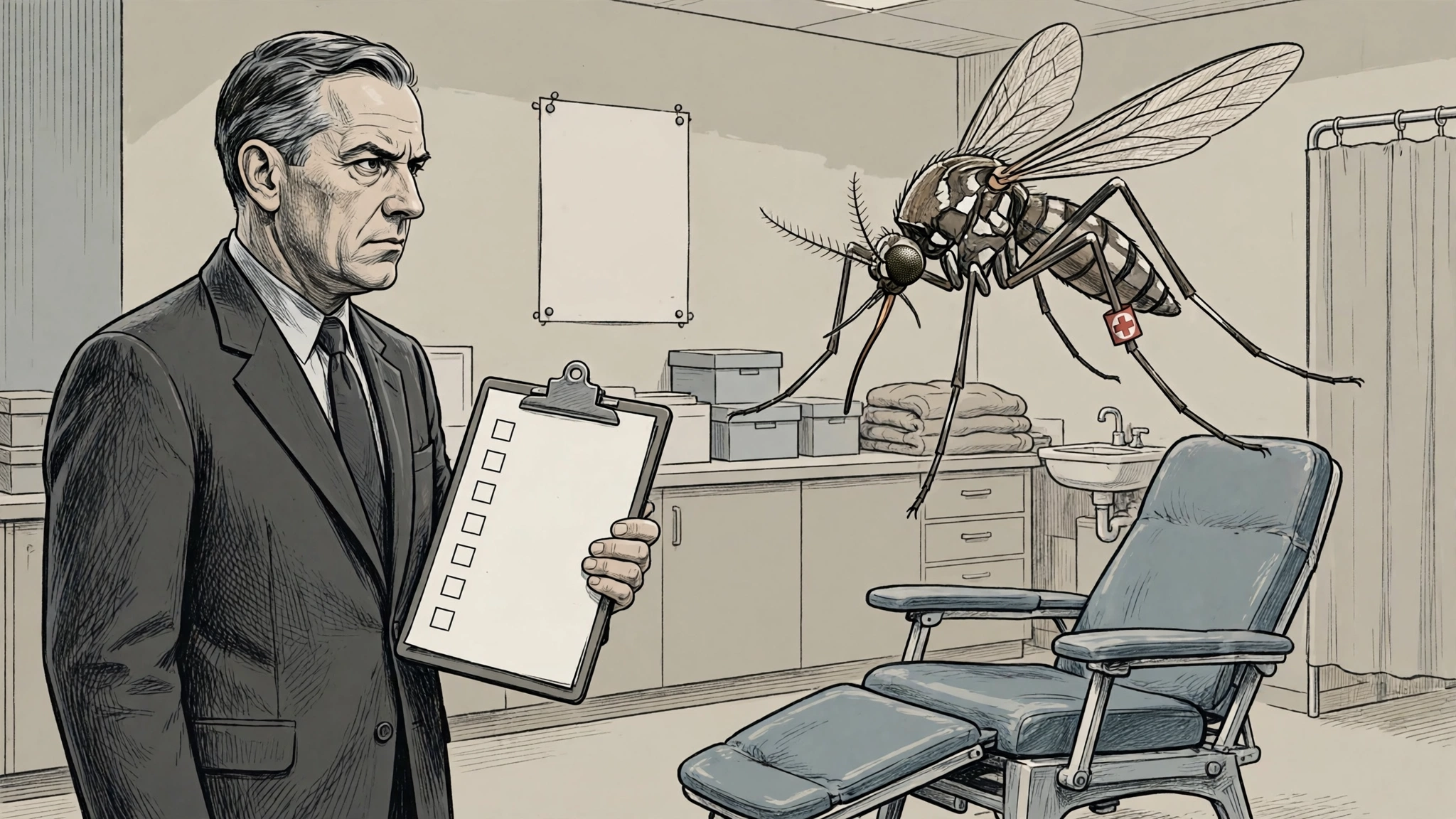
I. The Collector
The mosquito is the most industrious unlicensed blood collector in the United States, and also the least supervised. More than 3,500 species exist worldwide, and over 200 types live in the continental United States and its territories, of which about 12 spread germs that can make people sick.12 Most types are nuisance mosquitoes, which the Centers for Disease Control and Prevention describes as a problem that becomes immediate following heavy rains, hurricanes, or floods.1 The nuisance category does the drawing. The germ-spreading category does the drawing too.
Of all of these, only the females take blood. Both male and female mosquitoes feed on fruit and plant nectar, but the female needs the protein in blood to develop her eggs.3 The male subsists on nectar and never touches a donor. A bite is therefore never casual. It is a procurement, performed by a female, in service of reproduction.
The instrument is the proboscis, which acts like a hypodermic needle.4 While feeding, the female injects saliva containing an anticoagulant so the blood will not clot as she drinks, along with compounds that dilate the capillaries to increase the flow.25 The itchy bump that follows is an allergic response by the victim’s own immune system to the saliva.2 Consider that no licensed phlebotomist in any jurisdiction has ever been permitted to inject her own fluids into the donor.
The targeting is sophisticated. Receptors on the mosquito’s antennae detect the carbon dioxide released when a person exhales, and the insect also tracks lactic acid and octenol in breath and sweat, along with the heat and humidity surrounding the body.2 The average feeding draws about 5 microliters of blood, within a range of 1 to 10 microliters per bite, and a single meal can reach three times the insect’s own body weight.45 One good feeding provides enough nutrients for 75 to 500 eggs.5 The collector works nights, finds the donor in the dark, draws without waking her, and leaves before the allergic response begins. It is, by any operational measure, the most efficient blood-collection program ever devised. It is also the only one that has never filed a single form.
II. The Volume
In 2014, Bill Gates devoted a week of his blog to the argument that the mosquito is the deadliest animal in the world, with 725,000 deaths a year, more than humans, snakes, dogs, and sharks combined, noting that sharks kill fewer than a dozen people a year and get a week of cable television while the mosquito gets nothing.6 More recent estimates put the annual figure at 830,000.7 The mosquito’s publicists and its actuaries differ, but both agree on the ranking.
The bulk of the toll is malaria. The World Health Organization’s 2023 report counted an estimated 249 million cases of malaria and 608,000 deaths in 2022, mainly young children, with 95 percent of cases in sub-Saharan Africa.8 The parasite travels person to person inside the female mosquito, which passes it around when it sucks blood.7 In the United States, malaria was common into the 20th century, and the mosquitoes that can spread it, principally Anopheles freeborni and Anopheles quadrimaculatus, remain present across most of the continental United States.1
The domestic ledger is led by West Nile virus, the leading cause of mosquito-borne disease in the contiguous United States.9 Each year about 2,000 people are diagnosed, more than 1,300 develop severe illness affecting the central nervous system, and more than 130 die.9 The virus arrived in 1999 and has since been reported in all contiguous states.9 No licensed vaccines or medicines are available to prevent or treat it in people.9 The Centers for Disease Control and Prevention’s scientific literature notes that mosquitoes become infected when they feed on infected birds, and then spread the virus to people and other animals by biting them.9 The donors, in this program, are birds.
Then there is Zika. On February 1, 2016, the World Health Organization declared the outbreak a Public Health Emergency of International Concern as evidence grew that the virus causes birth defects and neurological disorders.1011 An estimated 1.5 million people were infected in Brazil, with over 3,500 cases of infant microcephaly reported between October 2015 and January 2016.10 The vector was Aedes aegypti, the yellow fever mosquito, an old hand at this: the same species introduced from Africa to the Americas brought yellow fever in 1647, dengue fever in 1780, dengue hemorrhagic fever in 1982, and chikungunya in 2013.11 Its cousin, Aedes albopictus, the Asian tiger mosquito, is now distributed as far north as the Great Lakes region.10 The operation is interstate. It is also international.
III. The License
California regulates who may draw blood. Under the Business and Professions Code, any unlicensed person employed by a clinical laboratory performing phlebotomy duties must possess a valid and current certification as a certified phlebotomy technician issued by the department.12 The path to certification for a Certified Phlebotomy Technician I includes at least 40 hours of didactic instruction, at least 40 hours of practical instruction, and at least 50 successful venipunctures.12 By April 9, 2006, all phlebotomists in California were required to maintain state certification.13 The state defines phlebotomy as the process of collecting blood by venipuncture, arterial puncture, or skin puncture.14
The mosquito has completed none of this. It has no hours of didactic instruction. It has no hours of practical instruction. Its venipunctures number in the millions per season but are uncounted, unsupervised, and performed without a single hour of department-approved training. The enforcement record against the insect, across twenty years of the certification requirement, is zero citations.
Above the state sits the federal establishment. All owners or operators of establishments that manufacture blood products are required to register with the Food and Drug Administration pursuant to section 510 of the Federal Food, Drug, and Cosmetic Act, unless exempt under 21 CFR 607.65, with products registered and listed within five days of beginning operation and updated every June and December.15 The mosquito’s operation predates the Act by some tens of millions of years and has never registered. The five-day window closed before mammals existed.
IV. The Consent
The licensed blood-collection system is built on donor eligibility. The American Red Cross requires donors to be 17 years of age in most states, 16 with parental consent where allowed by state law, to weigh at least 110 pounds, and to be in generally good health, and it requires a donor card, a driver’s license, or two other forms of identification at check-in, plus a pre-donation health history questionnaire.16 Massachusetts General Hospital’s eligibility guidelines add that whole-blood donors must wait at least 56 days, eight weeks, between donations, and that 16-year-olds need a parental permission form.17
The mosquito’s eligibility standards differ in every particular. It draws from toddlers weighing far less than 110 pounds. It draws from sleeping children without parental consent and without a permission form. It returns to the same donor the following night, well inside the 56-day window, and the night after that. It checks no identification. It administers no health history questionnaire. It uses the same unsterilized proboscis on donor after donor, which in the licensed system would be called a reuse violation and a cross-contamination event. And where the licensed system concludes with aftercare instructions and a cookie, the mosquito concludes with an allergic response, which is the donor’s immune system filing the only complaint it can.
Informed consent, the doctrine on which the entire licensed edifice rests, is absent in its entirety. No donor has ever been told what is being collected, by whom, or for what purpose. The purpose, when the female has finished, is 75 to 500 eggs.5 The donor is not compensated. The donor is not thanked. The donor is, in most cases, asleep.
V. The Enforcement
The enforcement apparatus is real and it is aimed, uniformly, at the wrong party. Local mosquito and vector control districts trap, test, and spray. Municipalities fine residents for standing water in their yards. The Centers for Disease Control and Prevention tracks nine mosquito-borne diseases in a dedicated arbovirus surveillance system.18 The federal government maps the collectors, names the diseases they carry, warns the public about all of them, and certifies none of them.
The regulatory guidance for the citizen amounts to personal armor. The Centers for Disease Control and Prevention lists only four chemicals as effective for repelling mosquitoes: DEET, picaridin, oil of lemon eucalyptus or its synthetic version PMD, and IR3535.2 There is no form to file against the collector. There is no license to revoke. There is no establishment to inspect, because the establishment is the backyard, the porch, the campsite, and the bedroom, and it relocates every few seconds at the speed of a 300-beat-per-second wing.
It must be said that the California code defines phlebotomy as the process of collecting blood “for the purpose of obtaining blood for clinical laboratory test or examination purposes,” and the mosquito collects blood for the purpose of developing eggs, a purpose the code does not contemplate.14 It must further be said that the statutes regulate persons, and the mosquito is not a person. These distinctions have not slowed the mosquito. They have not slowed it by a single microliter.
VI. Ergo
Consider the profile, assembled from the evidence above. A female insect, one of more than 3,500 species, operating across all 50 states and every continent but Antarctica, draws human blood nightly with an instrument that functions as a hypodermic needle, injects her own anticoagulant saliva into the donor, and uses the protein to manufacture up to 500 eggs per feeding. The toll of her industry runs to hundreds of thousands of deaths a year and hundreds of millions of infections. California requires 40 hours of classroom instruction, 40 hours of practical instruction, and 50 supervised venipunctures before a person may draw a single tube. The Food and Drug Administration requires registration within five days of opening. The Red Cross requires the donor to be 17, to weigh 110 pounds, to show identification, and to wait eight weeks between donations. The mosquito has no certificate, no registration, no questionnaire, and no scale. She draws from toddlers and returns the next night. She reuses the needle across every donor she will ever meet.
Any human operator with this profile would be shut down, decertified, and made an example of. This one is managed with four chemicals in a spray bottle and a request to empty the birdbath. The donor requirements exist to protect the donor. The licensing requirements exist to protect the recipient. The mosquito honors neither, and the federal counterstrategy is personal armor. The largest unlicensed blood-collection operation in American history does not operate a clinic. It operates on wings.
Sources
- Centers for Disease Control and Prevention, “About Mosquitoes in the United States”: over 200 types of mosquitoes live in the continental United States and U.S. territories, and about 12 types spread germs that can make people sick; most types are nuisance mosquitoes that become a problem immediately following heavy rains or natural disasters such as hurricanes or floods; most of the continental United States has Anopheles mosquitoes that can spread malaria; malaria was common in the United States into the 20th century. cdc.gov ↑ ↑ ↑
- Smithsonian Magazine, “14 Not-So-Fun Facts About Mosquitoes”: there are around 3,500 species of mosquitoes; only female mosquitoes bite, because they need a blood meal before they can lay eggs; the female’s saliva contains an anti-coagulant and induces an allergic response from the victim’s immune system, which is why the skin gets an itchy bump; mosquitoes are attracted to the carbon dioxide, lactic acid and octenol found in breath and sweat, and they sense heat and humidity; the CDC lists only four chemicals as effective for repelling mosquitoes: DEET, picaridin, oil of lemon eucalyptus (or its synthetic version, PMD) and IR3535. smithsonianmag.com ↑ ↑ ↑ ↑ ↑
- MegaCatch, “Mosquito Facts”: only female mosquitoes bite people; both male and female feed mainly on fruit and plant nectar, but the female also needs the protein in blood to help her eggs develop. megacatch.com ↑
- obnews.co, “How much blood does a mosquito drink in one bite?”: on average a female mosquito drinks about 0.001 to 0.01 milliliters of blood per bite, or 1 to 10 microliters, with most U.S. studies narrowing it to about 5 microliters; the proboscis acts like a hypodermic needle. obnews.co ↑ ↑
- Facts and Details, “Mosquitoes: Blood, Disease and Avoiding and Killing Them”: mosquitoes are capable of carrying three times their body weight in blood; one good feeding provides enough nutrients for 75 to 500 eggs; the proboscis is a composite of cutting blades and feeding tubes powered by two tiny pumps; saliva contains anticoagulants and compounds that dilate the capillaries to increase flow. factsanddetails.com ↑ ↑ ↑ ↑
- Tech Times, reporting Bill Gates’s Gates Notes “Mosquito Week” (April 2014): mosquitoes kill 725,000 people a year, more than humans, dogs, snakes, roundworms, tapeworms, crocodiles, hippos, elephants, lions, wolves, and sharks combined; sharks kill fewer than a dozen people a year and get a week of cable television. techtimes.com ↑
- ScienceAlert, “A Radical Plan to Exterminate Mosquitoes”: mosquitoes kill an estimated 830,000 people around the world each year, more deadly than any animal on Earth, humans included; a majority of those deaths (more than 440,000) are malaria, transmitted person to person in a one-celled parasite that female mosquitoes pass around when they suck blood. sciencealert.com ↑ ↑
- Reuters, reporting the WHO World Malaria Report 2023 (November 30, 2023): an estimated 249 million cases of malaria in 2022; an estimated 608,000 people died of the disease that year, mainly young children. reuters.com ↑
- Centers for Disease Control and Prevention, “About West Nile”: West Nile virus is the leading cause of mosquito-borne disease in the contiguous United States; each year about 2,000 people are diagnosed, more than 1,300 develop severe illness affecting the central nervous system, and more than 130 die; the virus was introduced to the United States in 1999 and has been reported from all contiguous states; no licensed vaccines or medicines are available to prevent or treat West Nile virus disease in people; mosquitoes become infected when they feed on infected birds, then spread the virus to people and other animals by biting them. cdc.gov ↑ ↑ ↑ ↑ ↑
- Wikipedia, “2015–2016 Zika virus epidemic”: in February 2016 the WHO declared the outbreak a Public Health Emergency of International Concern; an estimated 1.5 million people were infected in Brazil, with over 3,500 cases of infant microcephaly reported between October 2015 and January 2016; the virus is spread mainly by the Aedes aegypti mosquito and also by Aedes albopictus, distributed as far north as the Great Lakes region. en.wikipedia.org ↑ ↑ ↑
- JAMA, “The Emerging Zika Virus Epidemic in the Americas: Research Priorities”: on February 1, 2016, the WHO declared a public health emergency of international concern regarding neurological disorders associated with Zika virus; the trend started more than 500 years ago with the introduction of the yellow fever mosquito, Aedes aegypti, from Africa into the Americas, leading to epidemics of yellow fever (1647), dengue fever (1780), dengue hemorrhagic fever (1982), and chikungunya (2013), which share the same mosquito vector. jamanetwork.com ↑ ↑
- City of Long Beach, excerpt of California codes (Business and Professions Code): on and after the effective date of the regulations, any unlicensed person employed by a clinical laboratory performing the duties described in this section shall possess a valid and current certification as a certified phlebotomy technician issued by the department; certification as a certified phlebotomy technician I requires at least 40 hours of didactic instruction, at least 40 hours of practical instruction, and at least 50 successful venipunctures. longbeach.gov ↑ ↑
- The Dark Report, “Phlebotomists in Calif. Undergoing Certification” (May 30, 2005): by April 9, 2006, all phlebotomists in California will need to maintain state certification; California leads in requiring certification of phlebotomists. darkintelligencegroup.com ↑
- California Department of Public Health, DPH-11-012 (October 2, 2019): “Phlebotomy” means the process of collecting blood by venipuncture, arterial puncture or skin puncture for the purpose of obtaining blood for clinical laboratory test or examination purposes. cdph.ca.gov ↑ ↑
- U.S. Food and Drug Administration, “Biologics Establishment Registration”: all owners or operators of establishments that manufacture blood products are required to register with the FDA pursuant to section 510 of the Federal Food, Drug, and Cosmetic Act, unless exempt under 21 CFR 607.65; products must be registered and listed within 5 days of beginning operation, and annually between November 15 and December 31. fda.gov ↑
- Philadelphia Daily, reporting American Red Cross blood donation requirements: individuals who are 17 years of age in most states (16 with parental consent where allowed by state law), weigh at least 110 pounds and are in generally good health may be eligible to donate blood; a blood donor card or driver’s license or two other forms of identification are required at check-in; donors complete a pre-donation health history questionnaire. phillydaily.com ↑
- Massachusetts General Hospital, Whole Blood Donor Eligibility Guidelines: weight at least 110 lbs; age at least 16 years old (16-year-olds need parental permission form); last donation at least 56 days ago (8 weeks). massgeneral.org ↑
- Scientific American, “Mosquitoes Carry Nasty Diseases. Here’s How to Protect Yourself”: the CDC tracks nine mosquito-borne diseases in a surveillance system dedicated to monitoring arboviruses, viruses transmitted by arthropods; West Nile virus is the most common cause of mosquito-borne illness in the U.S. scientificamerican.com ↑