I. The Introduction
The kudzu plant was introduced to the United States from Japan in 1876 at the Centennial Exposition in Philadelphia, where it appeared as an ornamental in the Japanese pavilion.1 It was admired for its showy, fragrant flowers and its broad leaves, and it was quickly adopted in the South as a shade plant for gardens and porches.2 It appeared again at the New Orleans Exposition in 1883, and southerners began importing seeds for decorative plantings.1 For thirty years it did nothing of note. It shaded porches. It smelled pleasant in August. Nobody filed any paperwork, because no paperwork existed to file.
The federal government took an interest at the turn of the century. David Fairchild, the Department of Agriculture’s celebrated plant explorer, planted kudzu seedlings in his garden near Washington, D.C., in 1902 to observe how the plant would behave.3 By 1905 the vine had been recognized as a highly nutritious livestock forage.4 Fairchild himself would later turn against the plant; in his autobiography he recalled firsthand how kudzu covered bushes and climbed pines, smothering them.3 The Department did not share his misgivings. The Department had larger plans.
II. The Subsidy
The Dust Bowl made soil erosion a national emergency, and the newly formed Soil Conservation Service went looking for anything with roots that could hold a hillside together. Kudzu fit the brief. In the 1930s and 1940s the Service grew tens of millions of seedlings, the government-aided distribution totaling some 85 million seedlings, and paid farmers as much as eight dollars an acre to plant the vine.51 The Civilian Conservation Corps planted it as a solution for erosion.1 By 1946 an estimated three million acres of kudzu had been planted across the Southeast.1
The promotion had its enthusiasts. Atlanta Constitution columnist Channing Cope became the vine’s loudest believer, leading the Kudzu Club of America, which at its peak claimed 20,000 members, and telling readers the vine would make Southern farms live again.5 The vine was, for a time, the most heavily subsidized plant in American agriculture that nobody intended to eat. The government paid for the seedlings. The government paid for the planting. The government paid eight dollars an acre, and the acres ran into the millions.
III. The Reversal
The hero story did not survive contact with the vine. The plantings meant to save Southern farming turned out to be poor pasture and a nuisance in fields, and when boll weevil infestations and failing cotton crops drove farmers to abandon their farms, the kudzu plantings were left unattended.1 The climate of the Southeast allowed the vine to grow virtually unchecked.
In 1953 the Department of Agriculture removed kudzu from its list of suggested cover plants.1 In 1970 the Department listed it as a weed.1 In 1997 the vine was placed on the Federal Noxious Weed List.1 Consider the sequence from the vine’s perspective. The government paid farmers to plant it. Then the government stopped recommending it. Then the government called it a weed. Then the government placed it on a federal list of noxious weeds. At no point in this sequence did the vine alter its behavior. It grew a foot a day throughout.6
IV. The Repeal
In 2000, Congress repealed sections 2801 through 2813 of the Federal Noxious Weed Act of 1974, the very sections that had placed kudzu on the Federal Noxious Weed List three years earlier, and superseded them with updated legislation.1 Kudzu was removed from the federal list. The successor statute, the Plant Protection Act, prohibits any person from importing, exporting, or moving in interstate commerce an unauthorized plant pest, authorizes the Secretary of Agriculture to restrict the importation and movement of noxious weeds, and provides for criminal and civil penalties.7
The statutes, it must be said, prohibit persons from moving noxious weeds. The vine is not a person. This distinction has not slowed the vine. Kudzu is now present in 31 of the 50 states, has been recorded in all five boroughs of New York City and in Nova Scotia, Canada, and continues to extend its range across state lines under its own power, without authorization, without inspection, and without a permit.81 Every new acre is an interstate movement the statute was written to prevent, accomplished by an entity the statute cannot name.
V. The Present Violation
What the federal list surrendered, the states took up. Kudzu is a listed noxious weed in Florida, Illinois, Kansas, Kentucky, Mississippi, Missouri, Pennsylvania, Texas, and West Virginia, among others.4 In Texas, kudzu sits on the Department of Agriculture’s lists of noxious and invasive plants, which are illegal to sell, distribute, or import into the state.9 The vine grows in Texas. It did not apply for an exemption. It sells nothing, but it distributes constantly: it roots at the nodes, it sends out runners and rhizomes, and as many as thirty vines may grow from a single root crown.6 Each new vine is a distribution event. The statute prohibits distribution. The arithmetic follows.
The scale of the ongoing violation is a matter of record, though the records disagree with each other. The commonly cited estimate holds that kudzu covers 7.4 million acres of the Southeast.1 Recent Forest Service inventory information puts the figure at 227,000 acres, increasing by no more than 2,500 acres a year.1 The vine’s publicists and its auditors differ by a factor of thirty, which is either a testament to the difficulty of measuring a plant that grows a foot a day or the first documented case of a weed with better press than the agency tracking it.
The damages, by contrast, are consistently documented. The economic impact is estimated at $100 million to $500 million lost per year in forest productivity.10 Control costs run about $5,000 per hectare per year.10 Power companies spend about $1.5 million per year repairing damage to power lines, which the vine topples with some regularity.10 The mechanism of destruction is thorough: kudzu kills or degrades other plants by smothering them under a solid blanket of leaves, by girdling woody stems and tree trunks, and by breaking branches or uprooting entire trees and shrubs through the sheer force of its weight.6 Its taproots reach seven inches in diameter, six feet in length, and weights of up to four hundred pounds.6 It also serves as the most common overwintering host for Asian soybean rust, a fungal pathogen that threatens the nation’s soybean crop.4
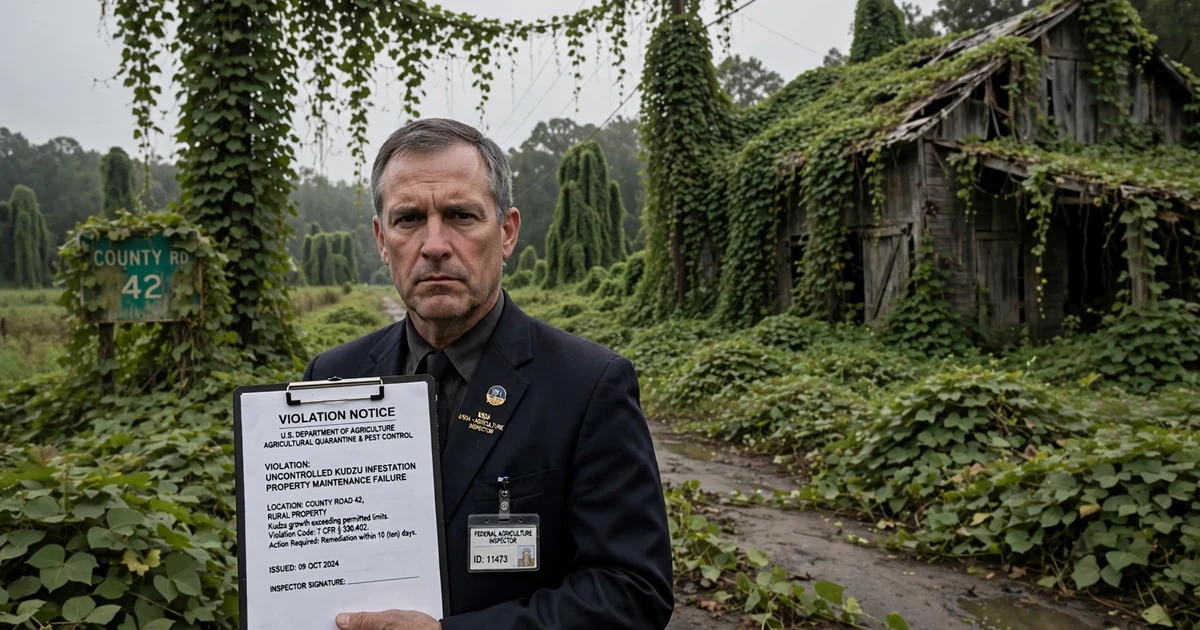
No vine has ever been charged under any of these statutes. No vine has ever applied for a permit. The enforcement record, across nine state noxious-weed lists and one repealed federal list, is zero prosecutions of the actual distributor, against millions of acres of ongoing distribution.
VI. Ergo
Consider the profile, assembled from the evidence above. A foreign vine was exhibited as an ornament in 1876, promoted as forage by 1905, and then planted across three million acres at government expense, at eight dollars an acre, by the very Department that would later list it as a weed, place it on the Federal Noxious Weed List, and watch Congress repeal the list rather than enforce it. It remains illegal to sell, distribute, or import in Texas and a listed noxious weed in at least eight other states. It grows a foot a day. It distributes itself across state lines without authorization. Its taproots weigh four hundred pounds. The damages run to half a billion dollars a year.
Any other distributor with this profile would be enjoined, fined, and made an example of. This one was subsidized, then listed, then delisted by repeal, and it has never once been asked to show a permit. The largest unpermitted noxious-weed distribution program in American history was not a crime. It was a farm program. The vine that ate the South did not break the law. The law paid for the vine, changed its mind, repealed itself, and left the South to the plant.
Sources
- Wikipedia, “Kudzu in the United States”: introduced from Japan in 1876 at the Centennial Exposition in Philadelphia; exhibited again at the 1883 New Orleans Exposition and marketed as an ornamental porch shade; the Soil Erosion Service’s recommendation led to the government-aided distribution of 85 million seedlings with plantings paying $19.75 per hectare ($7.99/acre); cultivated by Civilian Conservation Corps workers; by 1946 an estimated 1,200,000 hectares (3,000,000 acres) planted; plantings left unattended after farm abandonment; USDA removed kudzu from suggested cover plants in 1953 and listed it as a weed in 1970; placed on the Federal Noxious Weed List in 1997; removed from the list in 2000 with the repeal of sections 2801–2813 of the Federal Noxious Weed Act of 1974; commonly cited at 3,000,000 hectares (7,400,000 acres), while recent U.S. Forest Service information indicates 227,000 acres increasing by no more than 2,500 acres a year; recorded in Nova Scotia, Columbus, Ohio, and all five boroughs of New York City. en.wikipedia.org ↑ ↑ ↑ ↑ ↑ ↑ ↑ ↑ ↑ ↑ ↑ ↑ ↑
- Scientific American, “The Secret Life of Kudzu”: following its debut at the Japanese pavilion of the 1876 Philadelphia Centennial International Exhibition, the vine was quickly adopted to shade the gardens and porches of the American South and adorn them with showy, fragrant flowers; the Soil Conservation Service’s promotion resulted in approximately three million acres planted by 1946; poet James Dickey published “Kudzu” in The New Yorker in 1963. scientificamerican.com ↑
- europesays.com, reporting the USDA Forest Service Southern Research Station account and Smithsonian Magazine: plant explorer David Fairchild planted kudzu seedlings in his garden near Washington, D.C., in 1902; by 1938 he had turned against the plant, recalling in his autobiography The World Was My Garden how kudzu covered bushes and climbed pines, smothering them. europesays.com ↑ ↑
- Mississippi State University Extension Service, “Kudzu” (Publication 3187): introduced 1876 at the Centennial Exposition in Philadelphia; recognized as highly nutritious livestock forage in 1905; by 1946 an estimated 300,000 acres were planted; a noxious weed in Florida, Illinois, Kansas, Kentucky, Mississippi, Missouri, Pennsylvania, Texas, and West Virginia; can host Asian soybean rust, a potentially serious pathogen in soybeans. extension.msstate.edu ↑ ↑ ↑
- Space Daily (September 2026), “In 1935 the government paid Southern farmers eight dollars an acre to plant a fast-growing Japanese vine”: the Soil Conservation Service grew 70 million seedlings and paid farmers eight dollars an acre; columnist Channing Cope led the Kudzu Club of America, which at its peak claimed 20,000 members. spacedaily.com ↑ ↑
- Native Plant Society of Texas, “Kudzu (Pueraria montana)”: introduced 1876 at the Centennial Exposition; Soil Conservation Service encouraged planting for erosion control in the 1930s and farmers were paid as much as $8.00 per acre in the 1930s and 1940s; kills or degrades other plants by smothering them under a solid blanket of leaves, by girdling woody stems and tree trunks, and by breaking branches or uprooting entire trees through the sheer force of its weight; grows as much as 60 feet per season at about one foot per day; tap roots 7 inches or more in diameter, 6 feet or more in length, weighing as much as 400 pounds; as many as thirty vines may grow from a single root crown; on the Texas Department of Agriculture’s Lists of Noxious and Invasive Plants. npsot.org ↑ ↑ ↑ ↑
- Congress.gov, S.321 (106th Congress), Plant Protection Act, summary: Title I prohibits a person from importing, exporting, or moving in interstate commerce an unauthorized plant pest and authorizes the Secretary of Agriculture to permit such movement; Section 102 authorizes the Secretary to restrict the importation and movement of noxious weeds; Title II sets forth criminal and civil penalties. congress.gov ↑
- Ingenta Connect, “Kudzu: Invasive Weed Supports the Soybean Rust Pathogen Through Winter Months in Southeastern United States” (2014): kudzu’s range is now estimated to cover over 3 million hectares of the eastern United States and is present in 31 of the 50 states; severe infestations in Alabama, Georgia, and Mississippi; economic impact estimated at $100–500 million lost per year in forest productivity. ingentaconnect.com ↑
- Native Plant Society of Texas, ibid.: “Kudzu is on the Texas Dept. of Agriculture’s Lists of Noxious and Invasive Plants which are illegal to sell, distribute or import into Texas.” npsot.org ↑
- Pennsylvania Sea Grant, “Kudzu Fact Sheet” and “Hydrilla Aquatic Invasive Species factsheet” (kudzu biology section): lost productivity in forests estimated at $100–500 million per year; power companies spend an estimated $1.5 million per year on control as the vine topples power lines; grows one foot per day, extending as much as 60 feet per season; kudzu growth over rails can cause wheel slippage and derailments. seagrant.psu.edu ↑ ↑ ↑