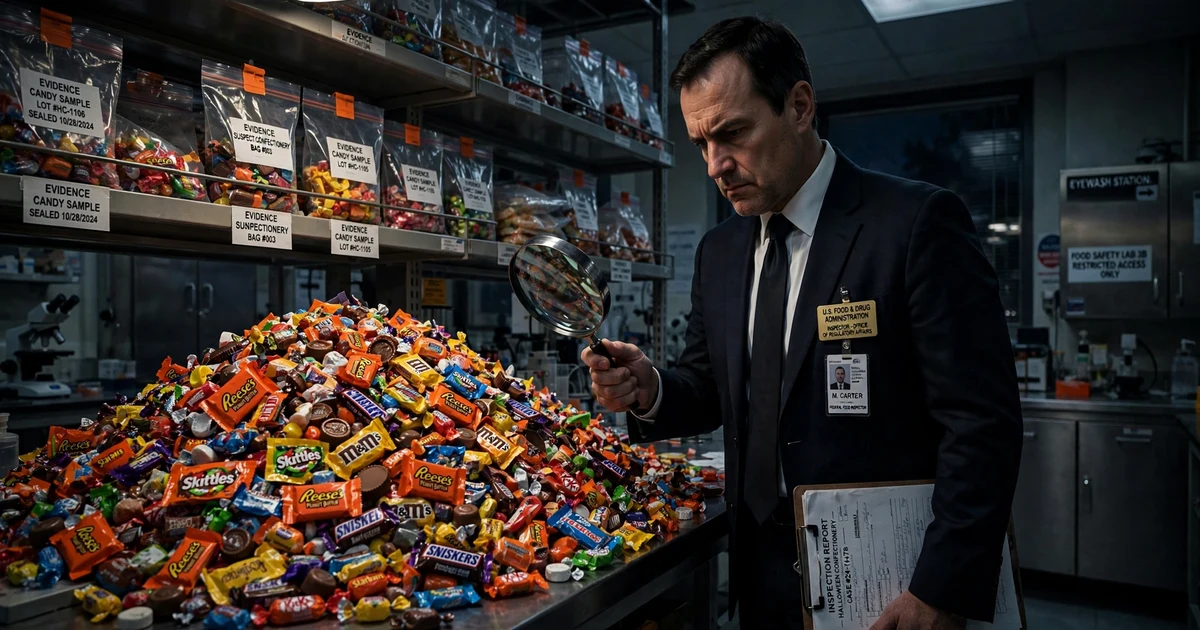
I. The Statute
Section 342 of Title 21 of the United States Code states the rule in language that admits no exception for holidays, traditions, or the age of the consumer: “A food shall be deemed to be adulterated” if “it bears or contains any poisonous or deleterious substance which may render it injurious to health.”1 The operative word is may. The statute does not require proof that the food has injured anyone. It requires only that the substance it bears or contains may render it injurious to health.
The statute then draws a distinction that will matter. Where the poisonous or deleterious substance is not an added substance, the food “shall not be considered adulterated under this clause if the quantity of such substance in such food does not ordinarily render it injurious to health.”1 Nature gets a proviso. For added substances, there is no such leniency in this clause; added poisons are routed instead to a separate regime of tolerances, at Section 346, which the Secretary may set.1 The distinction is between what the earth put in the food and what the manufacturer put in the food. The manufacturer put the colors in the candy.
The prohibited acts follow. Section 331 provides that the introduction or delivery for introduction into interstate commerce of any adulterated food is prohibited, as is the adulteration of any food in interstate commerce, as is the receipt in interstate commerce of any adulterated food “and the delivery or proffered delivery thereof for pay or otherwise.”2 Note the final phrase: for pay or otherwise. The statute reaches the commercial distributor and the neighbor handing out fun-size bars on the porch alike, because the porch distribution is a delivery, and the statute does not require payment.
The penalties are stated per violation. Section 333 provides that any person who violates a provision of Section 331 “shall be imprisoned for not more than one year or fined not more than $1,000, or both,” and that a violation committed after a prior conviction, or committed with the intent to defraud or mislead, draws imprisonment of not more than three years or a fine of not more than $10,000.3 No element of intent is required for the basic misdemeanor. The government need not prove that the distributor knew the candy was adulterated, or intended any harm, or was even negligent; a responsible corporate official can be held liable without proof of intent, negligence, or actual knowledge of the specific violation.4 Strict liability, one year per count, $1,000 per count. The arithmetic will be addressed in due course.
II. The Product
The scale of the distribution is a matter of annual measurement. The National Retail Federation’s 2026 forecast projects that total Halloween spending will reach a record $13.5 billion, with candy accounting for $4.1 billion of it, up from the Federation’s 2025 forecast of $3.9 billion and $3.5 billion in 2024.5 The 2025 survey found total spending at a record $13.1 billion, per-person spending at a record $114.45, seventy-three percent of consumers celebrating, and sixty-six percent handing out candy.6 Candy is, by the Federation’s own ranking, the most popular Halloween purchase category, bought by an estimated ninety-six percent of celebrants.5
The unit economics are these. Halloween candy prices have risen seventy-eight percent since 2020, more than triple the rate of inflation, driven in large part by a nearly fivefold increase in wholesale cocoa prices, from $2,200 a metric ton to more than $10,000 at the peak. The average price of a one-hundred-piece bag of assorted Halloween candy rose from $9.19 in 2020 to $16.39 in 2025.7 At sixteen cents a piece, $4.1 billion purchases approximately twenty-five billion individual pieces of candy. Twenty-five billion deliveries, for pay or otherwise, in a single season.
The recipients are counted too. The Census Bureau has estimated 41.2 million potential trick-or-treaters, children ages five to fourteen, across the United States.8 The distribution unit is the fun-size bar, a format whose commercial history is itself revealing: the wave of fun-size began in the 1950s as manufacturers sought smaller pieces for desks, lunches, and holidays, and in 2017 the major companies vowed that half of their individually wrapped treats would come in under two hundred calories by 2022.9 The industry calibrated the dose and named it fun.
III. The Colors
In September 2007, researchers at the University of Southampton published in The Lancet the results of a randomized, controlled trial funded by the United Kingdom’s Food Standards Agency. One hundred fifty-three three-year-olds and one hundred forty-four eight- and nine-year-olds, selected from the general population to represent the full range of behavior, were given drinks containing two different mixtures of artificial food colors and the preservative sodium benzoate, or placebo, over six weeks. Teachers, parents, trained observers, and computer-based attention tests all recorded the same finding: the mixtures increased hyperactivity. The effect appeared not only in children with diagnosed disorders but across the general population.10 The lead author’s summary: “These findings show that adverse effects are not just seen in children with extreme hyperactivity, but can also be seen in the general population and across the range of severities of hyperactivity.”
The European Union read the study and acted. Article 24 of Regulation (EC) No. 1333/2008, in force since July 20, 2010, requires that foods containing any of the six Southampton colors bear the warning that they “may have an adverse effect on activity and attention in children.”11 The six are sunset yellow, quinoline yellow, carmoisine, allura red, tartrazine, and ponceau 4R. Their American trade names are familiar from the ingredient panel of the Halloween bag: Yellow 6, Yellow 5, Red 40. The same molecules that must warn European parents require no warning on the American porch.
California read the study and acted further. On September 28, 2024, the governor signed Assembly Bill 2316, the California School Food Safety Act, the first law of its kind in the nation, prohibiting food served in public schools from containing Red 40, Yellow 5, Yellow 6, Blue 1, Blue 2, or Green 3, effective December 31, 2027. The legislation followed a 2021 report by the California Environmental Protection Agency linking synthetic dyes to hyperactivity and neurobehavioral problems in children.12 A state has determined that these colors may not be served to children at school. The same children will receive them, unregulated, at the door.
The Food and Drug Administration’s position is that the totality of the evidence indicates most children have no adverse effects from color additives, though some children may be sensitive, and it continues to evaluate the science.13 Consumer Reports has noted that the agency has not evaluated Red 40 since 1971.13 In January 2025, the agency revoked the authorization for Red No. 3 in food, more than three decades after the Delaney Clause should have settled the question.14 The colors in the Halloween bag are the colors the regulators keep revisiting. The bag keeps going out.
IV. The Whitener
Titanium dioxide is the white pigment that makes candy shells bright and icing opaque. On May 6, 2021, the European Food Safety Authority, after reviewing more than eleven thousand scientific publications, concluded that titanium dioxide “can no longer be considered safe as a food additive.” The panel could not rule out a concern for genotoxicity, damage to DNA, and consequently could not establish a safe level of daily intake.15 The European Commission then removed the authorization: Commission Regulation (EU) 2022/63 banned titanium dioxide as a food additive effective February 7, 2022, with existing stocks permitted until August 2022.16 France had already suspended it in food on January 1, 2020, following its own agency’s opinion on the additive’s oral toxicity.16
In the United States, titanium dioxide remains classified as generally recognized as safe. The FDA’s regulation provides that the color additive “may be safely used for coloring foods generally,” subject to the restriction that the quantity not exceed one percent of the food’s weight.17 A 2012 study in Environmental Science & Technology noted that children are especially exposed to titanium dioxide precisely because of the foods marketed to them, including candy.17 The whitener the European Union banned as a possible genotoxin is the whitener in the American Halloween bag, at up to one percent by weight, generally recognized as safe.
The contradiction has been litigated. In July 2022, a consumer filed a proposed class action in the United States District Court for the Northern District of California, Thames v. Mars Inc., No. 22-04145, alleging that Skittles contain “heightened levels” of titanium dioxide and are “unfit for human consumption.” The complaint noted that Mars had pledged in February 2016 to remove artificial colors from its products over five years and had confirmed that titanium dioxide was among the colorants being removed, yet the whitener remained.18 Mars responded that its use of titanium dioxide complies with FDA regulations.18 Both statements are true. The product complies with the American regulation and would be illegal under the European one. The bag is distributed on the American porch.
V. The Metals
In December 2022, Consumer Reports published testing of twenty-eight dark chocolate bars. Every bar contained both lead and cadmium. Twenty-three of the twenty-eight contained enough of at least one metal that eating just one ounce a day would exceed California’s maximum allowable dose levels; five bars were high in both. The organization used California’s levels because they are considered the most protective available.19 In October 2023, it tested forty-eight chocolate products and found sixteen with concerning levels; every product tested had detectable lead or cadmium.20 There are no federal limits for lead or cadmium in most foods, which is why the testers had to borrow California’s.20
The trade association’s response is a matter of record. The National Confectioners Association stated that the California guidelines Consumer Reports used are “not food safety standards” and that chocolate remains safe to eat.21 Consumers responded with litigation: Trader Joe’s has been sued at least nine times over its dark chocolate since the study, and Hershey’s, Mondelez, Godiva, and Lindt have been sued as well.21 The researchers found that cadmium enters through the soil where cacao grows and lead adheres after harvest, when beans dry outdoors in contact with dust and soil, and that manufacturers can reduce the levels, because the variation between brands shows it is possible.20 The metals are in the chocolate. The levels are reducible. The levels have not been reduced.
Lead and cadmium are not added substances. They arrive via soil and dust, which places them under the statute’s proviso for non-added substances: not adulterated unless the quantity “ordinarily” renders the food injurious to health.1 The proviso is doing considerable work in this article, and it will be examined in the defense. For now, note the shape of the finding: the nation’s most trusted consumer testing organization found two toxic heavy metals in one hundred percent of the dark chocolate bars it tested, and the federal government has set no limit for either in the food.
VI. The Sugar
The boldest count in this investigation concerns the ingredient listed first. In a standard fun-size assortment, the ingredient panel begins with sugar, continues through chocolate, and returns to sugar, cornstarch, and corn syrup.22 Sugar is not a trace contaminant. It is the product.
The American Heart Association’s scientific statement, published in Circulation, reviewed the evidence on added sugars and children and concluded that associations between added sugars and cardiovascular disease risk factors are present “at levels far below current consumption levels.” The evidence, the statement found, supports associations with increased energy intake, adiposity, dyslipidemia, elevated blood pressure, insulin resistance, and dental caries. The recommendation: children ages two to eighteen should consume no more than twenty-five grams, about six teaspoons, of added sugars per day, and children under two should consume none. The typical American child consumes about triple the recommended amount.23
Here the statute’s architecture becomes the argument. Sugar is an added substance. The leniency the statute extends to non-added substances, the “does not ordinarily render injurious” proviso, does not apply to it. For added substances, the clause asks only whether the food “bears or contains any poisonous or deleterious substance which may render it injurious to health.”1 The American Heart Association has stated, in a peer-reviewed scientific statement, that the risk factors are present at levels far below what children currently consume. The statute asks whether the substance may render the food injurious. The cardiologists have answered.
And the dose is not ordinary. Halloween is the year’s largest single-evening acute dosing event for added sugar in children: 41.2 million potential recipients, twenty-five billion pieces in circulation, each piece engineered in the 1950s format and the 2017 calorie pledge to be small enough to justify taking another.89 The statute does not recognize the holiday. It recognizes the substance.
VII. The Wrapper
The package is regulated too. Section 100.100 of Title 21 of the Code of Federal Regulations provides that a food is misbranded if its container is made, formed, or filled so as to be misleading, and presumes the container misleading where the consumer cannot fully view the contents and the package contains nonfunctional slack-fill: empty space filled for reasons other than the six recognized safe harbors, which include protecting the contents, machine requirements, unavoidable settling, and accommodating tamper-resistant devices.24 The fun-size bag is substantially air. The manufacturer will say the air protects the candy. The regulation presumes otherwise until the safe harbor is proved.
The wrapper’s warnings run in the wrong direction. Because fun-size versions are frequently produced in different plants from their full-size counterparts, a candy the consumer knows as peanut-free may carry peanut protein from a neighboring line; the package discloses this with the phrase “may contain.”25 The wrapper warns about what is not listed as an ingredient. It does not warn about what is.
And then there is the seal, or rather the absence of one. In September 1982, seven people in the Chicago area died after consuming Extra-Strength Tylenol capsules laced with potassium cyanide. Within weeks, the FDA published regulations requiring tamper-evident packaging for over-the-counter drug products, at 21 CFR 211.132, and Congress followed with the Federal Anti-Tampering Act of 1983, making product tampering a federal crime.26 The regulatory judgment, written in seven deaths, is that ingestible products distributed to the public must bear packaging that reveals interference.
Halloween candy is the only ingestible in American commerce distributed by hand to 41.2 million children by unlicensed, unregistered strangers, with no tamper-evident seal, no lot number, and no chain of custody, after dark, door to door. The tamper-evident rule governs aspirin. The fun-size bar is exempt by category, not by safety.
VIII. The Confessions
A pattern is visible in the legislative record, and the pattern is confessional. In 2023, California enacted the California Food Safety Act, prohibiting the manufacture, sale, and distribution of foods containing brominated vegetable oil, potassium bromate, propylparaben, or Red Dye No. 3.27 In 2024, California banned six more dyes from school food.12 In January 2025, the FDA revoked the authorization for Red No. 3.14 In 2010, the European Union imposed hyperactivity warnings on the Southampton colors.11 In 2022, it banned titanium dioxide from food.16
Each of these actions is a finding by a legislature or a regulator that the substance may render food injurious to health. That is precisely the finding Section 342(a)(1) requires. The statute does not specify which sovereign must make the finding. California has made it. The European Union has made it. France made it six years ago. The findings accumulate while the distribution continues, because the findings are jurisdictionally bounded and the candy is not.
There is also the older confession, the Delaney Clause. Section 348(c)(3)(A) provides that no food additive “shall be deemed to be safe if it is found to induce cancer when ingested by man or animal.”28 Congress wrote a zero-tolerance rule for carcinogenic additives in 1958. The clause has been invoked against flavors and colors over the decades, most recently in the agency’s 2018 withdrawal of seven synthetic flavoring agents shown to cause cancer in animals.28 The clause stands as Congress’s own statement of the principle: where the science finds the harm, the additive has no lawful dose. The only dispute is who does the finding, and when.
IX. The Tolerance
The regulatory apparatus has a second confession, quieter than legislation: the tolerance. Where an added poisonous or deleterious substance is concerned, Section 342(a)(2)(A) deems the food adulterated unless the substance is safe within the meaning of Section 346, the tolerance-setting provision.1 A tolerance is a number the government sets for a poison it has decided to permit. The titanium dioxide regulation is exemplary: the FDA permits up to one percent by weight.17 One percent of the food may be a substance the European Food Safety Authority says has no safe daily intake. The tolerance does not deny the poison. It prices it.
Then there is the designation “generally recognized as safe.” Under Section 321(s), a substance is excluded from the definition of “food additive”, and thus from premarket approval, if it is generally recognized, among experts qualified by training and experience, as safe under its conditions of use.29 GRAS is a recognition. The statute does not specify by whom the recognition must be shared, only that it be general among the qualified. Titanium dioxide is generally recognized as safe in the United States and generally recognized as unsafe in the European Union. Both recognitions are general. They cannot both be correct.
For lead and cadmium, there is not even a tolerance to confess with. There are no federal limits for either metal in most foods, which is why Consumer Reports borrowed California’s.20 The absence of a number is presented as the absence of a problem. The statute disagrees: where no tolerance exists, the (a)(1) clause governs unmodified, and the (a)(1) clause asks only whether the substance may render the food injurious to health.
X. The Defense
The defense must be stated, because the facts are real and the statute is real, and an honest investigation states the law that cuts against its conclusion before stating the conclusion.
First, the proviso. Section 342(a)(1) expressly provides that a food bearing a non-added poisonous or deleterious substance is not adulterated where the quantity “does not ordinarily render it injurious to health.”1 Lead and cadmium in chocolate arrive via soil and dust; they are non-added substances, and the proviso shelters them unless the ordinary quantity injures. The Consumer Reports findings, measured against California’s maximum allowable dose levels, describe exceedances at one ounce per day, not ordinary consumption. The statute’s leniency for nature’s poisons is not a loophole. It is the text.
Second, the tolerance system is a permission, not a confession. Section 342(a)(2)(A) affirmatively contemplates added poisonous substances made safe by Section 346 tolerances, and GRAS substances under Section 321(s) are lawfully excluded from the additive definition altogether. Titanium dioxide at or below one percent complies with a valid regulation. Compliance with a valid regulation is not a violation wearing a disguise. It is compliance.
Third, the Delaney Clause has never been invoked against Halloween candy. The clause reaches additives “found to induce cancer,” and no food additive in the Halloween bag has been so found by the Secretary.28 The European findings are not Secretarial findings. The California bans are state law, one of them not effective until December 31, 2027, and limited to school food. The Southampton study found hyperactivity, not cancer. The clause is powerful and inapplicable.
Fourth, the European Union applies the precautionary principle; the United States applies risk assessment. These are different legal standards for different sovereigns. That Brussels requires a warning or bans a whitener establishes what Brussels requires. It does not establish adulteration under 21 U.S.C. § 342, which is the only statute this article charges.
Fifth, sugar is food. No court has ever held a macronutrient to be a “poisonous or deleterious substance” under Section 342(a)(1), and eighty-eight years of enforcement history contain no prosecution of a candy manufacturer, distributor, or porch for adulteration by sugar. The American Heart Association’s recommendation is a dietary guideline, not a finding of adulteration. The statute regulates poisons, not dessert.
Sixth, the packaging counts fail on their own terms. The slack-fill rule’s safe harbors expressly include protecting the contents and the requirements of packaging machinery, and the air in the fun-size bag has never been adjudicated nonfunctional.24 The tamper-evident regulation, 21 CFR 211.132, governs drugs, not food; the Federal Anti-Tampering Act punishes the tamperer, not the distributor. No court has required lot numbers on lollipops.
Seventh, and finally, no court has ever held Halloween candy adulterated under any subsection of Section 342. The FDA has never seized a fun-size bar. The enforcement history of the statute, across nearly nine decades, is unanimous: the candy is lawful. The defense rests on the text, the tolerances, the proviso, the jurisdiction, and the unbroken record.
XI. The Conclusion
The defense is stated. It is overruled.
The proviso shelters non-added substances, but the colors, the whitener, and the sugar are added, and the statute’s leniency does not reach them. The tolerance system permits poisons by number, but a permission is not a finding of safety; it is a finding that the poison is present and a decision about how much of it the public will bear. Titanium dioxide is generally recognized as safe by the sovereign that permits one percent of it and generally recognized as unsafe by the sovereign that permits none of it. The recognition is general in both places. The substance is the same.
The Delaney Clause has never been invoked against candy because the Secretary has never made the finding, and the Secretary has never made the finding because the American system waits for proof of harm while the European system acts on the inability to rule it out. The statute, however, does not wait. It says may. The European Food Safety Authority could not rule out genotoxicity. California could not rule out neurobehavioral harm. The Southampton researchers ruled hyperactivity in. The findings the American statute requires have been made; they were made by other sovereigns, in other languages, under other standards, and the candy does not check passports at the porch.
Sugar is food, says the defense, and the statute regulates poisons, not dessert. But the statute does not contain the word “dessert.” It contains the phrase “poisonous or deleterious substance which may render it injurious to health,” and the American Heart Association has stated in a peer-reviewed scientific statement that the associations with cardiovascular risk factors are present at levels far below what children currently consume. The defense asks the court to read “food” as an exemption. The text contains no such exemption. The text contains may.
The packaging counts stand on the regulation’s own presumption. The container does not allow the consumer to view the contents, and the bag is substantially air; the safe harbor is an affirmative defense the manufacturer has never had to prove, because no case has ever been brought. The tamper-evident rule governs drugs because seven people died; the candy rule does not exist because the deaths, if any, arrive decades later, in cardiology wards, unattributed to any single fun-size bar. The statute of limitations is not the statute.
The arithmetic, presented as the docket would require. Twenty-five billion pieces in seasonal circulation, at sixteen cents of value each. Each piece received in interstate commerce and delivered, for pay or otherwise, in violation of Section 331. Each violation punishable under Section 333(a)(1) by imprisonment of not more than one year or a fine of not more than $1,000, or both. At the statutory maximum, the seasonal distribution exposes its participants to twenty-five trillion dollars in fines, a sum exceeding the gross domestic product of every nation on earth combined, for the distribution of candy to children.
The next distribution is scheduled for October 31, 2026, twenty-eight days from the publication of this article. The distributors will not be informed. The tolerances will not be consulted. The bags will be filled, the doors will open, and twenty-five billion pieces will change hands in the dark. The statute will wait on the porch.
Therefore.
Sources
- 21 U.S.C. § 342(a)(1): “A food shall be deemed to be adulterated” if “it bears or contains any poisonous or deleterious substance which may render it injurious to health; but in case the substance is not an added substance such food shall not be considered adulterated under this clause if the quantity of such substance in such food does not ordinarily render it injurious to health”; § 342(a)(2)(A) routes added poisonous substances to the tolerance regime of § 346. law.justia.com ↑ ↑ ↑ ↑ ↑ ↑ ↑
- 21 U.S.C. § 331: “The following acts and the causing thereof are prohibited: (a) The introduction or delivery for introduction into interstate commerce of any food … that is adulterated”; “(c) The receipt in interstate commerce of any food … that is adulterated …, and the delivery or proffered delivery thereof for pay or otherwise.” codes.findlaw.com ↑
- 21 U.S.C. § 333(a)(1): “Any person who violates a provision of section 331 of this title shall be imprisoned for not more than one year or fined not more than $1,000, or both”; § 333(a)(2): subsequent violation or violation with intent to defraud or mislead draws imprisonment of not more than three years or a fine of not more than $10,000. us-code.laws-info.com ↑
- FDA acknowledgement form guidance: “under the FDCA, a responsible corporate official can be held liable for a misdemeanor violation without proof that the corporate official acted with intent or even negligence, and even if such corporate official did not have any actual knowledge of, or participation in, the specific offense”; minimum penalties “up to one year in prison, a fine that could exceed $100,000, or both, for each separate offense committed” per 21 U.S.C. § 333(a)(1) and 18 U.S.C. § 3571. federal-lawyer.com ↑
- Inc., September 28, 2026, reporting the National Retail Federation’s 2026 Halloween forecast: record $13.5 billion total spending; candy projected at $4.1 billion, up from $3.9 billion in 2025 and $3.5 billion in 2024; ninety-six percent of celebrants buy candy. inc.com ↑ ↑
- National Retail Federation, Halloween Data and Trends: 2025 total spending expected at a record $13.1 billion; candy $3.9 billion; per-person spending a record $114.45; seventy-three percent of consumers celebrating; top activities include handing out candy (66 percent). nrf.com ↑
- Inc., September 28, 2026: Halloween candy prices up seventy-eight percent between 2020 and 2025, more than triple the rate of inflation; the average one-hundred-piece bag of assorted Halloween candy rose from $9.19 in 2020 to $16.39 in 2025; wholesale cocoa rose from $2,200 a metric ton to more than $10,000 at the peak. inc.com ↑
- U.S. Census Bureau, Facts for Features: Halloween: 41.2 million, the estimated number of potential trick-or-treaters in 2014, children ages five to fourteen, across the United States. census.gov ↑ ↑
- Marketplace, October 25, 2019: “the wave of fun size began in the 1950s” as manufacturers sought smaller pieces for desks, lunches, and holidays; in 2017 the major companies vowed to make half of their individually wrapped treats under two hundred calories by 2022. marketplace.org ↑ ↑
- Medical Xpress, reporting McCann et al., The Lancet (September 2007): University of Southampton researchers found hyperactive behavior increased in two groups of children, age three and ages eight and nine, when they consumed two different mixtures of artificial colors plus the preservative sodium benzoate; the effect appeared in the general population, not only in children suspected of sensitivity; ratings came from teachers, researchers, computers, and parents; the British Food Standards Agency, which commissioned the trial, advised parents to reduce or eliminate six colorings. medicalxpress.com ↑
- Confectionery Production, July 20, 2010: Article 24 of Regulation (EC) No. 1333/2008, in force from that date, requires products containing the six “Southampton colours” to bear the warning “may have an adverse effect on activity and attention in children”; the six are sunset yellow (E110), quinoline yellow (E104), carmoisine (E122), allura red (E129), tartrazine (E102), and ponceau 4R (E124). confectioneryproduction.com ↑ ↑
- EdSource, September 30, 2024: Governor Newsom signed Assembly Bill 2316, the California School Food Safety Act, prohibiting food served on school campuses from containing Red 40, Yellow 5, Yellow 6, Blue 1, Blue 2, or Green 3, effective December 31, 2027; the first law of its kind in the nation; introduced after a 2021 California Environmental Protection Agency report linked synthetic dyes to hyperactivity and neurobehavioral problems in children. edsource.org ↑ ↑
- Food Service Director, October 2024: the FDA “has declared the six food dyes safe for consumption” but states “certain children may be more sensitive to the dyes than others” and “will continue to evaluate emerging science”; Consumer Reports notes Red 40 “has not been evaluated by the FDA since 1971.” foodservicedirector.com ↑ ↑
- Drug and Device Law Blog, January 2025: “FDA Delists Color Additive Red No. 3”, revoking the authorization for the dye in food and ingested drugs. druganddevicelawblog.com ↑ ↑
- Food Safety Authority of Ireland, summarizing the EFSA opinion of May 6, 2021: after reviewing the evidence, EFSA concluded titanium dioxide (E171) “can no longer be considered safe when used as a food additive”; the scientists “could not rule out a concern for genotoxicity” and “could not establish a safe level for daily intake.” fsai.ie ↑
- ANSES (French Agency for Food, Environmental and Occupational Health & Safety): since January 2022 the use of E171 in food is no longer authorized in the European Union, following the EFSA assessment highlighting concerns about potential DNA damage; France suspended marketing of foodstuffs containing the additive on January 1, 2020, following ANSES’s 2019 opinion. anses.fr ↑ ↑ ↑
- USA Today via ND Insider, July 2022: per the FDA’s Code of Federal Regulations, “The color additive titanium dioxide may be safely used for coloring foods generally,” restricted to not more than one percent of the food’s weight; Children’s Health Defense, summarizing a 2012 Environmental Science & Technology study, notes children are especially exposed to titanium dioxide because of foods marketed to them, including candy. ndinsider.com childrenshealthdefense.org ↑ ↑ ↑
- Insurance Journal, July 15, 2022 (Reuters): in Thames v. Mars Inc., U.S. District Court for the Northern District of California, No. 22-04145, plaintiff Jenile Thames alleged Skittles contain “heightened levels” of titanium dioxide and are “unfit for human consumption”; Mars pledged in February 2016 to remove artificial colors over five years and confirmed titanium dioxide was among them; Mars responded that its use of titanium dioxide complies with FDA regulations. insurancejournal.com ↑ ↑
- Akron Beacon Journal, February 2023, reporting Consumer Reports (December 2022): of twenty-eight dark chocolate bars tested, all contained both lead and cadmium; twenty-three were high in at least one metal at one ounce per day against California’s maximum allowable dose levels; five were high in both. beaconjournal.com ↑
- WebMD, October 26, 2023, reporting Consumer Reports: researchers tested forty-eight chocolate products and found concerning levels of lead or cadmium in sixteen; all forty-eight had detectable levels of one or both metals; the testers used California’s standards because “there are no federal limits of lead or cadmium in most foods”; cadmium likely enters via soil, lead via dust and soil contact during outdoor drying after harvest. webmd.com ↑ ↑ ↑ ↑
- BusinessWorld (Reuters), January 26, 2023: the National Confectioners Association said the California guidelines Consumer Reports used are “not food safety standards” and that chocolate remains safe to eat; Trader Joe’s has been sued at least nine times over its dark chocolate since the study; Hershey’s, Mondelez, Godiva, and Lindt have also been sued. bworldonline.com ↑ ↑
- Open Food Facts, product 0041376201455 (six fun-size chocolate candy packs): ingredients list “Milk chocolate (sugar, chocolate, skim milk, cocoa butter, lactose, milkfat, soy lecithin, salt, artificial flavors), sugar, cornstarch,” corn syrup, dextrin, and colorings including Blue 1, Yellow 6, Red 40, Yellow 5, and Blue 2. world.openfoodfacts.org ↑
- ScienceDaily, August 2016, reporting the American Heart Association scientific statement in Circulation: children ages two to eighteen should consume less than six teaspoons (twenty-five grams) of added sugars daily; children under two should avoid added sugars; eating foods high in added sugars throughout childhood is linked to cardiovascular risk factors including obesity and elevated blood pressure; “the typical American child consumes about triple the recommended amount of added sugars”; associations with increased cardiovascular disease risk factors are present “at levels far below current consumption levels.” sciencedaily.com ↑
- Capessokol, November 2016: 21 CFR § 100.100 defines slack-fill as the difference between a container’s actual capacity and the volume of product; a food is presumptively misbranded where the consumer cannot fully view the contents and the package contains nonfunctional slack-fill, defined as empty space filled for reasons other than six safe harbors including protecting the contents, machine requirements, unavoidable settling, and accommodating tamper-resistant devices. capessokol.com ↑ ↑
- ScienceLine, October 2012: fun-size versions are frequently produced in different plants from full-size versions, so a candy known as peanut-free may be exposed to peanut protein from a neighboring line, hence the “may contain” statement. scienceline.org ↑
- Pajiba, reporting the regulatory history: in September 1982 seven people died after consuming cyanide-laced Extra-Strength Tylenol; that November the FDA published regulations requiring tamper-evident packaging for over-the-counter drug products (21 CFR 211.132); Congress passed the Federal Anti-Tampering Act, making it a federal offense to adulterate a food, drug, or cosmetic. pajiba.com ↑
- Food Navigator, October 2024: California’s 2023 California Food Safety Act prohibits the manufacture, sale, and distribution of foods containing brominated vegetable oil, potassium bromate, propylparaben, or Red Dye No. 3. foodnavigator.com ↑
- Center for Science in the Public Interest, March 2024 comments: under the Delaney Clause, 21 U.S.C. §§ 348(c)(3)(A), no food additive “shall be deemed to be safe if it is found to induce cancer when ingested by man or animal”; in 2018 the FDA invoked the clause to withdraw approval of seven synthetic flavoring agents shown to cause cancer in animals. cspi.org ↑ ↑ ↑
- Drug and Device Law Blog, January 2025: under 21 U.S.C. § 321(s), substances “generally recognized as safe for their intended use” are excluded from the definition of “food additive” and thus from premarket approval; novel ingredients otherwise require FDA approval on a showing of “reasonable certainty” of safety. druganddevicelawblog.com ↑