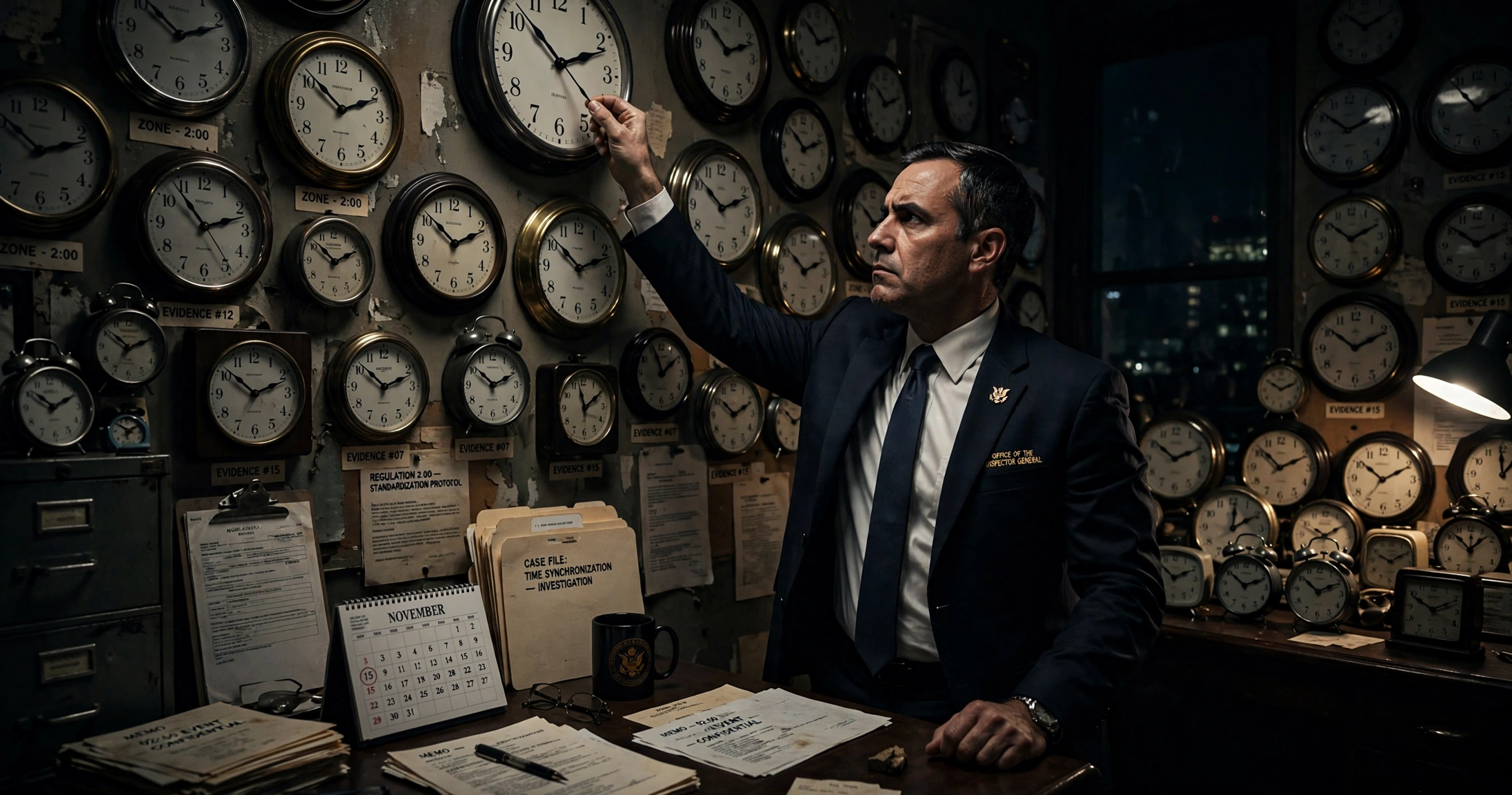
I. The Statute
Section 260a of Title 15 of the United States Code, the advancement-of-time provision of the Uniform Time Act of 1966, states the protocol in language that admits no exception for biology, employment, or the convenience of the subject: “During the period commencing at 2 o’clock antemeridian on the second Sunday of March of each year and ending at 2 o’clock antemeridian on the first Sunday of November of each year, the standard time of each zone established by sections 261 to 264 of this title, as modified by section 265 of this title, shall be advanced one hour and such time as so advanced shall for the purposes of such sections 261 to 264, as so modified, be the standard time of such zone during such period.”1 Every clock in every observing jurisdiction is advanced one hour in March and restored in November, by federal law, at two in the morning, on Sundays chosen by Congress.
The schedule has been amended twice. The Energy Policy Act of 2005, at Section 110, struck “first Sunday of April” and inserted “second Sunday of March,” struck “last Sunday of October” and inserted “first Sunday of November,” extending the intervention by four weeks beginning in 2007.2 Congress also ordered the Secretary of Energy to report to Congress on the impact of the extension on energy consumption, and it reserved, in the text of the statute, a right to revert: “Congress retains the right to revert the Daylight Saving Time back to the 2005 time schedules once the Department study is complete.”2 The legislature built a stopping rule into the protocol and has never used it.
The statute further provides that it is “the express intent of Congress by this section to supersede any and all laws of the States or political subdivisions thereof insofar as they may now or hereafter provide for advances in time or changeover dates different from those specified in this section.”1 No state, county, or city may run the intervention on its own schedule. There is one protocol, and it is federal.
II. The Administrator
The Department of Transportation oversees the Nation’s time zones. The assignment dates to the industry that created the problem: in 1883, the railroads adopted a four-zone system to replace more than 144 conflicting local times, and federal oversight of the zones began in 1918 with the Interstate Commerce Commission. When Congress created the Department of Transportation in 1966, it transferred the responsibility for “regulating, fostering, and promoting widespread and uniform adoption and observance of standardized time” to the new Department.3 The Department’s regulations at 49 CFR Part 71 contain the official listing of the Nation’s time zones, and Section 71.2 restates the advancement mandate verbatim.4
The Department states the scope of its authority plainly. It oversees the Nation’s time zones and the Nation’s uniform observance of Daylight Saving Time. It does not have the power to repeal or change Daylight Saving Time. A state may exempt itself from observing the change by state law, but a state may not choose to remain on Daylight Saving Time year-round; that requires an act of Congress.5 The Department administers an intervention it cannot stop, over subjects who cannot individually leave, with the only exit being a state legislature willing to surrender the hour.
Enforcement is real. Section 260a(c) provides that the Secretary of Transportation “may apply to the district court of the United States for the district in which such violation occurs for the enforcement of this section,” and the court may enforce obedience “by writ of injunction or by other process, mandatory or otherwise.”1 The original 1966 text assigned this power to the Interstate Commerce Commission; the 1983 amendment substituted the Secretary of Transportation.6 The Secretary can also move a community from one time zone to another, but only on a petition from the highest political authorities in the state and only on a finding that the change serves the “convenience of commerce.” The most recent such change was Mercer County, North Dakota, in 2010.3 The Department will relocate your county in time. It will not stop moving it.
The subjects have noticed. The Department’s own Inspector General, in a September 2022 audit, reported that since 2015 at least 45 states have proposed legislation either to change their observance of Daylight Saving Time or to establish permanent standard time.7 Forty-five of fifty states have tried, through their legislatures, to alter their participation in the protocol. The protocol continues.
III. The Protocol
The intervention is administered twice yearly. In 2026, the spring advance occurred at 2:00 a.m. on Sunday, March 8. The fall restoration will occur at 2:00 a.m. on Sunday, November 1, thirty days from the publication of this article. On that morning, every clock in the observing states will be set back one hour, and every subject will receive one additional hour of sleep that the statute does not record as an intervention.
The subject population is the population of the observing states: the entire United States except Hawaii and most of Arizona, plus the territories that observe. The senior author of the largest study of the intervention’s traffic effects put the scale this way: the transition “affects billions of people every year.”8 No consent form has ever been distributed. No subject has ever been asked. Participation is the default, and the default is set by 15 U.S.C. § 260a.
The protocol has two arms, and they are not symmetric. The spring arm removes one hour of sleep. The fall arm adds one. The adverse events cluster in the spring arm, as the literature below documents, while the fall arm is mildly protective or null. This asymmetry is itself a finding: the intervention’s harms track the hour taken, not the hour given.
IV. The Adverse Events
The medical literature on the intervention is extensive, and it reads like the safety section of a trial that has been running for sixty years without a data monitoring committee.
Cardiac events. In the October 30, 2008 issue of the New England Journal of Medicine, researchers at the Karolinska Institute reported on the Swedish acute myocardial infarction registry, which has recorded every heart attack in Sweden since 1987. In the first week of summer time, the number of heart attacks rose by about five percent, concentrated in the first three weekdays after the advance. The authors’ proposed mechanism: “The disruption in the chronobiological rhythms, the loss of one hour’s sleep and the resulting sleep disturbance are the probable causes.”9 The fall restoration, by contrast, was followed by a 1.5 percent reduction in heart attacks for a single day. The net effect of the protocol, the authors concluded, is likely negative, because the spring harm is larger and persists longer than the fall benefit.
Traffic fatalities. The largest study of the intervention’s traffic effects, published January 30, 2020 in Current Biology, analyzed 732,835 fatal motor vehicle accidents recorded in the federal Fatality Analysis Reporting System from 1996 to 2017, across every state that observes the change. The finding: a six percent increase in the risk of fatal traffic accidents in the workweek following the spring advance, translating to 5.7 additional fatal accidents per day from Monday to Friday, or more than 28 deaths per year that the authors state could have been prevented. Over the 22 years studied, that is 626 of 8,958 fatal accidents. When the protocol’s dates moved in 2007 under the Energy Policy Act, the risk moved with them, which the authors took as causal evidence. The study excluded Arizona and Indiana, where the intervention was not consistently applied.8 The senior author, a circadian sleep scientist at the University of Colorado Boulder, stated: “Our study provides additional, rigorous evidence that the switch to daylight saving time in spring leads to negative health and safety impacts. These effects on fatal traffic accidents are real, and these deaths can be prevented.”
Workplace injuries. In the Journal of Applied Psychology in 2009, two Michigan State researchers analyzed U.S. Department of Labor and Mine Safety and Health Administration data around the transitions. After the spring advance, workers slept 40 minutes less, suffered 5.7 percent more workplace injuries, and lost 67.6 percent more workdays to those injuries. The fall restoration produced no significant effects on sleep or injuries.10 The injuries did not merely increase in number. They increased in severity.
Medical errors. A research abstract published in the journal Sleep found an 18 percent increase in medical errors related to human mistakes during the spring-forward period.11 The adverse events of the intervention include errors made by the physicians treating the adverse events of the intervention.
The professional societies have read this literature and rendered their judgment. In 2020, the American Academy of Sleep Medicine published a position statement in the Journal of Clinical Sleep Medicine holding that “an abundance of accumulated evidence indicates that the acute transition from standard time to daylight saving time incurs significant public health and safety risks, including increased risk of adverse cardiovascular events, mood disorders, and motor vehicle crashes,” and concluding that “these seasonal time changes should be abolished in favor of a fixed, national, year-round standard time.”12 The Academy reaffirmed and updated the statement in 2024, citing new evidence: the United States should eliminate seasonal time changes in favor of permanent standard time, which “aligns best with human circadian biology.”13 The physicians who study sleep have reviewed the protocol and recommended its termination.
V. The Control Arm
Every experiment needs a control, and this one has one. Hawaii has never observed the change. Most of Arizona has been exempt since 1968, observing standard time year-round. The territories of American Samoa, Guam, the Northern Mariana Islands, Puerto Rico, and the Virgin Islands do not participate.5 These jurisdictions receive no intervention, file no reports, and experience no spring advance. They are the non-participant cohort.
The researchers treat them as such. The Current Biology traffic study excluded Arizona and Indiana precisely because the intervention was not consistently applied there; including them would have contaminated the comparison.8 The subjects of Hawaii and Arizona are thus doubly excluded: excluded from the intervention by their legislatures, and excluded from the literature by the investigators, because their unaltered sleep would distort the measurement of the altered.
International controls exist as well. In 2019, the European Parliament voted to end the mandatory clock change across the European Union.12 The European Biological Rhythms Society, the European Sleep Research Society, and the Society for Research on Biological Rhythms jointly declared that permanent standard time is the best option for public health. The American protocol continues with its own control arm living inside its own borders, unexamined, on Mountain Standard Time.
VI. The Prior Trial
The protocol has been run at full intensity before, and it was stopped early. During the 1973 energy crisis, Congress passed the Emergency Daylight Saving Time Energy Conservation Act, imposing year-round Daylight Saving Time as a two-year trial. The trial did not last two years. It became, in the words of one of the nation’s foremost experts on the subject, “very unpopular very quickly,” as Americans discovered they disliked going to work and sending their children to school in darkness for months. Congress repealed the law in 1974, before the two-year trial was complete. It also did not reduce energy consumption as intended.14
Consider what this means in the language of the field. A federal intervention on the sleep of the population was designed as a time-limited trial. The trial was terminated early for a combination of futility and subject harm. The intervention was then resumed in its original twice-yearly form, where it has continued for fifty years. No investigator would describe this as anything other than a trial stopped for futility, followed by a resumption of the intervention without a protocol amendment.
VII. The Efficacy Data
The stated purpose of the intervention has always been energy conservation. Congress ordered the measurement. In October 2008, the Department of Energy delivered its Report to Congress on the impact of the extended schedule. The total electricity savings of the four added weeks were about 1.3 terawatt-hours. This corresponds to 0.5 percent per day of extended Daylight Saving Time, or 0.03 percent of electricity consumption over the year, against total 2007 consumption of 3,900 terawatt-hours. In primary energy terms, the savings were 17 trillion Btu, or roughly 0.02 percent of total U.S. energy consumption. The statistical variation on the result was plus or minus 40 percent at a 95 percent level of confidence.15
The savings occurred over a three-to-five-hour period in the evening, offset slightly by small increases in energy use in the early morning hours. There was no evidence that the extension altered gasoline consumption.16 Congress had extended the intervention by four weeks, ordered a study of the extension, received a finding of three one-hundredths of one percent with a 40 percent margin of error, retained its statutory right to revert, and did not revert.
Set the efficacy against the adverse events. The measured benefit of the 2005 extension was 0.03 percent of annual electricity, a figure the Department itself reported with 40 percent uncertainty. The measured harms of the spring advance include a five percent rise in heart attacks, a six percent rise in fatal traffic crashes, a 5.7 percent rise in workplace injuries with 67.6 percent more lost workdays, and an 18 percent rise in human-error medical mistakes. The risk-benefit ratio that 45 CFR § 46.111 requires an Institutional Review Board to evaluate is not close. It is not close in either direction, because one side is measured in hundredths of a percent and the other in whole percentage points of death and injury.
VIII. The Confession
The legislature has confessed its knowledge of the adverse events, repeatedly, on the record.
On March 15, 2022, the United States Senate passed the Sunshine Protection Act, which would make Daylight Saving Time permanent and end the switching, by unanimous consent. Two days later, reporting revealed that many senators had not been aware the request had been made, that legislative staff had vetted it as too benign to bother their bosses with, and that at least one senator, Tom Cotton of Arkansas, was vehemently opposed and would have objected had he been informed.17 The upper chamber of the legislature voted unanimously to alter the protocol for 330 million people without reading the bill. The 117th Congress then ended without the House voting on the measure.
The current Congress has resumed. In May 2026, the House Energy and Commerce Committee voted 48 to 1 in favor of the Sunshine Protection Act. The House Rules Committee took up the measure in July. A rival bill, the Sunshine for Our Kids Act, would instead make standard time permanent nationwide. President Trump has aggressively pushed for an end to the twice-annual switching.18 And the supporters of the change state the adverse events as their own rationale: the time shift, they say, causes sleep disturbances, greater workplace injuries, and more car crashes. The proponents of the protocol cite the protocol’s harms as the reason to amend the protocol, while leaving the existing protocol in place.
The confession is complete. The legislature knows the intervention disrupts sleep, injures workers, and kills drivers, because its members say so when proposing to change it. It has known since at least 2008, when the New England Journal of Medicine published the cardiac data. The intervention continues on the schedule set by 15 U.S.C. § 260a, administered by a Department that states it has no power to repeal it.
IX. The Regulation
The Federal Policy for the Protection of Human Subjects, known as the Common Rule, governs research involving human subjects that is conducted or supported by the federal government. Before such research may proceed, an Institutional Review Board must determine that all of the following requirements are satisfied: risks to subjects are minimized; risks to subjects are reasonable in relation to anticipated benefits; selection of subjects is equitable, with the Board “particularly cognizant of the special problems of research that involves a category of subjects who are vulnerable to coercion or undue influence, such as children”; informed consent will be sought from each prospective subject; informed consent will be appropriately documented; and the research plan makes adequate provision for monitoring the data collected to ensure the safety of subjects.19
Apply the criteria to the protocol. Risks to subjects are not minimized: the spring advance removes an hour of sleep from the entire observing population in a single night, the precise exposure the literature associates with cardiac events, crashes, and injuries. Risks are not reasonable in relation to anticipated benefits: the measured benefit is 0.03 percent of annual electricity with 40 percent uncertainty, and the measured risks include death. Selection of subjects is not equitable: children, who cannot consent and whom the regulation singles out for special protection, are subjected to the intervention; shift workers and residents of the western edges of time zones bear disproportionate risk. Informed consent has not been sought from a single subject, let alone documented. Data monitoring exists only in the form of the peer-reviewed literature, which the investigators publish while the intervention continues unchanged.
No Institutional Review Board has ever approved the time change. No board has ever been asked. The largest federally administered intervention on human physiology in American history, conducted twice a year on the entire observing population, has never once satisfied a single criterion of 45 CFR § 46.111.
X. The Defense
The defense must be stated, because the facts are real and the regulation is real, and an honest investigation states the regulation that cuts against its conclusion before stating the conclusion.
First, the Common Rule defines its own scope. Research, under 45 CFR 46.102(l), means a systematic investigation, including research development, testing, and evaluation, designed to develop or contribute to generalizable knowledge. Daylight Saving Time was not designed to develop generalizable knowledge. It was designed to save energy, and later, to extend the shopping and recreation hours of the American evening. A statute is not a study, and the fact that studies are later conducted about a statute does not retroactively convert the statute into research.
Second, the Common Rule binds federally conducted or supported research. It does not bind legislation. Congress cannot submit an IRB application for a statute, and no Institutional Review Board has jurisdiction over Title 15. The regulatory framework the article invokes was written for investigators, not legislatures.
Third, the adverse-event literature is contested. In 2025, the Duke Clinical Research Institute published what is described as the largest analysis of the question in JAMA Network Open: 168,000 heart attack patients across 1,124 hospitals from 2013 to 2022. The finding was no significant association between the seasonal clock changes and the incidence of heart attacks, in-hospital death from heart attacks, or stroke outcomes. The authors concluded there is no significant association between daylight saving time and the incidence and outcomes of patients presenting with myocardial infarction.20 The cardiac arm of the case against the protocol rests on studies the largest study contradicts.
Fourth, the protocol has a protective arm. The fall restoration reduces heart attack risk slightly for a day, and the workplace-injury researchers found no significant effects from the November change. Half the intervention is benign. The adverse events are concentrated in the spring, which is to say the protocol is harmful for one of its two annual administrations and neutral or mildly helpful for the other.
Fifth, democratic authorization is the consent mechanism for laws. The statute was enacted by Congress, amended by Congress, and administered under congressional oversight. The subjects are citizens, not enrollees. Two states and several territories have exercised the statutory opt-out, which is the mechanism the law provides for withdrawal. Informed consent, in the context of legislation, is representation.
XI. The Conclusion
The defense is stated. It is overruled.
A statute that was explicitly designed as a two-year trial, terminated early for futility and subject harm, and then resumed without amendment, is an experiment that outlived its protocol. The 1974 trial had a beginning, a stated duration, a stopping rule, and an early termination. The current protocol has a beginning, no duration, a statutory right to revert that has never been exercised, and no termination date. The difference between the 1974 trial and the present regime is not the design. It is the oversight.
The reversion clause that Congress wrote into the Energy Policy Act of 2005, retaining “the right to revert the Daylight Saving Time back to the 2005 time schedules once the Department study is complete,” is a data-safety-monitoring clause by another name. The Department’s study is complete. It found three one-hundredths of one percent, plus or minus forty percent. The clause has not been invoked in eighteen years. A monitoring provision that is never consulted is not a safeguard. It is a paragraph.
The generalizable knowledge is being developed, whatever the original intent. The New England Journal of Medicine, Current Biology, the Journal of Applied Psychology, and the Journal of Clinical Sleep Medicine now contain a standing literature on the physiological effects of the federal time protocol, produced by studying its subjects. The knowledge is generalizable. The subjects are the general public. The investigation is systematic. That the legislature did not intend to produce it does not unproduce it, and the Common Rule’s definition turns on design, not on the candor of the designer.
The consent mechanism of representation does not satisfy the regulation the article cites. The regulation requires that informed consent be sought from each prospective subject and documented. No subject has been informed of the cardiac literature, the crash literature, or the injury literature before the 2:00 a.m. intervention. The opt-out requires a state legislature. A child in the western edge of a time zone, whom the regulation names as warranting special protection, cannot petition a legislature. The equitable-selection criterion is not a metaphor. The regulation lists children.
The arithmetic, presented as the Board would require. Risks: a five percent rise in heart attacks in the spring week, a six percent rise in fatal traffic crashes, 5.7 percent more workplace injuries with 67.6 percent more lost workdays, an 18 percent rise in human-error medical mistakes, per the published literature. Benefits: 0.03 percent of annual electricity consumption, with 40 percent statistical uncertainty, and no measured effect on gasoline. Subjects: the observing population of the United States, enrolled by default at birth, withdrawn only by interstate relocation. Consent forms executed: zero. Board approvals granted: zero. Monitoring: the literature, which recommends termination.
The next administration of the intervention is scheduled for 2:00 a.m. on Sunday, November 1, 2026. The subjects will not be informed. The Board will not convene. The clocks will move. Therefore.
Sources
- 15 U.S.C. § 260a, “Advancement of time or changeover dates”: “During the period commencing at 2 o’clock antemeridian on the second Sunday of March of each year and ending at 2 o’clock antemeridian on the first Sunday of November of each year, the standard time of each zone established by sections 261 to 264 of this title, as modified by section 265 of this title, shall be advanced one hour”; subsection (b) preempts state laws; subsection (c) authorizes the Secretary of Transportation to seek enforcement in federal district court. law.cornell.edu ↑ ↑ ↑
- Energy Policy Act of 2005, Pub. L. 109-58, § 110, 119 Stat. 615: struck “first Sunday of April” and inserted “second Sunday of March,” struck “last Sunday of October” and inserted “first Sunday of November”; § 110(c) ordered the Secretary of Energy to report to Congress on energy impact; § 110(d): “Congress retains the right to revert the Daylight Saving Time back to the 2005 time schedules once the Department study is complete.” en.wikisource.org ↑ ↑
- Bureau of Transportation Statistics, “History of Time Zones and Daylight Saving Time.” 1883: railroads adopted the four-zone system, replacing more than 144 local times; 1918: the Interstate Commerce Commission was given time-zone authority; 1966: responsibility transferred to the newly created Department of Transportation, charged with “regulating, fostering, and promoting widespread and uniform adoption and observance of standardized time”; most recent boundary change: Mercer County, North Dakota, 2010, on “convenience of commerce.” bts.gov ↑ ↑
- 49 CFR § 71.2, “Annual advancement of standard time”: “The Uniform Time Act of 1966 (15 U.S.C. 260a(a)), as amended, requires that the standard time of each State observing Daylight Saving Time shall be advanced 1 hour beginning at 2 a.m. on the second Sunday in March of each year and ending at 2 a.m. on the first Sunday in November.” law.cornell.edu ↑
- U.S. Department of Transportation, “Uniform Time.” “The U.S. Department of Transportation (DOT) oversees the Nation’s time zones” and “oversees the Nation’s uniform observance of Daylight Saving Time; however, DOT does not have the power to repeal or change Daylight Saving Time.” States may exempt themselves by law; “States do not have the authority to choose to be on permanent Daylight Saving Time.” Non-observers: Hawaii, most of Arizona, American Samoa, Guam, the Northern Mariana Islands, Puerto Rico, the Virgin Islands. transportation.gov ↑ ↑
- Cornell LII editorial notes to 15 U.S.C. § 260a: 1983, Pub. L. 97-449, substituted “Secretary of Transportation or his” for “Interstate Commerce Commission or its” in subsection (c). law.cornell.edu ↑
- U.S. Department of Transportation, Office of Inspector General, Report ST2022037, September 20, 2022: “Since 2015, at least 45 States have proposed legislation either to change their observance of DST or to establish permanent standard time.” oig.dot.gov ↑
- Medical Xpress, January 30, 2020, reporting Fritz et al., Current Biology: 732,835 fatal accidents from the Fatality Analysis Reporting System, 1996–2017, all DST-observing states; six percent increase in fatal-accident risk in the workweek after the spring transition; 5.7 additional fatal accidents per day Monday–Friday; more than 28 deaths per year; 626 of 8,958 over 22 years potentially preventable; the risk moved with the 2007 date change; Arizona and Indiana excluded; risk higher farther west in a time zone; Vetter: “the DST transition affects billions of people every year” and “Our study provides additional, rigorous evidence that the switch to daylight saving time in spring leads to negative health and safety impacts.” medicalxpress.com ↑ ↑ ↑
- ScienceDaily, October 30, 2008, reporting Janszky & Ljung, New England Journal of Medicine: Swedish acute myocardial infarction registry since 1987; heart attacks rise about five percent in the first week of summer time, concentrated in the first three weekdays; 1.5 percent reduction for one day after the fall return; “The disruption in the chronobiological rhythms, the loss of one hour’s sleep and the resulting sleep disturbance are the probable causes”; net effect likely negative. sciencedaily.com ↑
- Newswise, reporting Barnes & Wagner, Journal of Applied Psychology (2009): U.S. Department of Labor and Mine Safety and Health Administration data; after the March advance, workers slept 40 minutes less, suffered 5.7 percent more workplace injuries, and lost 67.6 percent more workdays to injuries; no significant effects from the November restoration. newswise.com ↑
- Smithsonian Magazine, September 2, 2020: a research abstract published in the journal Sleep found an 18 percent increase in medical errors related to human mistakes during the spring-forward period. smithsonianmag.com ↑
- American Academy of Sleep Medicine, position statement, J Clin Sleep Med 2020;16(10):1781–1784 (Rishi et al.): “An abundance of accumulated evidence indicates that the acute transition from standard time to daylight saving time incurs significant public health and safety risks, including increased risk of adverse cardiovascular events, mood disorders, and motor vehicle crashes”; “these seasonal time changes should be abolished in favor of a fixed, national, year-round standard time.” The statement also notes the European Parliament’s 2019 vote to end the mandatory clock change and the joint European sleep-societies statement favoring permanent standard time. aasm.org ↑ ↑
- Rishi MA, Cheng JY, Strang AR, et al., “Permanent standard time is the optimal choice for health and safety: an American Academy of Sleep Medicine position statement,” J Clin Sleep Med 2024;20(1):121–125: the United States should eliminate seasonal time changes in favor of permanent standard time, which “aligns best with human circadian biology.” pubmed.ncbi.nlm.nih.gov ↑
- WAMC / NPR, March 19, 2022: during the 1973 energy crisis Congress imposed year-round Daylight Saving Time as a two-year trial under the Emergency Daylight Saving Time Energy Conservation Act; it became “very unpopular very quickly” as Americans faced dark winter mornings for work and school; Congress repealed the law in 1974 before the two-year trial was complete; per David Prerau, it did not reduce energy consumption as intended. wamc.org ↑
- U.S. Department of Energy, “Impact of Extended Daylight Saving Time on National Energy Consumption: Report to Congress,” October 2008: total electricity savings of the four added weeks about 1.3 TWh; 0.5 percent per EDST day; 0.03 percent of annual electricity consumption (3,900 TWh in 2007); 17 trillion Btu, roughly 0.02 percent of total U.S. energy consumption; statistical variation plus or minus 40 percent at 95 percent confidence; savings over three-to-five evening hours, small morning increases. akleg.gov ↑
- Live Science: the DOE authors found no evidence that extending daylight saving time altered gasoline consumption. livescience.com ↑
- Wikipedia, “Sunshine Protection Act”: passed the Senate by unanimous consent on March 15, 2022 (Rubio); BuzzFeed News reported two days later that many senators were unaware the request had been made and that Sen. Tom Cotton would have objected had he been informed; the 117th Congress ended without a House vote. en.wikipedia.org ↑
- Reuters, July 13, 2026: the House Energy and Commerce Committee voted 48–1 in May in favor of the Sunshine Protection Act; the House Rules Committee took up the measure; a rival “Sunshine for Our Kids Act” would set permanent standard time; supporters argue the shift causes “sleep disturbances, greater workplace injuries and more car crashes”; President Trump has pushed to end the switching. reuters.com ↑
- 45 CFR § 46.111, “Criteria for IRB approval of research”: the Board must determine that risks to subjects are minimized; risks are reasonable in relation to anticipated benefits; selection of subjects is equitable, with the Board “particularly cognizant of the special problems of research that involves a category of subjects who are vulnerable to coercion or undue influence, such as children”; informed consent will be sought per § 46.116 and documented per § 46.117; and the plan makes adequate provision for monitoring data to ensure subject safety. law.cornell.edu ↑
- Diabetes.co.uk, September 2025, reporting JAMA Network Open (Duke Clinical Research Institute): 168,000 heart attack patients across 1,124 hospitals, 2013–2022; no significant association between the seasonal clock changes and heart attack incidence, in-hospital death, or stroke outcomes. diabetes.co.uk ↑