I. The Rule
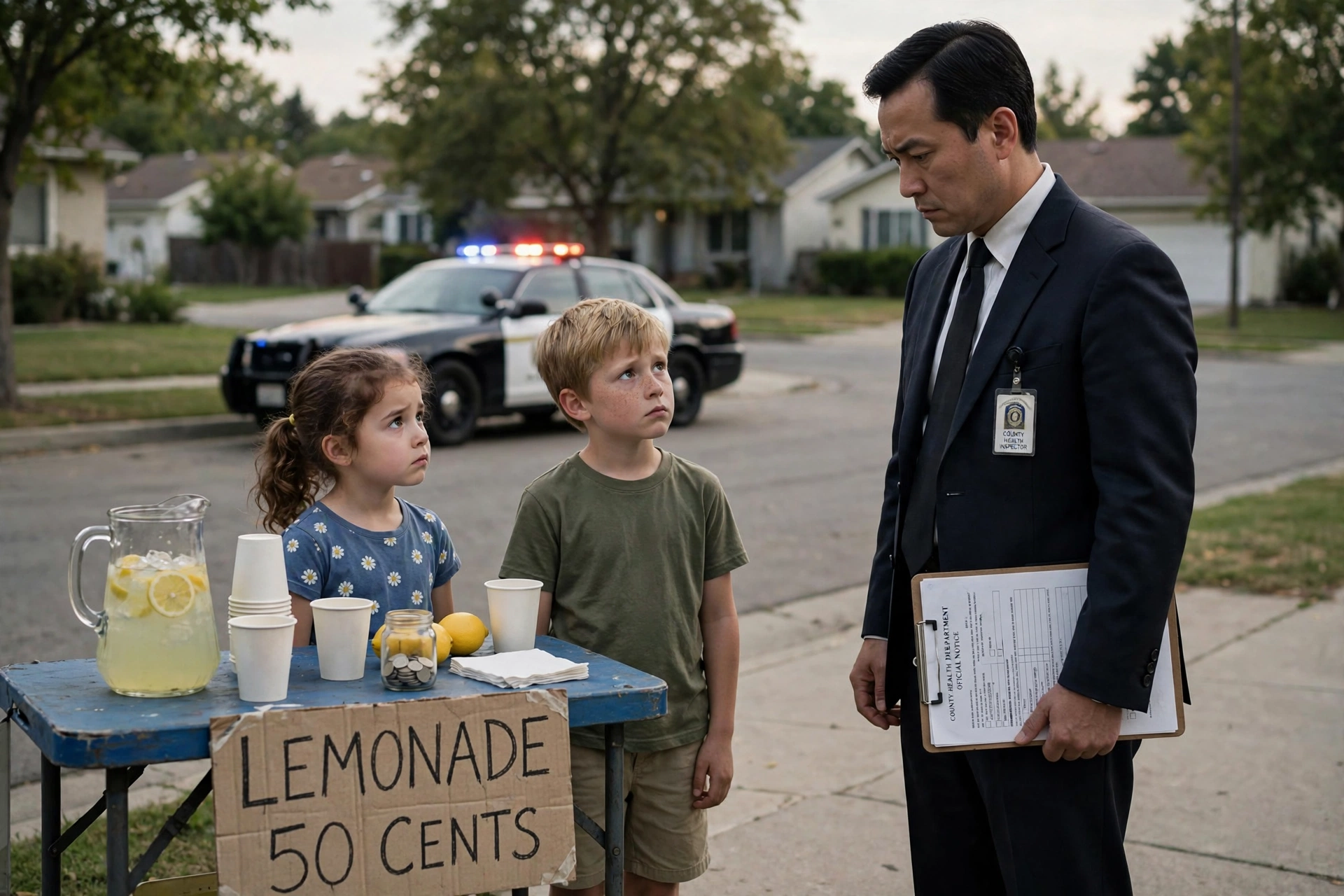
The FDA Food Code, at Section 8-301.11, states the prerequisite for operation in language that admits no exception for age, motive, cuteness, or the presence of a hand-lettered sign: “A PERSON may not operate a FOOD ESTABLISHMENT without a valid PERMIT to operate issued by the REGULATORY AUTHORITY.”1 The Code is a model, but it is the model that the states adopt. Washington’s administrative code reproduces the provision verbatim and cites it as “FDA Food Code 8-301.11.”2 Municipal permit applications cite it by number. It is the law of the land in the only sense that matters to a person operating a food establishment without a permit.
The Code then sets the timeline. Section 8-302.11 requires that the applicant submit the permit application at least thirty calendar days before the date planned for opening the food establishment.3 Thirty calendar days. The application must state whether the establishment is mobile or stationary, temporary or permanent. A folding table on a sidewalk is stationary. A folding table that folds is not a legal category. The Code recognizes two kinds of establishments, and the lemonade stand is both and neither, which is to say it is one of them.
II. The Establishment
The Code defines a food establishment as an operation that stores, prepares, packages, serves, or vends food directly to the consumer, among other things.4 Consider the lemonade stand against this definition. It stores lemonade, in a pitcher. It prepares lemonade, from lemons, sugar, and water, mixed on site. It serves lemonade, into paper cups. It vends lemonade directly to the consumer, for fifty cents a cup, or seventy-five cents, the price varying by jurisdiction and ambition. Every element of the definition is satisfied before the first customer arrives. The stand is not like a food establishment. It is the thing the definition defines.
Nor does the definition contain a de minimis exception, a childhood exception, or a sidewalk exception. The Code knows how to write exceptions. It wrote none for this. A person who operates the stand without the permit violates Section 8-301.11 on the first cup, the tenth cup, and every cup thereafter, because each cup is served by an establishment operating without the permit the section requires.
III. The Temperature Control
The cottage food laws, which liberalized home food production across the country, do not save the stand. Texas House Bill 970, the Texas cottage food law, permits the sale of certain home-produced foods but prohibits the sale of food that requires time or temperature control for safety. When police in Overton, Texas shut down a lemonade stand run by two sisters, ages seven and eight, in 2015, the stated basis was exactly this: lemonade requires refrigeration to prevent bacterial growth, the stand had no health department inspection and no permit, and the operation was therefore illegal.5 The city agreed to waive the $150 peddler’s permit fee. It would not waive the health inspection. The law the police cited was the state health code, and the police chief said so on the record: “We have to follow by the state health guidelines. They have to have a permit if they’re going to do the lemonade stands.”6
The girls had made $25 in the hour before the police arrived. They were raising money for a Father’s Day gift. The stand was illegal anyway. The statute does not ask what the money was for.
IV. The Enforcement Record
The Overton shutdown was not an anomaly. It was a late entry in a documented enforcement history stretching back sixty years.
In 1967, in Satellite Beach, Florida, the Brevard County Health Department closed the sidewalk refreshment stand of Billy Churchill, age eleven, after a neighbor complained that the boy was selling frozen refreshments without a permit.7 In 1975, in Indianapolis, Indiana, a health inspector ordered an Explorer Scout lemonade stand closed at a county fair, ruling that it needed screening, a floor, a roof, and a sliding door, and that the operators had to wear hairnets.8 In 1984, in Coronado, California, police served a formal complaint on three sisters, ages twelve, ten, and five, whose umbrella-shaded stand on a golf course was taking in $60 to $80 a week selling lemonade, cookies, and granola bars to golfers.9 In 1987, in Pacific Grove, California, a policeman ordered nine-year-old Clementine Bonner to close her neighborhood stand for lack of a city sales permit, acting on an anonymous complaint.10
The modern era has kept pace. In 2010, in Multnomah County, Oregon, two officers shut down the lemonade stand of seven-year-old Julie Murphy for operating without a $120 temporary business license, and threatened her with a $500 fine if the stand remained open.11 In 2011, in Coralville, Iowa, city health officials told four-year-old Abigail Krutsinger she needed a permit and a health inspection to sell lemonade to cyclists riding past in the Des Moines Register’s Annual Great Bicycle Ride Across Iowa.12 Also in 2011, in Midway, Georgia, police closed a stand run by three girls, one of them fourteen, for lacking a business license and a peddling permit that could cost $50 to $180 per day.13 In 2018, in Ballston Spa, New York, four separate vendors at the Saratoga County Fair called state health officials to complain about seven-year-old Brendan Mulvaney, who was selling premixed lemonade from his family’s porch for seventy-five cents a cup while the fair vendors charged $7; a health inspector came to the family home and shut the stand down, and officials said the boy would need a $30 temporary food permit.14
Sixty years of enforcement. Four-year-olds, five-year-olds, seven-year-olds, nine-year-olds, eleven-year-olds, twelve-year-olds, fourteen-year-olds, and one post of Explorer Scouts. The regulatory authority has never once found a lemonade stand too small to inspect.
V. The Corporation
In June 2018, Country Time, the powdered lemonade manufacturer owned by Kraft Heinz, launched a campaign called Legal-Ade with the stated premise that “kids across the country are getting busted for operating lemonade stands without a permit.”15 The company offered to pay the fines and permit fees of children fourteen and younger, up to $300 per child, from an initial budget of $60,000, enough to indemnify at least 200 young offenders, and pledged $1 for every retweet toward a fund of up to $500,000.16 A major American food company established, in effect, a legal defense fund for juvenile food-code violators, capitalized at half a million dollars, on the theory that the violations were too numerous to be handled case by case.
The company continued the program into 2019, and reported that as of September 2, 2019, it had awarded $30,000 to parents whose children had been fined by local governments for running unpermitted stands.17 Thirty thousand dollars in documented fines against children, in a single program year, from a single corporate sponsor, covering only the families who applied. The company’s own legalization tracker stated that only sixteen of fifty states permitted lemonade stands to operate without a permit.18 Its slogan: “Whether you live in a red state or blue state, every state can be a yellow state.”
VI. The Legislation
The legislatures have confirmed the baseline by carving the exceptions. In June 2019, Texas Governor Greg Abbott signed House Bill 2847, which prohibits cities, counties, public health officials, and homeowners associations from blocking or requiring permits for the occasional sale of lemonade and other nonalcoholic drinks by anyone under eighteen on private property or in public parks.19 The bill passed the Texas legislature unanimously. The governor signed it on video, holding a glass of lemonade, and said: “We had to pass a law because police shut down a kid’s lemonade stand.”20 The law took effect September 1, 2019. Before that date, the stands were illegal in Texas. The governor said so while signing the bill that made them legal.
Other states have followed, each with its own conditions. Utah’s 2017 law bars local licensing of occasional businesses run mainly by minors. Colorado’s 2019 law permits stands for up to eighty-four days a year, at a sufficient distance from permitted businesses. Georgia’s 2023 law caps annual revenue at $5,000.21 The current count stands at fourteen to sixteen states with express exemptions.22 In the remaining thirty-four to thirty-six states, the permit requirement stands, and the FDA Food Code’s thirty-day application rule with it.
VII. The Scale
The scale of the violation is bounded below by the enforcement record and above by nothing. Every summer, in thirty-four or more states, every lemonade stand that opens without a permit is an unpermitted food establishment under Section 8-301.11. The compliance rate, outside the exemption states, is zero. No child files the application thirty calendar days before opening, because no child knows that Section 8-302.11 exists, and because the stand is conceived on a Saturday morning and open by noon.
The economics are documented at both ends. The Overton sisters made $25 in an hour. The Coronado sisters made $60 to $80 a week. The Saratoga boy undercut the fair vendors by $6.25 a cup, which is why four vendors called the health department. The Midway permit would have cost $50 to $180 per day, against revenues measured in quarters. At these margins, the permit is not a regulatory formality. It is a prohibitive tariff on childhood commerce, set by the regulatory authority and enforced by officers with cruisers.
VIII. The Verdict of the System
No child has ever been criminally prosecuted for operating a lemonade stand. The system’s verdict on the question of prosecution is unanimous and has been for sixty years. But prosecution is not the measure of the violation. The measure of the violation is the permit, and the permit has never been obtained, and the shutdowns have never stopped. The Brevard County Health Department did not prosecute Billy Churchill in 1967. It closed his stand. The Multnomah County officers did not prosecute Julie Murphy in 2010. They threatened her with a $500 fine. The Saratoga County health inspector did not prosecute Brendan Mulvaney in 2018. He came to the family home on a weekend, on a complaint from four vendors, and shut down a seven-year-old.
The distinction between prosecution and enforcement is the distinction the system itself draws. It does not jail the operators. It closes the establishments. The establishments keep opening.
IX. The Confession
The strongest evidence for the conclusion is the behavior of the institutions that know the law best. A legislature does not pass a unanimous bill to legalize conduct that is already legal. Governor Abbott did not sign House Bill 2847 on video, holding lemonade, because Texas children were already permitted to sell lemonade. He signed it because, in his words, police shut down a kid’s lemonade stand, and the stand was illegal until the law he was signing took effect.
A corporation does not capitalize a $500,000 legal defense fund for conduct that is lawful. Country Time’s Legal-Ade program is a corporate legal reserve for juvenile food-code violations, administered through an application process requiring a photograph of the fine. Thirty thousand dollars in documented fines in one program year is not a marketing premise. It is a claims history.
And a health inspector does not order screening, a floor, a roof, a sliding door, and hairnets for an Explorer Scout lemonade stand at a county fair unless the stand is, in the inspector’s professional judgment, a food establishment subject to the Code. The inspector in Indianapolis in 1975 was not confused. He was applying the definition.
X. The Defense
The defense must be stated, because the facts are real and the law is real, and an honest investigation states the law that cuts against its conclusion before stating the conclusion.
First, enforcement discretion. Health departments and police overwhelmingly decline to act against lemonade stands. The shutdowns make national news precisely because they are rare, absurd, and newsworthy, which is another way of saying they are not the norm. A regulatory regime that declines to enforce itself against its most numerous violators is a regime that has, in practice, repealed itself.
Second, the science. Lemonade has a pH of roughly two to three, well below the 4.6 threshold at which pathogenic bacteria grow. The Texas rationale that lemonade “requires time or temperature control” is the law’s rationale, stated by a police chief on television, not the microbiology’s. The cottage food statutes were written for shelf-stable goods, and lemonade is shelf-stable in every sense that matters to a pathogen.
Third, the path to compliance is trivial where it exists. Temporary food establishment permits cost $25 to $30 in many jurisdictions, require no thirty-day lead time in practice, and come with rules a child could follow. The Code’s thirty-day rule is honored in the breach for every church bake sale in America, and nobody suggests the bake sales are criminal enterprises.
Fourth, the trend of the law. Fourteen to sixteen states have now expressly exempted minors’ stands, and the number grows with each legislative session. The arc of the food code bends toward lemonade.
Fifth, the verdict of time. Sixty years of stands, millions of cups, zero prosecutions. That is the legal system’s own statement of what the statute covers, written in the absence of indictments.
XI. The Conclusion
The defense is stated. It is overruled.
The Code does not know the operator’s age. Section 8-301.11 says “a PERSON may not operate,” and a seven-year-old is a person. The Code does not contain a cuteness exception, a Saturday-morning exception, or a fifty-cents-a-cup exception. It contains a thirty-day application rule, and no lemonade stand in the history of the Republic has opened on a thirty-day regulatory timeline, because the stand is conceived at breakfast and serving by noon, which is twenty-nine days and change short of compliance.
Discretion is not a defense the Code recognizes. That inspectors usually look the other way does not amend Section 8-301.11, any more than a speed trap’s mercy amends the speed limit. The pH of lemonade does not amend it either. The statute classifies by operation, not by acidity, and the operation is storing, preparing, serving, and vending food directly to the consumer.
The exemptions are confessions. Texas passed House Bill 2847 unanimously because the stands were illegal without it. Fifteen exemptions are fifteen admissions that the baseline rule covers the conduct, in the thirty-four states where no exemption exists and the thirty-day rule still runs. Country Time’s half-million-dollar fund is not a marketing stunt that happens to involve the law. It is a loss reserve, priced at $300 per child, against a liability the company’s lawyers evidently consider real enough to insure.
The arithmetic, presented as maxima. Thirty-four states where the permit is required. Sixty years of documented enforcement against operators aged four to fourteen. A corporate claims history of $30,000 in a single program year from one sponsor. A statutory application deadline of thirty calendar days that no stand has ever met. Prosecutions to date: zero. Permits obtained to date: zero. The compliance rate is zero, and the operation runs every summer.
The largest unpermitted food service operation in American history does not have a commissary, a commissary agreement, or a certified food manager. It has a folding table, a pitcher, a hand-lettered sign, and operators who cannot yet drive to the health department. Therefore.
Sources
- FDA Food Code 2022, § 8-301.11: “A PERSON may not operate a FOOD ESTABLISHMENT without a valid PERMIT to operate issued by the REGULATORY AUTHORITY.” staging.fsnqs.com ↑
- Washington Administrative Code 246-215-08300, reproducing FDA Food Code 8-301.11 verbatim: “A PERSON may not operate a FOOD ESTABLISHMENT without a valid PERMIT to operate issued by the REGULATORY AUTHORITY.” lawfilesext.leg.wa.gov ↑
- FDA Food Code 2022, § 8-302.11: “An applicant shall submit an application for a PERMIT at least 30 calendar days before the date planned for opening a FOOD ESTABLISHMENT.” webarchive.library.unt.edu ↑
- FDA Food Code, Chapter 1 definitions: “Food establishment” means an operation that “stores, prepares, packages, serves, vends, or otherwise provides FOOD for human consumption,” including operations that relinquish possession of food to a consumer directly. webarchive.library.unt.edu ↑
- 105.7 The Hawk, June 2015: Overton, Texas police shut down the lemonade and kettle corn stand of sisters Andria Green, 8, and Zoey Green, 7; the town waived the $150 peddler’s permit fee but required county health department licensing because lemonade requires temperature control under Texas House Bill 970, the cottage food law. 1057thehawk.com ↑
- The Free Thought Project, June 2015: Overton Police Chief Clyde Carter: “We have to follow by the state health guidelines. They have to have a permit if they’re going to do the lemonade stands.” thefreethoughtproject.com ↑
- Gizmodo, July 2015: in 1967 in Satellite Beach, Florida, the Brevard County Health Department closed the sidewalk refreshment stand of eleven-year-old Billy Churchill after a neighbor complained he was selling frozen refreshments without a permit. gizmodo.com ↑
- Gizmodo, July 2015: in 1975 in Indianapolis, Indiana, a health inspector ordered an Explorer Scout lemonade stand closed at a county fair, ruling it needed screening, a floor, a roof, and a sliding door, and that the operators had to wear hairnets. gizmodo.com ↑
- Gizmodo, July 2015: in 1984 in Coronado, California, police served a formal complaint on three sisters, ages twelve, ten, and five, whose umbrella-shaded stand on a golf course was taking in $60 to $80 a week. gizmodo.com ↑
- Gizmodo, July 2015: in 1987 in Pacific Grove, California, a policeman ordered nine-year-old Clementine Bonner to close her stand for lack of a city sales permit, on an anonymous complaint. gizmodo.com ↑
- TTIP Watch, 2011: in August 2010 in Multnomah County, Oregon, two officers shut down seven-year-old Julie Murphy’s lemonade stand for lacking a $120 temporary business license and threatened a $500 fine if it remained open. ttipwatch.net ↑
- TTIP Watch, 2011: in 2011 in Coralville, Iowa, health officials told four-year-old Abigail Krutsinger she needed a permit and health inspection to sell lemonade to RAGBRAI cyclists. ttipwatch.net ↑
- TTIP Watch, 2011: in 2011 in Midway, Georgia, police closed a stand run by three girls for lacking a business license and peddling permit costing $50 to $180 per day. ttipwatch.net ↑
- Reason, August 1, 2018: in Ballston Spa, New York, four Saratoga County Fair vendors complained to state health officials about seven-year-old Brendan Mulvaney selling premixed lemonade from his porch for 75 cents a cup against the fair’s $7; an inspector came to the home and shut the stand down, requiring a $30 temporary food permit. reason.com ↑
- Reason, June 7, 2018: Country Time launched the Legal-Ade campaign on the premise that “kids across the country are getting busted for operating lemonade stands without a permit.” reason.com ↑
- Reason, June 7, 2018: Legal-Ade covered fines and fees up to $300 per child age fourteen or younger, from a $60,000 budget covering at least 200 children, with $1 per retweet pledged toward a fund of up to $500,000. reason.com ↑
- The Hayride, October 2019: as of September 2, 2019, Country Time had awarded $30,000 to parents whose children were fined for running unpermitted stands. thehayride.com ↑
- ValueWalk, July 2020: Country Time’s legalization tracker stated that only sixteen of fifty states allowed lemonade stands to operate without a permit. valuewalk.com ↑
- ABA Journal, June 13, 2019: Texas Governor Greg Abbott signed House Bill 2847, banning cities, counties, public health officials, and homeowners associations from blocking or requiring permits for occasional sales of lemonade and other nonalcoholic drinks by anyone under eighteen on private property or in public parks; the bill passed unanimously. abajournal.com ↑
- Reason, June 12, 2019: Governor Abbott, signing the bill on video with a glass of lemonade: “We had to pass a law because police shut down a kid’s lemonade stand.” The law took effect September 1, 2019. reason.com ↑
- Sweekr lemonade stand guide: Utah (2017) bars local licensing of occasional minor-run businesses; Colorado (2019) permits stands up to eighty-four days a year at a sufficient distance from permitted businesses; Georgia (2023) caps annual revenue at $5,000. sweekr.com ↑
- Greatest Gift / ProfitableVenture: fourteen to fifteen states have passed laws allowing minors to operate lemonade stands without permits; in the remaining thirty-five to thirty-six states, permits are required. profitableventure.com ↑