I. The Prohibition
Section 2511 of Title 18, the Wiretap Act, provides that any person who “intentionally intercepts, endeavors to intercept, or procures any other person to intercept or endeavor to intercept, any wire, oral, or electronic communication” violates federal law.1 The prohibition was enacted as Title III of the Omnibus Crime Control and Safe Streets Act of 1968, and it has been on the books for fifty-eight years.
Note what the prohibition does not require. It does not require that the interceptor be the government. It does not require that the interception serve a criminal purpose. It does not require that the communication be important, or interesting, or related to anything at all. It requires an intentional interception of an oral communication, full stop.
II. The Penalty Schedule
The Department of Justice states the penalty plainly: “The basic penalty provision for the intentional interception of a wire, oral, or electronic communication is five years imprisonment and a fine under Title 18, United States Code.”2 Five years per violation. The Hobbs Act, recently examined in these pages, carries twenty years; the Wiretap Act carries five, per interception, and interceptions at a doorbell occur by the dozen per day.
The criminal penalty is not the only exposure. Section 2520 provides a civil action for any person whose communication is intercepted, with statutory damages of “whichever is the greater of $100 a day for each day of violation or $10,000,” plus punitive damages and attorney’s fees.3 The floor, not the ceiling, is ten thousand dollars per violation.
III. The Device
The device began as Doorbot. In 2013, inventor Jamie Siminoff pitched it on the television program Shark Tank, seeking $700,000 for ten percent of the company at a $7 million valuation; the sharks passed, with one exception, and Siminoff rejected the single offer extended.4 He rebranded the company as Ring. In February 2018, Amazon acquired it for more than $1 billion, according to reports citing Reuters.5 The garage project that could not hear its own doorbell became a subsidiary of the largest retailer on earth.
The current product line carries a built-in microphone, two-way talk with noise cancellation, and recording modes that include Audio and Motion Detection, meaning the device captures sound whenever its sensor registers movement, whether or not anyone presses the button.6 The microphone is not an accessory. It is listed on the specification sheet between the camera resolution and the battery capacity, which is where a product lists the things it is for.
IV. The Interception
Section 2510 defines the operative verb. “Intercept” means “the aural or other acquisition of the contents of any wire, electronic, or oral communication through the use of any electronic, mechanical, or other device.”7 A video doorbell acquires the aural contents of conversations on the porch through an electronic device. That is not an analogy to the definition. It is the definition, with the product name filled in.
The device does not distinguish the homeowner from the visitor, the courier from the canvasser, or the argument from the greeting. It acquires whatever the porch produces, stores it in the cloud, and notifies the owner that an event has occurred. The event is a conversation. The acquisition is aural. The statute has a word for this, and the word is defined in the same chapter as the prohibition.
V. The Communication
Not every utterance qualifies. Section 2510 defines an “oral communication” as “any oral communication uttered by a person exhibiting an expectation that such communication is not subject to interception under circumstances justifying such expectation.”8 Two elements: the exhibition of the expectation, and circumstances justifying it.
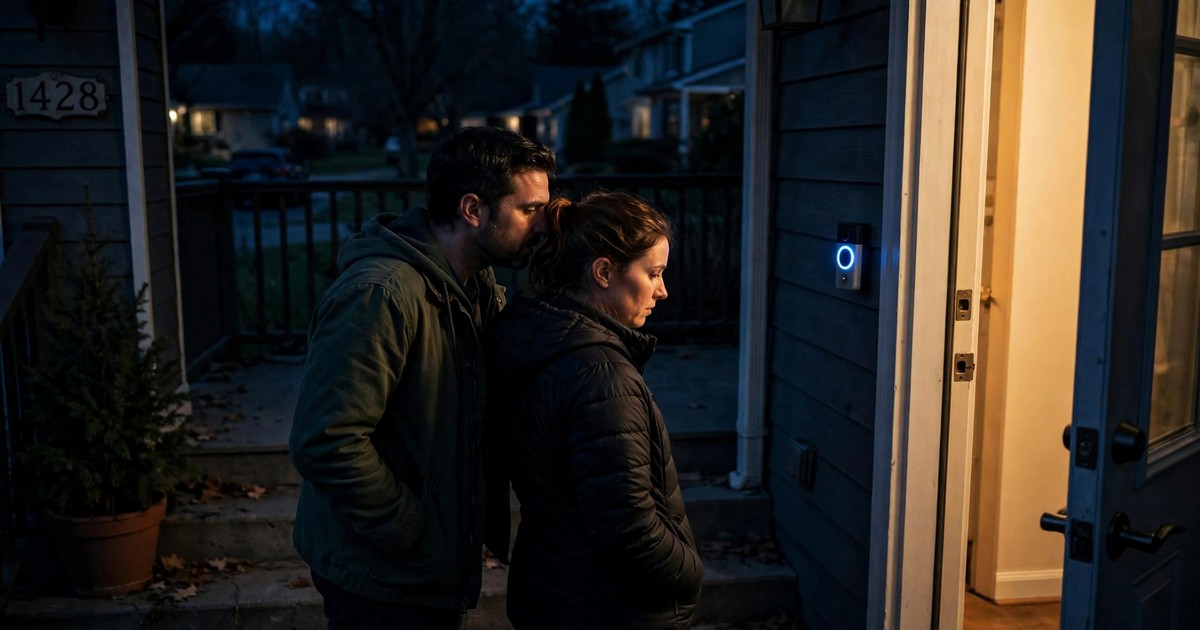
Consider two people quarreling in low tones on a porch at one in the morning. They have lowered their voices. They have chosen the porch, not the sidewalk, precisely because the porch is the part of the property where the activity of home life extends. They exhibit the expectation in the statute’s own words: they behave as people who believe they are not being intercepted. The Supreme Court has held that the front porch is “the classic exemplar of an area to which the activity of home life extends” and that the curtilage is “part of the home itself for Fourth Amendment purposes.”9 The highest court in the land regards the porch as the home. The microphone regards it as a recording studio.
The states have their own vocabulary for the same idea. California prohibits the recording of “confidential communications” without the consent of all parties, and a low-voiced conversation between two people on a residential porch at night is the textbook instance of what the statute describes.10
VI. The Intent
The statute requires that the interception be intentional. This element is satisfied the way most elements are satisfied in this investigation: by the deliberate conduct of the operator.
The owner purchases the device, mounts it beside the door, aims it at the porch, connects it to the home network, powers it, and configures it to record on motion. Every step is deliberate. The interception that follows is not an accident of the installation; it is the purpose of the installation. The statute asks whether the interception was intentional, not whether the interceptor could recite the statute. A person who buys a microphone, points it at a porch, and leaves it running has intentionally acquired the aural contents of the porch, which is the thing the statute prohibits.
VII. The States
Federal law sets the floor. Twelve states build above it: California, Connecticut, Delaware, Florida, Illinois, Maryland, Massachusetts, Montana, New Hampshire, Oregon, Pennsylvania, and Washington require the consent of all parties before a conversation may be recorded.11 In those states, recording a conversation without every participant’s consent is a crime, in some a felony, and several authorize civil suits by the recorded parties.
The doorbells do not check the state. They record in all fifty. A device mounted in Sacramento acquires the same audio as a device mounted in Reno, but only one of those acquisitions occurs in a jurisdiction where every party must consent. The hardware is national. The consent regimes are local. The mismatch is total.
VIII. The Scale
Parks Associates reports that twenty-two percent of American internet households now own a video doorbell, and that thirty percent of American households, almost thirty-four million of them, own a smart camera or a video doorbell.12 A separate Parks Associates release puts video doorbell ownership at twenty percent of households.13 Taking the conservative floor of twenty million devices, and assuming each device acquires the aural contents of at least one oral communication per day, a minimum given that motion-triggered devices record dozens of events daily, the enterprise performs 7.3 billion interceptions per year.
Each interception carries five years. Each violation carries a statutory civil floor of $10,000. The devices have no licenses, because no licenses exist. No federal agency issues doorbell wiretap permits. The entire installed base operates on the honor system, and the honor system has never once been tested in court.
IX. The Enforcement Record
On May 31, 2023, the Federal Trade Commission settled charges against Ring for $5.8 million, alleging that the company gave every employee, as well as hundreds of Ukraine-based third-party contractors, full access to every customer video, regardless of whether the employee needed that access to perform his job.14 The Commission alleged that on at least two occasions, employees improperly accessed private videos; in one case, an employee viewed videos of at least eighty-one female users, spying for months, undetected by Ring.15 The complaint further alleged that hackers exploited the company’s lax security to take over cameras, taunt children, sexually proposition people, and threaten a family with harm if they did not pay a ransom.16
Read that record the way a prosecutor would read it. The federal government has already determined, as a matter of enforcement, that this surveillance apparatus was operated unlawfully: unrestricted access to every customer’s recordings, employees spying on women for months, strangers seizing control of bedroom cameras to taunt children. The government fined the company and left the operators in place. The devices are still on the doorframes. The microphones are still on.
Against this, the criminal enforcement record for the operators is a null set. In fifty-eight years of the Wiretap Act, no doorbell owner has ever been prosecuted under Section 2511 for recording a porch conversation. Not one.
X. The Defense
The defense must be stated, because the facts are real and the law is real, and an honest investigation states the law that cuts against its conclusion before stating the conclusion.
First, the expectation must be “under circumstances justifying such expectation.” Conversations on a front porch, audible to anyone on the sidewalk, do not carry a justifiable expectation of non-interception. Recording-law surveys note that consent requirements apply only where the parties have a reasonable expectation of privacy, for example not in a public place.17 A visitor speaking at full volume on a doorstep knows the neighborhood can hear. The midnight whisperers are the edge case, not the rule.
Second, one-party consent. Section 2511(2)(d) provides that it is not unlawful to intercept a communication “where such person is a party to the communication or where one of the parties to the communication has given prior consent to such interception.”18 When the homeowner greets the courier, the homeowner is a party, and the recording is lawful under federal law. Most states follow the federal one-party rule. The bulk of what doorbells capture is the homeowner’s own front-door business.
Third, notice. The devices are visible. Many owners post signs. Several state regimes treat notice as sufficient, and Massachusetts, the strictest of the all-party states in some readings, bans only “secret” recordings.19 A doorbell with a glowing ring, mounted at eye level beside the door it guards, is the opposite of a secret.
Fourth, purpose. The devices are marketed and used for home security in the ordinary course of protecting one’s property, not for surreptitious interception. The device ban at Section 2512 targets devices “primarily useful for the purpose of the surreptitious interception” of communications. A doorbell is primarily a doorbell. The microphone serves the doorbell.
Fifth, the verdict of time. Fifty-eight years, tens of millions of devices, billions of recordings, zero prosecutions. That is the legal system’s own statement of what the statute covers, written in the absence of indictments.
XI. The Conclusion
The defense is stated. It is overruled.
The statute asks what the speaker exhibited, not what a court later deems justified. The two people quarreling in low tones on the porch at one in the morning exhibit the expectation in the statute’s own words: they behave as people who believe they are not being intercepted. That the porch faces the street does not make the whisper a broadcast. The Supreme Court calls the porch part of the home itself. The home is where the expectation of non-interception is at its strongest, and the microphone is mounted six inches from the door.
“Intentionally” modifies the act, and the act is deliberate. The device was purchased, mounted, aimed, powered, and configured to acquire the aural contents of the porch, which is what it does, around the clock, by design. Intent is not a mystery here. It is the marketing copy.
One-party consent protects the homeowner’s own conversations. It does not protect the interception of a conversation between two strangers on the steps, neither of whom is the operator, neither of whom consented, both of whom lowered their voices. Notice is not consent in the twelve all-party states, whose statutes demand consent, not awareness. And purpose is not a defense the statute recognizes: Section 2511 contains no home-security exception, no doorbell exception, and no exception for interceptions the operator found convenient.
The Federal Trade Commission has already found, as a matter of federal enforcement, that this surveillance apparatus was operated unlawfully, with unrestricted access to every customer’s recordings and employees spying on women for months. The government punished the company and left the operators in place, which means the only party ever held responsible for the wiretapping was the party that sold the wiretaps.
The arithmetic, presented as maxima. Twenty million devices, one interception per device per day, 7.3 billion interceptions per year of operation, five years per interception: 36.5 billion years of maximum criminal exposure per year of operation, 182.5 billion years within the five years covered by the general federal limitations period. Civil exposure at the statutory floor of $10,000 per violation: $73 trillion per year of operation, more than twice the annual economic output of the United States. Prosecutions to date: zero.
The largest ongoing wiretapping operation in American history does not run from a windowless office. It is bolted to your doorframe, it greets every visitor by name, and it has never once been indicted. Therefore.
Sources
- 18 U.S.C. § 2511(1)(a): “intentionally intercepts, endeavors to intercept, or procures any other person to intercept or endeavor to intercept, any wire, oral, or electronic communication.” tscm.com ↑
- U.S. Department of Justice, Criminal Resource Manual § 1058: “The basic penalty provision for the intentional interception of a wire, oral, or electronic communication is five years imprisonment and a fine under Title 18, United States Code. 18 U.S.C. § 2511(4)(a).” justice.gov ↑
- 18 U.S.C. § 2520(c)(2)(B): “statutory damages of whichever is the greater of $100 a day for each day of violation or $10,000,” plus punitive damages and attorney’s fees. tscm.com ↑
- GeekWire, March 2, 2018: in 2013, founder Jamie Siminoff pitched Doorbot on Shark Tank, seeking $700,000 at a $7 million valuation; Kevin O’Leary made an offer combining a loan and an equity stake, which Siminoff rejected, leaving without an investment; the company later rebranded as Ring. geekwire.com ↑
- TheStreet, February 27, 2018: Amazon acquired Ring, with multiple reports pegging the value at above $1 billion, citing Reuters. thestreet.com ↑
- Ring Video Doorbell specifications: built-in microphone, two-way talk with noise cancellation, and recording modes including Audio, Continuous, Event, Loop, Manual, and Motion Detection. harveynorman.co.nz ↑
- 18 U.S.C. § 2510(4): “‘intercept’ means the aural or other acquisition of the contents of any wire, electronic, or oral communication through the use of any electronic, mechanical, or other device.” tscm.com ↑
- 18 U.S.C. § 2510(2): “‘oral communication’ means any oral communication uttered by a person exhibiting an expectation that such communication is not subject to interception under circumstances justifying such expectation, but such term does not include any electronic communication.” law.justia.com ↑
- Florida v. Jardines, 569 U.S. 1 (2013): the curtilage is “part of the home itself for Fourth Amendment purposes,” and the front porch is “the classic exemplar of an area to which the activity of home life extends.” caselaw.findlaw.com ↑
- California Penal Code § 632 prohibits the recording of “confidential communications” without the consent of all parties. justia.com ↑
- Twelve states require all-party consent to record a conversation: California, Connecticut, Delaware, Florida, Illinois, Maryland, Massachusetts, Montana, New Hampshire, Oregon, Pennsylvania, and Washington. en.wikipedia.org ↑
- Parks Associates, via Xailient whitepaper (2024): twenty-two percent of U.S. internet households own a video doorbell; thirty percent of U.S. households, almost thirty-four million, own a smart camera or a video doorbell. xailient.com ↑
- Parks Associates, via SecurityInfoWatch: twenty percent of U.S. households have a video doorbell. securityinfowatch.com ↑
- TechCrunch, May 31, 2023: Ring agreed to pay $5.8 million to settle FTC charges that it gave every employee, as well as hundreds of Ukraine-based third-party contractors, full access to every customer video, resulting in “dangerously overbroad access and lax attitude toward privacy and security”; the settlement was filed in the U.S. District Court for the District of Columbia. techcrunch.com ↑
- Reuters, May 31, 2023: in one instance in 2017, a Ring employee viewed videos made by at least eighty-one female customers, continuing to spy for months undetected by Ring. reuters.com ↑
- Space Daily (AFP), May 31, 2023: hackers exploited vulnerabilities to access video streams and take control of cameras to taunt children, sexually proposition people, and threaten a family with harm if they did not pay a ransom. spacedaily.com ↑
- Recording-law survey: consent requirements apply only in situations where the parties have a reasonable expectation of privacy, for example not in a public place. justia.com ↑
- 18 U.S.C. § 2511(2)(d): “It shall not be unlawful under this chapter for a person not acting under color of law to intercept a wire, oral, or electronic communication where such person is a party to the communication or where one of the parties to the communication has given prior consent to such interception.” tscm.com ↑
- Massachusetts, Mass. Gen. Laws ch. 272 § 99: the prohibition turns on “secret” recording. en.wikipedia.org ↑