I. The Exclusive Right of Public Performance
Section 106 of the Copyright Act, 17 U.S.C. § 106, enumerates the exclusive rights of the copyright owner. Among them, at § 106(4), is the exclusive right “to perform the copyrighted work publicly.”1 The word “exclusive” does the heavy lifting in the sentence. It means what it says: no one else may do this without the owner’s authorization.
Section 101, 17 U.S.C. § 101, defines what “publicly” means. To perform a work “publicly” means either (1) “to perform or display it at a place open to the public or at any place where a substantial number of persons outside of a normal circle of a family and its social acquaintances is gathered,” or (2) “to transmit or otherwise communicate a performance or display of the work to a place specified by clause (1) or to the public, by means of any device or process, whether the members of the public capable of receiving the performance or display receive it in the same place or in separate places and at the same time or at different times.”2 A café is a place open to the public. This is not a close question. The café knows it is a place open to the public. It has a sign that says so.
Anyone who violates any of the exclusive rights of the copyright owner is an infringer of the copyright, under 17 U.S.C. § 501.3 The remedies available to the copyright owner include, at the owner’s election, statutory damages of “not less than $750 or more than $30,000 as the court considers just” for all infringements with respect to any one work, under 17 U.S.C. § 504(c)(1). Where the court finds the infringement was committed willfully, it may increase the award “to a sum of not more than $150,000.”4 These are per-work figures. A playlist is not one work. A playlist is dozens of works, each carrying its own statutory damage range.
This is the entire legal architecture of the American public performance regime. It was written for concert halls and it applies to espresso bars.
II. The Operator
The branded coffee shop market in the United States now comprises 45,227 outlets, according to World Coffee Portal’s Project Café USA 2026 report, a $58.5 billion segment.5 The overwhelming majority of these establishments play recorded music for their customers throughout business hours. The music is the point. Nobody sits in a silent café. A café without music is a waiting room with better chairs.
The music arrives, in the overwhelming majority of cases, from a consumer streaming service. A survey commissioned by Soundtrack, a licensed commercial music provider, found that an estimated 800,000 business locations in the United Kingdom play music every day, and that 86 percent of those locations play it through regular consumer streaming services: Spotify, Apple Music, YouTube Music, and Amazon Music.6 The American pattern is materially identical. Spotify alone reported 300 million Premium subscribers and 777 million monthly active users as of the second quarter of 2026.7 Somewhere in that subscriber base are the owners of tens of thousands of cafés, each of whom pays approximately twelve dollars a month for what the terms of service describe as personal use, and each of whom uses it for anything but.
The scale of the operation is difficult to overstate. If even one quarter of America’s 45,227 branded outlets streams a consumer playlist to its customers for eight hours a day, the American café sector is performing more copyrighted works per day than every licensed radio station in the country combined, with exactly zero of the paperwork.
III. The Terms on Which the Music Arrives
Spotify’s Terms of Service are unambiguous on the subject. Under the heading “Your rights to use the Spotify Service,” the company grants “limited, non-exclusive, revocable permission to make personal, non-commercial use of the Spotify Service and the Content.”8 The words “personal” and “non-commercial” are not decorative. They are the boundary of the license. The moment the playlist is audible to paying customers, the use is commercial, and the license does not cover it.
A common misconception holds that upgrading to Premium resolves the problem. It does not. Premium removes the advertisements and unlocks offline listening. The license stays personal. Ad-free is not the same as cleared for business.9
Spotify itself recognized the gap. The company launched a commercial product, originally called Spotify for Business, which later became Soundtrack Your Brand, an independent Stockholm-based company founded by former Spotify personnel and built specifically to supply fully licensed music to commercial venues.10 The existence of Soundtrack Your Brand is Spotify’s own admission that its consumer product is not the commercial product. The company that sells you the playlist is telling you, through a separate company, that you are using the wrong product. The café industry has declined the invitation.
IV. The Exemption That Protects the Radio and Abandons the Playlist
Congress anticipated the small establishment that plays background music. Section 110(5) of the Copyright Act, 17 U.S.C. § 110(5), known as the homestyle exemption, provides that the public performance of nondramatic musical works by means of receiving a radio or television transmission is not infringement, provided certain conditions are met.11 For a food service or drinking establishment with less than 3,750 gross square feet of space, excluding customer parking, the exemption applies with no apparent limit on the equipment used. For larger establishments, the performance must be communicated by means of no more than six loudspeakers total, of which no more than four may be located in any one room or adjoining outdoor space. No direct charge may be made to hear the transmission. The transmission may not be further transmitted beyond the establishment. And the transmission itself must be licensed by the copyright owner.12
The exemption has a boundary, and the Congressional Research Service states it in plain language: the exemption “do[es] not authorize an establishment to originate its own broadcasts of copyrighted material. That is, an establishment may play the radio or show a television broadcast without violating copyright law, but the act still does not shield the same business when it plays, for example, CDs protected by the copyright laws.”13
Read that sentence again, because it is the entire case. The same café, the same customers, the same song, the same speakers: played from the radio, it is a lawful exercise of a statutory exemption. Played from Spotify, it is an infringement for which the copyright owner may elect statutory damages of up to $150,000 per work. The statute does not care what the customers hear. It cares how the bits arrived. The lawfulness of the performance turns entirely on whether the café received the song over the air or summoned it from a server. A café that switches from FM radio to a Spotify playlist of the identical songs has moved, in the eyes of federal law, from full compliance to willful infringement, without changing a single audible note.
There is a further condition worth noting. The exemption requires that the transmission being received be “licensed by the copyright owner of the work so publicly performed or displayed.”14 A café that tunes its radio to an unlicensed pirate station therefore loses the exemption as well. The statute is thorough. It has contemplated the pirate. It has simply not contemplated the playlist.
V. The Enforcement Record
The performing rights organizations enforce these rights against venues with the regularity of a metronome. The cases are not close calls about edge technologies. They are about ordinary establishments playing ordinary music.
In 2026, Broadcast Music, Inc. (BMI) sued the Ottobar, a Baltimore music venue, over three songs performed at karaoke nights. BMI sent a representative to surveil the venue and record audio to confirm each of the three songs was played. The venue conceded liability. The court awarded slightly over $12,000 in statutory damages plus $6,500 in attorneys’ fees, against BMI’s request for $60,000.15 Three songs. Eighteen thousand five hundred dollars.
In Texas, a federal court awarded $45,000 in statutory damages for fifteen songs performed at karaoke nights in a hotel bar, plus $11,243.36 in attorneys’ costs, after rejecting the manager’s testimony that she believed the karaoke provider was independently licensed. The court found the defendants had been warned repeatedly and “were not innocent infringers.”16
In North Carolina, a federal court found a bar and grill’s infringement willful, noting repeated phone calls, warnings, cease-and-desist letters, and an attempted license application, and awarded approximately $35,000 in statutory damages for seventeen claimed infringements.17
And in the Ninth Circuit, in Range Road Music, Inc. v. East Coast Foods, Inc., the court affirmed a $36,000 statutory damages award, plus more than $160,000 in attorneys’ fees, against the owners of a California restaurant that allowed a musical group to play covers of copyrighted songs and played copyrighted music on a CD player after refusing to negotiate a license with ASCAP.18 The attorneys’ fees exceeded the damages by a factor of four. This is the part of the enforcement record that venue owners tend to discover last.
VI. The Statutory Damages Arithmetic
The arithmetic of § 504(c) deserves to be stated plainly, because the café sector has never done it.
A typical café playlist contains roughly sixty songs. At the statutory minimum of $750 per work, the floor exposure for one playlist is $45,000. At the standard maximum of $30,000 per work, it is $1,800,000. Where the infringement is willful, and a café that has read Spotify’s terms of service has been put on notice in writing, the ceiling is $150,000 per work, for a playlist total of $9,000,000.
These figures are per copyright owner. A single song typically implicates multiple owners, and the performing rights landscape requires separate licenses from each of the licensing societies, ASCAP, BMI, and SESAC, to cover the works owned by their respective members.19 A café that purchases one society’s license has purchased one society’s license. The other three societies’ repertoires remain unlicensed, and their songs continue to play on the same speakers.
A blanket license from a performing rights organization costs a small establishment a few hundred dollars per year. The sector has instead chosen the alternative: zero dollars per year in licensing costs, against a statutory exposure measured in the millions, enforced by organizations that send investigators to record karaoke audio. This is not a loophole. It is a bet, placed daily, by 45,227 outlets, that the investigator is busy elsewhere.
VII. The Broadcaster Classification
The copyright analysis, however, understates the café’s regulatory position. The café is not merely performing works publicly. It is transmitting them by radio.
Section 301 of the Communications Act, 47 U.S.C. § 301, provides that “no person shall use or operate any apparatus for the transmission of energy or communications or signals by radio … except under and in accordance with a license granted under the provisions of this chapter.”20 The prohibition is categorical. It does not exempt short distances. It does not exempt lattes.
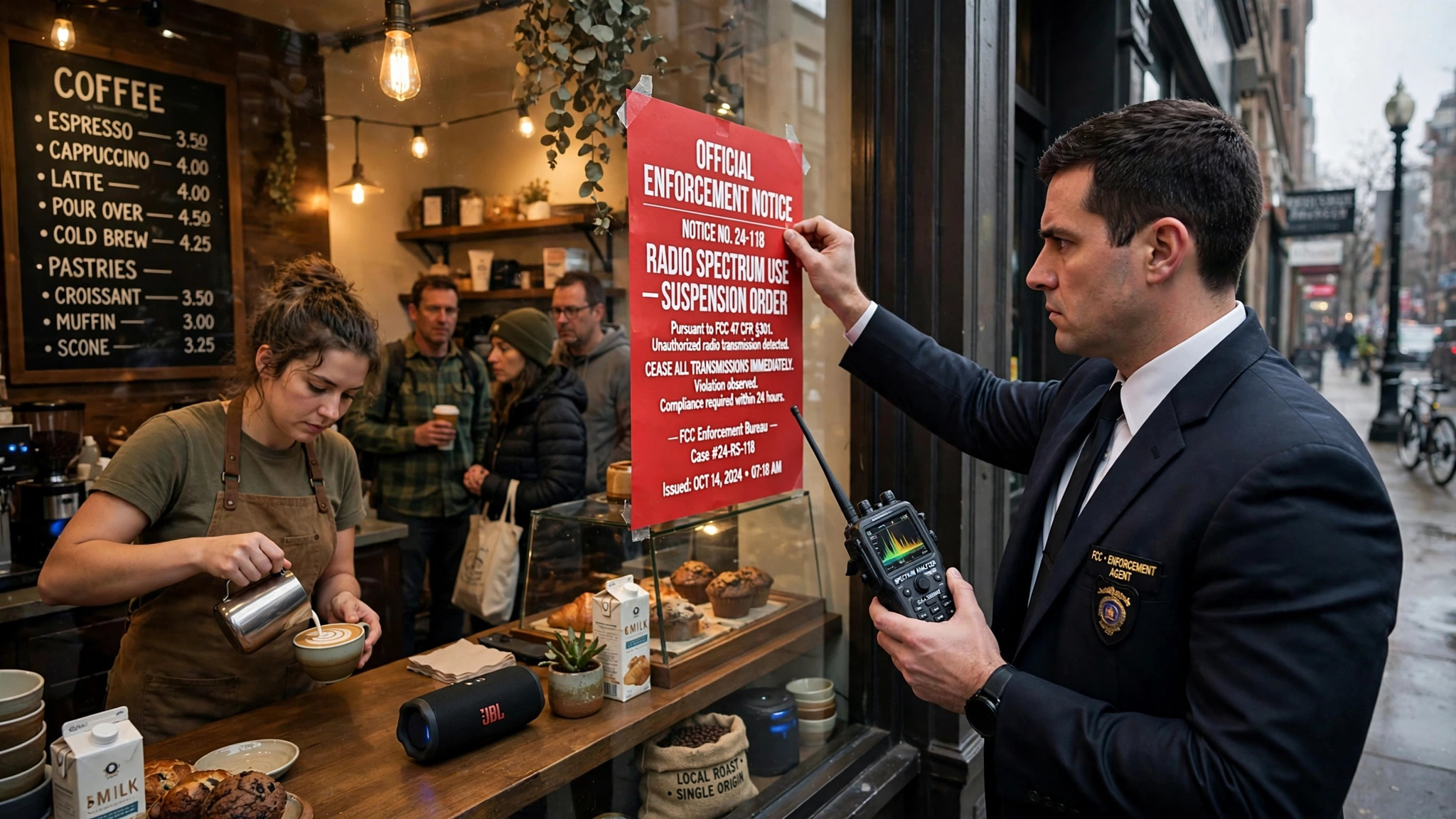
The modern café sound system is a radio network. The phone on the counter pairs with a Bluetooth speaker, and the performance travels from one device to the other as radiofrequency energy. Bluetooth operates in the 2.4 GHz industrial, scientific, and medical band, using frequency-hopping spread-spectrum radio signals.21 The FCC classifies Bluetooth transmitters as intentional radiators operating under Part 15 of its rules, specifically 47 CFR § 15.247 for frequency-hopping systems.22 The café is therefore operating apparatus for the transmission of energy by radio. It holds no license for this apparatus. No café has ever held a license for this apparatus.
Note the vocabulary of the Copyright Act itself. Section 101 defines a “transmission program” as “a body of material that, as an aggregate, has been produced for the sole purpose of transmission to the public in sequence and as a unit.”23 That is a playlist. The statute’s definition of a transmission program describes, with legal precision, the Spotify queue currently running in every café in America: a body of material, in sequence, as a unit, transmitted to the public. The café originates a transmission program and communicates it to the public by means of a radio device. Under the combined reading of the two statutes, the café is not a music venue. It is a broadcast station.
An unlicensed broadcast station is what the Commission calls pirate radio. The Preventing Illegal Radio Abuse Through Enforcement Act, the PIRATE Act, enacted January 24, 2020, and codified at 47 U.S.C. § 511, authorizes the Commission to impose forfeitures of up to $100,000 for a single violation, up to a total of $2 million, against any person who willfully and knowingly engages in pirate radio broadcasting.24 In fiscal year 2024, the Commission issued 18 Notices of Apparent Liability and six Forfeiture Orders in pirate radio matters, with penalties totaling more than $5 million.25 Every one of those enforcement actions targeted a transmitter on the AM or FM bands. None targeted a café. The Commission’s enforcement bureau sweeps the dial for unlicensed stations while 45,227 unlicensed transmission operations run eight hours a day in plain sight, each of them originating transmission programs to the public by radio, each of them holding no license for the apparatus.
VIII. The Part 15 Parenthetical
There is, as there always is, an escape hatch. The PIRATE Act defines pirate radio broadcasting as the unlicensed transmission of communications on the AM and FM broadcast bands, and the definition expressly “does not include unlicensed operations in compliance with part 15 of title 47, Code of Federal Regulations.”26 The café’s Bluetooth speaker is a Part 15 intentional radiator. It is therefore excluded from the definition of pirate radio by a parenthetical.
Consider what this means. The café is saved from classification as a pirate radio station not by a license, which it does not hold, not by an exemption for small businesses, which does not exist in the Communications Act, and not by any affirmative determination that its operation is lawful, but by a definitional carve-out for low-power devices that Congress inserted to avoid criminalizing baby monitors. The café transmits copyrighted works to the public by radio without a copyright license, without a broadcast license, and without an equipment authorization in its own name, and it is lawful only in the sense that the statute’s definition stops one clause short of reaching it.
There is a second escape hatch, and it is even narrower. The Copyright Act’s definition of “proprietor,” the party liable for performances at an establishment, provides that no owner or operator of an FCC-licensed radio station, and no commercial subscription music service, “shall under any circumstances be deemed to be a proprietor.”27 The café owner is not a licensed broadcaster and not a commercial subscription music service. The statute therefore deems the café owner exactly what the café owner is: the proprietor. The provision that excludes broadcasters from liability confirms, by its own negative implication, that the establishment playing the music is the liable party. The law has looked directly at the café, distinguished it from an actual broadcaster, and assigned it the bill.
IX. Conclusion
The Copyright Act gives every copyright owner the exclusive right to perform the work publicly. The Act defines a café as a public place and a playlist as a transmission program. Spotify’s license covers personal, non-commercial use only. The homestyle exemption covers the radio and stops at the playlist. The courts have priced the violation at $12,000 for three songs. The statute prices a sixty-song playlist at up to $9,000,000. The Communications Act prohibits operating radio transmitting apparatus without a license. The café’s speakers are radio transmitting apparatus. The café holds no license.
The industry’s position, reduced to its essentials, is that the lawfulness of playing music for customers depends on which button the barista pressed: the FM tuner, lawful; the Spotify app, infringement. The same song. The same speakers. The same customers. Different button, different federal statute, different seven-figure exposure.
The performing rights organizations have investigators. The Commission has enforcement sweeps. The café has a playlist, a Bluetooth speaker, and a sign that says it is open to the public.
Ergo.
Sources
- 17 U.S.C. § 106(4), exclusive rights in copyrighted works, including the exclusive right “to perform the copyrighted work publicly.” govregs.com ↑
- 17 U.S.C. § 101, definitions of “publicly,” “perform,” “transmit,” and “transmission program.” law.justia.com ↑
- 17 U.S.C. § 501(a), infringement of copyright: “Anyone who violates any of the exclusive rights of the copyright owner as provided by sections 106 through 122 … is an infringer of the copyright.” congress.gov ↑
- 17 U.S.C. § 504(c)(1)–(2). Statutory damages of not less than $750 nor more than $30,000 per work; up to $150,000 per work for willful infringement. Congressional Research Service summary. congress.gov ↑
- World Coffee Portal, Project Café USA 2026: the US branded coffee shop market reached 45,227 outlets with $58.5 billion in sales. worldcoffeeportal.com ↑
- Soundtrack (formerly Soundtrack Your Brand), survey of 1,070 UK business executives, reported September 23, 2026: an estimated 800,000 UK business locations play music daily; 86% play it through consumer streaming services including Spotify, Apple Music, YouTube Music, and Amazon Music. musically.com ↑
- Spotify Technology S.A., Q2 2026 results: 300 million Premium subscribers, 777 million monthly active users. demandsage.com ↑
- Spotify Terms of Service, “Your rights to use the Spotify Service”: “we grant to you limited, non-exclusive, revocable permission to make personal, non-commercial use of the Spotify Service and the Content.” github.com (terms archive) ↑
- See, e.g., Horra Music, “Can you use Spotify in a restaurant or shop?”: “Whether your plan is free or Premium, Spotify is licensed for personal use, not business use”; “Premium removes ads and unlocks offline listening, but the licence stays personal.” horra.music ↑
- Soundtrack Your Brand, founded in Stockholm in 2013, initially launched as a joint venture with Spotify called “Spotify for Business”; now an independent B2B licensed music streaming company. dealroom.co ↑
- 17 U.S.C. § 110(5)(B), the homestyle exemption for food service and drinking establishments. codes.findlaw.com ↑
- Id. § 110(5)(B)(i)–(v): under 3,750 gross square feet (excluding customer parking) with no equipment limit; 3,750 or more with no more than 6 loudspeakers total and no more than 4 in any one room; no direct charge; no further transmission beyond the establishment; the transmission must be licensed by the copyright owner. codes.findlaw.com ↑
- Congressional Research Service, “Copyright Law’s ‘Small Business Exception’: Public Performance Exemptions for Certain Establishments,” RS21107: the exemptions “do not authorize an establishment to originate its own broadcasts of copyrighted material. That is, an establishment may play the radio or show a television broadcast without violating copyright law, but the act still does not shield the same business when it plays, for example, CDs protected by the copyright laws.” everycrsreport.com ↑
- 17 U.S.C. § 110(5)(B)(v). codes.findlaw.com ↑
- The Baltimore Banner, “Baltimore’s Ottobar to pay $18,500 over unlicensed karaoke songs,” June 2026: BMI sued over three songs confirmed by an investigator’s audio surveillance; the venue conceded liability; the court awarded slightly over $12,000 in statutory damages plus $6,500 in attorneys’ fees. thebanner.com ↑
- TorrentFreak, “Bar Hit With $45,000 Fine for ‘Pirated’ Karaoke Songs,” July 2013: Texas federal court awarded $45,000 in statutory damages for 15 infringements plus $11,243.36 in attorneys’ costs; the court rejected the innocent-infringer defense, finding the defendants had been warned repeatedly. torrentfreak.com ↑
- Broad. Music, Inc. v. River City Bar & Grill LLC, No. 5:13-cv-00046 (W.D.N.C.): infringement found willful after repeated notices and cease-and-desist letters; approximately $35,000 in statutory damages for seventeen claims. casemine.com ↑
- Range Road Music, Inc. v. East Coast Foods, Inc., 9th Cir., No. 10-55691 (Feb. 16, 2012): Ninth Circuit affirmed $36,000 in statutory damages and over $160,000 in attorneys’ fees against a California restaurant that played copyrighted music after refusing to negotiate an ASCAP license. news.bloomberglaw.com ↑
- See, e.g., IP Trademark Attorney, “Copyright Attorneys Sue Redondo Beach Restaurant”: “a license from each of the following licensing societies must be obtained to cover the music owned by the various recording companies: ASCAP … BMI … SESAC.” iptrademarkattorney.com ↑
- 47 U.S.C. § 301: “No person shall use or operate any apparatus for the transmission of energy or communications or signals by radio … except under and in accordance with a license granted under the provisions of this chapter.” law.cornell.edu ↑
- Bluetooth operates in the 2.4 GHz ISM band using frequency-hopping spread-spectrum radio signals; Bluetooth and Wi-Fi both operate in the unlicensed 2.4 GHz industrial, scientific, and medical band. edn.com ↑
- STMicroelectronics Application Note AN5570: low-power non-licensed devices in the 2400–2483.5 MHz band operate under Part 15 of Title 47; the FCC classifies Bluetooth BR/EDR as a frequency-hopping system under 47 CFR § 15.247. st.com ↑
- 17 U.S.C. § 101: “A ‘transmission program’ is a body of material that, as an aggregate, has been produced for the sole purpose of transmission to the public in sequence and as a unit.” law.justia.com ↑
- Preventing Illegal Radio Abuse Through Enforcement (PIRATE) Act, Pub. L. 116-109 (Jan. 24, 2020), codified at 47 U.S.C. § 511: fines of up to $100,000 for a single violation, up to $2,000,000 total. FCC, PIRATE Act Annual Report to Congress, January 22, 2026. docs.fcc.gov ↑
- In Compliance Magazine, “FCC Issues its PIRATE Radio Annual Report”: in FY2024 the Commission issued 18 Notices of Apparent Liability and six Forfeiture Orders in pirate radio matters, with penalties totaling over $5 million. incompliancemag.com ↑
- 47 U.S.C. § 511(h)(2): pirate radio broadcasting “does not include unlicensed operations in compliance with part 15 of title 47, Code of Federal Regulations.” law.cornell.edu ↑
- 17 U.S.C. § 101, definition of “proprietor”: “no owner or operator of a radio or television station licensed by the Federal Communications Commission, … commercial subscription music service, or owner or operator of any other transmission service, shall under any circumstances be deemed to be a proprietor.” uscode.ecfr.io ↑